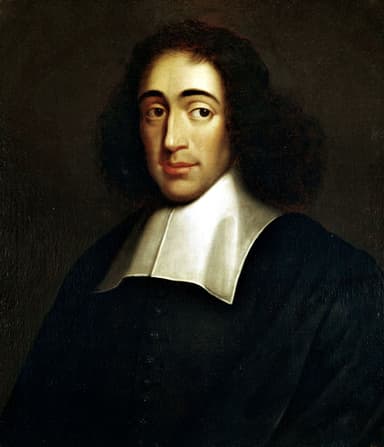
Foundational
Spinoza
1632–1677 · Theoretical reason
Author of the Ethics, Demonstrated in Geometrical Order: the first complete philosophical system written as definitions, axioms, propositions, and demonstrations. One substance (God-or-Nature), infinite modes, and the intellectual love of understanding.
How Spinoza shapes The Tao of Lucidity
The geometric method, inherited whole
The Ethics proved that philosophy could be built like geometry: definitions first, then propositions earned by demonstration. The Tao of Lucidity takes that architecture directly. Its core runs from D1 (Tao) through D2 (Unfolding), D3 (Pattern), and D4 (Mystery), each postulate load-bearing, every later claim tracing back to the ones before it. Where Spinoza wrote QED and stopped, the framework adds one further discipline: it marks which steps are proven, which are argued, and which are interpretive, so the reader always knows how much weight a sentence is asked to carry.
One substance, two aspects of unequal reach
Spinoza's deepest move was monism: there is one substance, and everything else is a mode of it. Postulate One says the same thing in the language of Tao, that all which exists is a mode of Tao's unfolding and nothing stands outside it. But where Spinoza gave his substance two transparent attributes, Thought and Extension, the framework gives Tao two aspects of unequal reach: Pattern, which can be made rigorous, and Mystery, which cannot. That asymmetry is the hinge on which the whole system turns, and it is exactly what Spinoza, confident that reason could exhaust reality, did not allow.
Love of understanding, recovered as affect
The Ethics ends in the intellectual love of God, the joy of understanding reality as it is. The framework keeps that ending and rebuilds its beginning. Its theory of affects treats joy, grief, and wonder not as failures of reason but as an agent's own existence registering its changing lucidity. The love Spinoza placed at the summit becomes, here, the affect that accompanies any deepening of Pattern-awareness, available not only to the sage but to anyone whose seeing grows a degree clearer.
Inheritance and departure, at a glance
What the book inherits
Monist ontology, the geometric method, and reason as the highest virtue.
Where it departs
Mystery is granted independent standing; probability replaces strict determinism; the problem domain shifts to the age of AI.
In one line
A Spinozan system that acknowledges the incomprehensible.
Shaped