Foundational
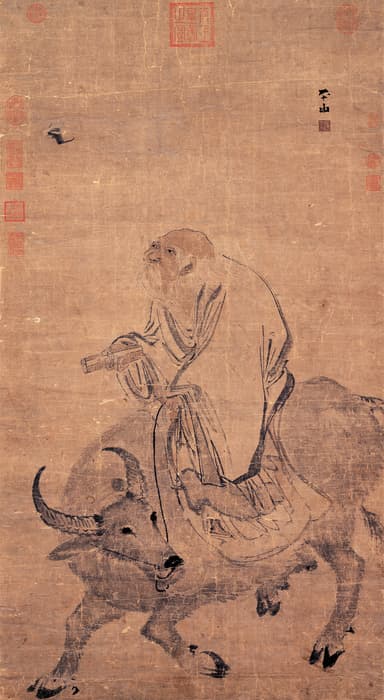
Laozi
6th c. BCE · Beyond reason
The Daoist source. The Tao Te Ching opens with "the Tao that can be spoken is not the eternal Tao," giving the framework both the word Tao and the discipline of Mystery, along with wu-wei.
How Laozi shapes The Tao of Lucidity
The Tao that gives the framework its name
The framework takes its very first definition, D1 Tao, directly from the opening line of the Tao Te Ching: the Tao that can be spoken is not the eternal Tao. From this single source it inherits both the word Tao and the discipline of Mystery, the disposition to treat what cannot be said as a real and standing feature of reality rather than a temporary gap in knowledge. P3 Dual Aspect carries this forward by insisting that every region of the Tao shows two faces at once, Pattern that can be made rigorous and Mystery that cannot, and P6 Cognitive Finitude grounds the second face in the limits of any finite knower. The Daoist intuition that the deepest thing is precisely the unspeakable thing becomes, here, a formal postulate rather than a poetic gesture.
A Daoism that embraces reason
The classical Daoist distrusts naming and analysis. This framework keeps the reverence for Mystery but reverses the suspicion of reason. It formalizes on purpose, building definitions, postulates, and theorems so the boundary of the sayable can be drawn with care, not waved at. And it stays in the world: wu-wei is acting well within the unfolding, not stepping out of it. It honors the Daoist source without conceding that lucidity must be wordless.
Why Mystery matters in the age of AI
An age that can compute almost anything is tempted to believe that what resists computation is merely unsolved rather than genuinely unspeakable. The Daoist inheritance is the standing correction to that temptation: it keeps Mystery in the architecture as a permanent aspect, so that mastery over Pattern never collapses into the illusion that Pattern is all there is. Living lucidly, on this view, means holding both faces at once, working the intelligible side with full rigor while keeping a trained sense for the side that no model exhausts. That double posture is what wu-wei becomes when reason is finally welcomed into the Daoist house.
Inheritance and departure, at a glance
What the book inherits
The concept of Tao itself, the wisdom of Mystery, and wu-wei.
Where it departs
It embraces reason and formalization, and stays politically engaged rather than withdrawing.
In one line
A Daoist system that embraces reason.
Shaped