Book Structure Overview
~2 min left · 338 words
Book Structure Overview
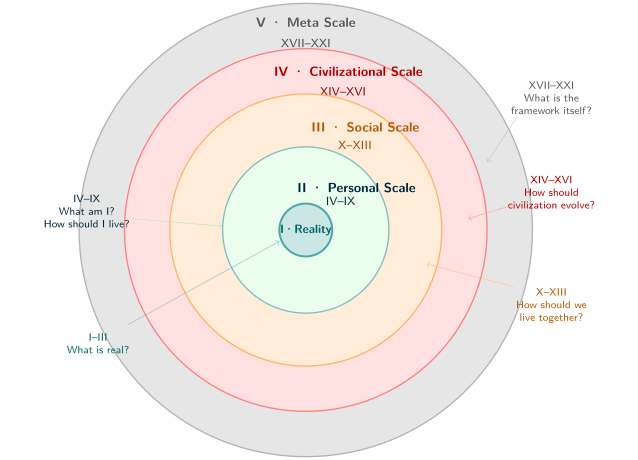
The chapters of The Tao of Lucidity follow a progression of scale, starting from the most fundamental structure of reality, moving through the individual’s existence and action, society’s politics and practice, onward to civilizational and cosmic expanses, before returning to a meta-theoretical examination of the framework itself. The book is divided into five parts, each re-asking the same question at a larger scale: At this level, what does lucidity mean?
| Ch. | Topic | Core Question | Part · Scale |
|---|---|---|---|
| I–III | Ontology | What is real? How does the Tao unfold? | I · Reality |
| IV–V | Archetypes & Affects | Within this reality, what am I? | II · Personal |
| VI–VIII | Ethics & Reflection | Knowing all this, how should I live? | |
| IX | Practice | How do I live it out in everyday life? | |
| X | Social & Political | What conditions make lucidity possible? | III · Social |
| XI | Political Philosophy | Why does politics exist? Power, justice, freedom | |
| XII | Political Affects | How are political affects | |
| XIII | Political Practice | How to live out political lucidity? | |
| XIV | Intelligence & Wisdom | What distinguishes intelligence from wisdom? | IV · Civilization |
| XV | Civilizational Lucidity | How should civilization evolve? | |
| XVI | Dark Universe | Where are the framework’s limits? | |
| XVII–XXI | Meta-theory | What is this framework, where does it come from, and how has it evolved? | V · Meta |
This structure has a deep rhythm: first an outward breath (from the individual to society to civilization), in which Political Practice (Chapter XIII) completes the arc from theory to action: Political Philosophy (XI) diagnoses “why,” Political Affects (XII) reveals “what we feel,” and Political Practice answers “how to act,” before the trajectory extends into the civilizational scale. Then Chapter XVI tests that arc at the cosmic boundary, exposing where political imagination reaches its limit. Finally, Chapters XVII–XXI turn inward to examine the framework’s genealogy, name, method, sources, and evolution. Readers may follow the sequence from beginning to end, or start at whichever scale interests them most; every layer points to every other, because lucidity itself is indivisible.