Part II · The Personal Scale · What am I? How should I live?
VIII · Practice
~15 min left · 3,593 words
VIII · Practice
By now The Tao of Lucidity has laid down its metaphysics, its ethics, its meditations on being, and a philosophy cut to the measure of the AI age. But knowing how to swim and being able to swim are two different things. Why, then, a whole chapter on practice? Because lucidity is a capacity you exercise daily, a muscle that goes slack with neglect, never a state you “understand” once and thereafter own free and clear. To read a chapter about practice and then change nothing is the oldest trick the mind plays on itself: it lets the act of reading masquerade as the deed itself. This chapter sets out concrete daily practices. They are not dogma. Try them, keep what earns its place, and discard what does not.
Each practice is followed by a “Caution,” which names how the practice can become its own opposite. This is meant to deepen practice, not discourage it: examining practice itself is part of The Tao of Lucidity’s spirit.
VIII.1 · Daily Practice
Morning calibration begins upon waking. Before doing anything else, ask yourself one question: “What do I need to face lucidly today?” Before answering, notice the affective weather already present: anxiety (AF8), restlessness, or calm. The affect you wake into is already shaping what you will see and what you will miss. The question to ask is “What calls for my lucid attention?” rather than “What do I need to accomplish today?” (that is utilitarian thinking). The answer may be a relationship, a decision, or an emotion.
Caution: If morning calibration becomes an anxiety ritual (“I must find something to face lucidly today!”), it has already curdled. Some mornings, you need not face anything in particular. That is also fine.
Contemplatio, or understanding meditation, asks you to choose a system (the weather, the growth of a tree, the running of code, the structure of a piece of music) and spend fifteen to thirty minutes understanding how it works. The point is not to “learn” efficiently, but to experience the joy of understanding itself. When you suddenly “see” a system’s inner order (its pattern, causality, elegance), you feel a satisfaction beyond words. This is joy (AF2), the active unfolding of existential tendency, a transition toward lucidity. It does not require understanding more or faster than AI. It is experiential, not competitive, and joy arising from lucidity is more stable than the pleasure of external stimulation (AP1).
Caution: For those prone to compulsive thinking, “understanding meditation” can become pressure to understand at all costs. If the practice produces only frustration, stop. The purpose of meditation is experience.
Wu wei awareness1 begins with one concrete pause each day. Notice whether you are “forcing action,” doing things driven by anxiety rather than because they genuinely need doing. If you notice this, try stopping: do nothing, even for thirty seconds. Most “urgent” things do not get worse when you pause.
Caution: Wu wei awareness is not a license to procrastinate. If you face a genuine deadline or urgent task, “stopping to do nothing” may be avoidance dressed in The Tao of Lucidity’s language. Distinguishing “a lucid pause” from “disguised procrastination” is itself a lesson in practical wisdom.
Embodiment practice returns lucidity to the body. Spend at least fifteen minutes each day doing something purely physical (walking, breathing exercises, stretching, cooking, gardening) without using a screen or AI at the same time. This is simply returning to the experience of your body: your feet touching the ground, your lungs drawing air, your hands sensing temperature. Call it presence, not “detox.” That is enough.
Evening reflection happens at the day’s end. Review three questions: When today was I lucid? When today was I obscured? Tomorrow, in what area am I willing to live more lucidly? Pay attention not only to what you did, but to how you were seeing while you did it. The same outward action becomes different when it arises from lucidity rather than obscuration (D6). This is self-awareness. Self-criticism says “I did wrong.” Self-awareness says “I see.”
Caution: If evening reflection becomes self-judgment (“I was not lucid enough again today”), it has already departed from its purpose. Noticing that you were obscured is itself lucidity. For those prone to self-reproach, consider adding a fourth question: “Was I gentle enough with myself today?”
Sovereign choice is a practice of deliberately preserving agency. At least once a week, deliberately choose to do something “suboptimal”: cook instead of ordering delivery, handwrite a letter instead of using AI, walk somewhere you could have driven. The point is not that you do it better than AI or any service. The point is that making your own choice, even a suboptimal one, is itself an exercise in being. It reminds you that you are not merely an optimization function; you are an autonomous being. Chapter §XIV, E-Evol.1 supports this from an evolutionary perspective: the “slowness” of biological evolution is precisely the condition for generating experiential depth, and deliberately choosing the suboptimal actively maintains that condition.
Caution: Sovereign choice is a practice. If you are facing a career crisis or financial pressure, spending time handwriting a letter instead of addressing a more urgent problem may be avoidance rather than lucidity. Sovereign choice works best when life is relatively stable; in crisis, lucid action often means directly confronting the problem.
VIII.2 · Practice in Crisis
Daily practices assume a relatively calm life. Crises ask for the same lucidity under harsher conditions.
When the job is gone, “Your existence needs no justification” has to stop being a slogan and start being something you do, here, in the wreckage of this particular afternoon. Concretely: sit with the thought “I have no value” for ten minutes a day. Watch it surface; refuse to wear it. The work is subtler than mere noticing. The real task is to catch the hinge, the precise instant when “I observe this thought” buckles into “I am this thought.” That buckling is obscuration condensing before your eyes. You are not your job. You are not even “the person who lost it.” You are a being undergoing unemployment, and undergoing it lucidly. Then move: scout new directions, not to certify your worth to anyone, but because moving is itself the shape your freedom takes.
When you lose someone you love, the finitude parable is no longer just theory; you are living it. Do not rush to “understand” or “accept.” Grief (suffering (AF3)) is real; let it exist. Suffering cannot be talked away by mere intellect (AP2); to console the bereaved with “you should be more rational” helps nothing at all. The one thing The Tao of Lucidity can offer here is this: your grief is itself the evidence of love (AF5): only a finite being can truly lose, and only a being that can truly lose can truly love. To face grief lucidly keeps existential tendency (AF1) active within the grief: leaning, slowly, toward equanimity (AF16).
When an AI system wounds you through a verdict, an algorithmic slip that denies you the loan or strips you of the job, begin by granting that indignation (AF20) is real and earned; it is the lucid affective answer to obscuration baked into a system. Then put the harder question: “What is the lucid action?” File the appeal, demand the explanation, lean on the machinery until it changes. Everything hinges on holding indignation’s structural aim steady (AP5), aimed at the institution that manufactures the obscuration. Let that aim slip and indignation rots into anger (ira), and now you are striking out from inside the very obscuration you meant to oppose. The Tao of Lucidity never asks you to “rise above” indignation. It asks you to stay clear-eyed within it, clear enough to strike where the structure actually breaks.
VIII.3 · Collective Practice
A Lucidity Circle gathers five to twelve people on a regular cadence around a single load-bearing principle: no guru, no pupils, and the role of facilitator rotates through every chair. A typical meeting might open into five minutes of shared silence, then hand each person a turn to recount one concrete episode from the week’s Lucidity Test, then slide into a collective understanding meditation in which each member burrows into some system and surfaces to report what they found, before closing the loop with a second five minutes of silence.
The subtlest danger of a Lucidity Circle is groupthink masquerading as collective lucidity. A circle where everyone nods along may feel lucid, even as each member quietly suppresses a doubt to keep the harmony intact. That is collective obscuration. A second deformation occurs when the “no hierarchy” principle is quietly subverted by one naturally charismatic participant whose interpretations come to be treated as authoritative, so that the circle slides back into the teacher-student structure it was designed to refuse. The antidote lies within the framework itself: the anti-dogmatism principle (EP6) demands that we ask, at intervals, whether the circle has degenerated from a site of genuine inquiry into a comfort zone. If the question itself feels uncomfortable, that discomfort is exactly why it needs to be asked.
Lucid dialogue is a deep conversation between two people, with simple rules: listen fully before responding; no judging; no advice unless requested. The aim is not immediate problem-solving, but the deepening of both persons’ lucidity through mutual listening. This practice of collective listening resonates at the civilizational scale: T6 in Chapter §XV shows that a civilization’s maturity is marked not by noise but by silence; the silence within collective practice is a microcosm of civilizational silence.
VIII.4 · From Seeing to Doing: The Practice of Action
To “see” here is to dwell, not to glance: a sustained, unhurried observation that lets the situation disclose its own contours before judgment so much as begins. Seeing obscuration (D6) is by no means the endpoint. E1 (the value of lucidity over obscuration) and E3 (lucidity as existential fulfillment) carry a single hard consequence between them: to have seen lucidly is to be bound to respond. Whoever sees injustice and then shuts their eyes, feigning blindness, has already crossed into obscuration. The full practice of The Tao of Lucidity runs as a See \(\to\) Judge \(\to\) Act \(\to\) Reflect cycle (Figure 26), never a bystander “sitting there watching”: observe (see), discern (judge), respond (act), and then test whether the response itself bred new obscuration (reflect).
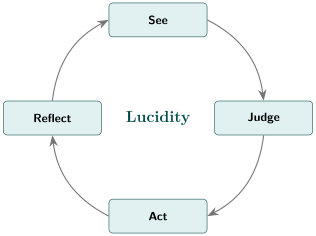
Having seen, you must weigh before you move. “Judge” is simply §VI’s Lucidity Test brought to bear on what you have just observed. Run the four questions in their order of rank: Am I seeing lucidly, or through a fog of obscuration? Will my response guard or fray genuine connection? Will it deepen experience or leave it shallow? Does it honor the manifold variety of Tao? When the answers pull against one another, the Priority Guide breaks the tie: lucidity first, connection second, experience third, reverence fourth. That is the real flesh of “Judge,” reaching for the diagnostic vocabulary of EP1–EP6 to settle what kind of response the moment is asking for. Only then do you act.
Action usually takes four modes.
The first mode is speaking. When obscuration shows its face inside your workplace or your society, do not let the silence hold. An algorithm is quietly minting bias, and you have seen it; an institution is grinding dignity thin, and you have seen that too. Having seen, name it aloud. Speaking demands no flawless remedy in your pocket; “there is a problem here” is already a contribution worth making. Silence, after all, signs its name to obscuration.
The second mode is creating. When you notice an absence, a gap where something ought to be, do not stop at faultfinding; build the alternative. Criticism points at the dark patch; creation strikes a match. A more lucid way of teaching, a tool whose workings you can see through, a more honest register of speech: each is an act of making. E-Cre has already shown that the worth of creation lives in the doing itself. The principle carries straight over into action: your alternative need not arrive finished, because the very act of building is bending possibility into a new shape.
The third mode is refusing. When you are handed a part in the manufacture of obscuration, practice lucid non-cooperation. They ask you to engineer an algorithm that hijacks attention; they ask you to bury the unflattering numbers in the report; they ask you to keep your mouth shut about an injustice. Refusal is itself an action, and now and then the hardest one in the room. Its price can run steep. The Tao of Lucidity will not pretend refusal comes cheap, yet it insists the price of complicity runs steeper still, charged not against your career but against your lucidity.
The fourth mode is cultivating. When you have influence: create the conditions for others’ lucidity. An educator cultivates critical thinking in students; a manager cultivates a safe space for truth-telling in the team; a parent cultivates tolerance for uncertainty in the child. Cultivation is the quietest action and the most enduring; it does not change today’s situation but changes tomorrow’s soil.
The Lucidity Test for Action gives these practices their practical meaning: they train lucid deliberation, improving the agent who decides rather than merely improving the algorithm by which decisions are made.
Action itself can become obscuration: self-righteous justice (pride, AF12), anger-driven impulse (indignation degenerated into ira, AP5), the arrogance of “I will save you” (benevolence without compassion’s foundation, AP4). Therefore, after every action, return to “reflect”: Was my action driven by lucidity or by fear (AF8), anger, or narcissism? Did I maintain awareness of my own possible error? Was there room for shame (AF11)? Did I respect the dignity and autonomy of those my action affected? If the action itself created new obscuration, acknowledge it and adjust it. See \(\to\) Judge \(\to\) Act \(\to\) Reflect is a cycle.
VIII.5 · Attention: The Operational Mechanism of Lucidity
This book repeatedly invokes attention: algorithms manipulate attention (§X), practice demands training attention (this chapter), emotional lucidity presupposes attention (§V). But what exactly is attention? Why is it so central to The Tao of Lucidity? This section provides a systematic account.
Attention is the working floor of lucidity. If lucidity (D5) names a quality of being, attention is the gear by which that quality grinds into reality, moment after moment. You cannot “have” lucidity in the abstract, the way one has a degree on a wall; you enact it at each concrete instant by pointing attention at what actually matters. Lucidity is the bearing; attention is the footstep. In the AI age “living in the present” takes on a sharper edge: it no longer means waving off the past and the future, which AI can shoulder for you, but treasuring the sheer irreversibility of this one moment’s experience (C6.2).
Attention has a dual structure. Just as lucidity simultaneously faces Pattern and Mystery, attention has two modes:
Focused attention corresponds to Pattern-awareness (\(L_{\text{Pattern}}\)). It concentrates attention on a system, a problem, or a pattern, seeking to understand it deeply. Logonaut’s four methods of navigation (§IV.2) are all applications of focused attention: analyzing dissipation, tracking gradients, making selections, calibrating feedback. Each requires deploying attention with surgical precision.
Open attention corresponds to Mystery-awareness (\(L_{\text{Mystery}}\)). It releases attention from any single object and receives the entire experiential field. Mystient’s four listenings (§IV.3) are all different depths of open attention: feeling qualia, receiving thisness, dissolving boundaries, receiving awe. Each requires expanding attention without forcing it into a target.
The attention crisis of the AI age opens with algorithms set loose in a bidding war over attention. They seem to be fighting for your hours, yet the true prize is attention itself, since attention, not time, is the genuinely scarce coin. Once a feed has seized it, you are left with neither focused attention, because you skitter across fragments without sinking into any one, nor open attention, because you are passively swallowing rather than openly receiving. What remains is a third, degraded state: scattered attention, neither focused nor open, neither Logonaut’s navigation nor Mystient’s listening. Scattered attention is the most ordinary and most widespread form obscuration takes. Chapter §XIV, E-Att sets this down formally: attention is the material ground of lucidity, and the systematic capture of attention amounts, point for point, to the erosion of lucidity (E-Att.1). Nor does the matter stay private; when algorithms compete for attention at scale, they are wielding political power (P19), because to shape attention is to shape the whole cognitive weather a mind must breathe.
In practice, you can consciously train the movement between the two modes of attention each day. Spend fifteen minutes on a focusing exercise: deeply understanding one specific thing (understanding meditation is an instance of this). Then spend fifteen minutes on an opening exercise: tracking nothing, simply sitting open, receiving everything (non-action awareness is an instance of this).
Before you start, feel out what scattered attention is like from the inside: the tug toward the next stimulus, the faint static of anxiety when nothing is demanding a reply, the looping self-commentary that rushes in to fill any silence. None of this is noise; it is affect in motion. Fear (AF8) powers the compulsive refresh; fixation cinches the field of view tight; craving leans you toward the next little reward. The moment of capture, that jolt when you surface and realize twenty minutes of scrolling slid past without a single deliberate choice, is obscuration (D6) caught in the open. To catch that moment, and to catch it without flogging yourself for it, is where attentional lucidity begins.
Caution: Attention training easily becomes another optimization anxiety: “I must become more focused!” But lucid attention is a practice of being. If what you feel during attention training is anxiety, you may be turning lucidity’s tool into obscuration’s tool.
Summary
Theory hardens into practice through the four-beat cycle of See \(\to\) Judge \(\to\) Act \(\to\) Reflect. Sovereign choice (§VIII.1) is where it all begins: in an age when AI stands ready to decide everything on your behalf, carving out room for a judgment that is your own is already a lucid act. Attention is the working floor of lucidity: focused attention answers to Pattern-awareness, open attention to Mystery-awareness, and scattered attention is the most commonplace face that obscuration wears. Practice never stays penned on the meditation cushion; it spills across every daily choice and every crisis alike. The personal scale now lies fully unfolded. And yet lucidity is social to its very root (T5): the conditions of your practice are forged by others, and yours in turn forge theirs. The chapters ahead ask how lucidity scales upward, from the single person to the institution, and what political principles, shared affects, and civic practices it takes to build and hold open the environments in which individual lucidity can actually thrive.
Inquiries
Of the four-phase cycle See \(\to\) Judge \(\to\) Act \(\to\) Reflect (See: lucid perception; Judge: discernment via the Lucidity Test; Act: response in one of four modalities; Reflect: post hoc review of what was done and learned), which do you most often skip? Why? What are the consequences of skipping it?
Of the six daily practices (morning calibration, understanding meditation, non-action awareness, embodied practice, evening reflection, sovereign choice), choose one to practice this week. After one week, look back: what changed?
Of the four action modalities (speak: name what you see; create: build a corner worth inhabiting; refuse: say no to obscuring arrangements; cultivate: enable others’ lucidity), which do you use most often? Which least? What does this imbalance reveal?
Design a “sovereign choice” for this week: a deliberately non-optimal decision that preserves your autonomy. It can be small (a handwritten letter instead of a message, walking instead of calling a ride). Why is this choice important to you?
What state is your attention in right now: focused (Pattern-awareness: directed at a discernible object), open (Mystery-awareness: directed at the un-named whole), or scattered (neither focused nor open, drifting passively)? If scattered, can you shift it toward focus or openness without forcing?
Lucid Dialogue’s rules are “listen fully before responding; no judging; no advice.” In your daily conversations, which rule do you most often break? What does this pattern of violation reveal?
This chapter says seeing obscuration (D6: aware of Tao yet choosing not to look) is only the starting point; E1 (the Bridge Axiom of Ethics: lucidity is more worthy of pursuit than obscuration) means that having seen lucidly includes the obligation to respond. When did you last see injustice and choose to close your eyes? What stopped you from responding?
Wu wei, literally “non-action” or “effortless action,” is a central concept in Daoist philosophy. In the Daodejing (Laozi c. 4th c. BCE) (Ch. 48: “In pursuit of Tao, one does less each day”) and the Zhuangzi (Zhuangzi c. 4th c. BCE), wu wei denotes acting in harmony with the natural pattern of things rather than forcing outcomes. The Tao of Lucidity’s usage preserves this core meaning: awareness of when you are forcing rather than flowing, and the lucid choice to stop.↩︎
Was this chapter helpful?