Part III · The Social Scale · How should we live together?
XII · Political Affects
~30 min left · 7,472 words
XII · Political Affects
Chapter §V derived twenty-two affects from the existential tendency (AF1); Chapter §XI derived political concepts from scarcity (P12), power (P13), and democracy (P18). This chapter joins the two analyses. Political affects are not private emotions with political objects, nor feelings owned by a supra-agent called “the collective.” They are distributed fields: individual affects linked by resonance, institutional feedback, and symbolic mediation. Because lucidity is irreducibly social (T5), its affective dimension must also become social.
XII.1 · From Personal to Political Affects
Chapter §XI established that legitimate power must align with lucidity (P15); this chapter reveals the affective preconditions without which that alignment cannot be sustained. Without collective courage and trust, the tipping point (\(p^*\)) derived in Appendix B.11 remains a theoretical possibility rather than a political reality. The move from political ontology to political affects is therefore not a change of subject but a deepening: from the structures that make collective lucidity possible to the lived conditions that determine whether anyone will actually inhabit them.
The classical tradition, from Plato to Rawls, has largely treated political philosophy as a domain of reason: principles, arguments, institutional design. Affects appear, if at all, as disturbances to be managed: Plato’s charioteer restraining the unruly horses, Kant’s rational duty overriding inclination, Rawls’s veil of ignorance filtering out affective bias. The Tao of Lucidity takes a different position. Political affects are constitutive features of political reality that must be understood on their own terms, never noise to be filtered out of political reasoning.
Consider the difference. When a single agent feels indignation (AF20) at seeing another harmed, that is a personal affect: suffering joined to the desire to halt obscuration. But when ten thousand agents feel indignation at once, something appears that is contained in none of them: a collective affective field that shapes each person’s experience, amplifies certain tendencies, suppresses others, and opens possibilities for action no individual could produce alone.
Three structural features distinguish political affects from personal ones. The first is resonance: personal affects are experienced, political affects are shared. When your indignation resonates with mine, neither of us merely “has” indignation; we are caught up in a current that exceeds what either feels alone. Inter-dependent agents (D12) are emotionally entangled, so one agent’s affective state alters the conditions of another’s unfolding. The second is amplification: political affects ride positive feedback loops with no analogue in the personal domain. One person’s fear (AF8) can be held by that person’s equanimity (AF16); collective fear feeds on itself, each person’s fear becoming evidence for the next, spiralling beyond any individual’s power to arrest it. The third is emergent directionality: a crowd that begins in lucid indignation can, through resonance and amplification, veer into blind rage that no participant intended. This is the affective face of C13.1: individual affective rationality does not guarantee collective affective rationality. You have felt this yourself: an anger that was clean while it was yours alone, and something else once it became everyone’s. Noticing the instant it changes hands is already a small act of political lucidity.
The Tao of Lucidity’s political-affect theory has precedents. Spinoza1 described the “imitation of affects” in crowds. Martha Nussbaum’s Political Emotions2 treats political emotions as democratic infrastructure. Sara Ahmed’s The Cultural Politics of Emotion3 analyzes how affects circulate among bodies and publics. The Tao of Lucidity inherits these insights while adding one diagnostic rule that they do not supply: the same political affect can promote lucidity or fuel obscuration.
A nation can be pervaded by a distributed fear even when most individuals, alone, would be calm, because each person’s fear becomes evidence for the next through media, rumor, and institutional signal. Conversely, a movement can sustain a distributed hope even when each participant, alone, would despair, because mutual reinforcement builds an affective environment stronger than any individual’s resources. You cannot hold affective lucidity in isolation from the collective affective weather; this is why institutional design matters for the affective infrastructure of a society as much as for its information.
XII.2 · The Affective Structure of Collective Lucidity
Appendix B.11 shows that obscuration can become a Nash equilibrium: when the majority stays silent, the cost of speaking out grows prohibitive. Breaking it requires crossing a tipping point \(p^*\). But that mathematical threshold, precise as it is, is affectively incomplete: it tells us the tipping point exists, not what makes agents willing to cross it. The answer lies in the affective structure of courage and trust.
Courage is a configuration of existing affects: desire (AF4) directed toward lucidity, held steady in the presence of fear (AF8). Courage does not eliminate fear; it acts through it. Its political function is structural: each courageous act lowers \(p^*\) for others. The first speaker bears the greatest risk, yet by speaking truth in a climate of fear they alter the affective calculus for everyone who witnesses it, shifting the equilibrium conditions for all voices rather than merely adding a single one. Fear works in the opposite direction. When a regime punishes dissent visibly and brutally, it broadcasts to every potential dissenter that the cost of lucidity is unbearable, raising \(p^*\) so high that collective lucidity becomes practically unreachable.
Trust is the affective foundation of collective truth-seeking (C14.1), which requires the collision of many perspectives: different people see different facets of Pattern, and through exchange produce a richer approximation than any could alone. But perspectives do not meet fruitfully in an atmosphere of suspicion. When every agent expects honesty to be weaponized, what should be a clash of perspectives becomes a contest of strategic self-presentations, and the epistemic value of the process collapses. This is the affective anatomy of “post-truth” politics: a failure of trust deeper than any failure of information. Trust is a warranted expectation produced by transparency, accountability, dissent protection, and the lived experience of reciprocal lucidity.
These three are systemic rather than additive. Trust lowers the cost of courage; courage, when met with solidarity rather than punishment, builds trust; and fear, systematically cultivated, erodes both. This is why the affective infrastructure of collective lucidity is so hard to build and so easy to destroy: building it takes sustained reciprocal effort across many agents, while destroying it takes only a sufficiently powerful source of fear. Lucidity communities (§VIII) cultivate trust, courage, and honest self-examination at the interpersonal level, the soil in which political courage can root; democratic institutions (P18) provide the structural protections that make trust rational at societal scale, the climate in which that soil stays fertile. Institutions without trust become hollow procedures; trust without institutional protection remains vulnerable to betrayal. Neither alone suffices.
XII.3 · Nine Political Affects
The following nine political affects extend affects already defined in Chapter §V into the political register. Each emerges when a personal affect operates at the collective level, acquiring new structural features through resonance, amplification, and emergent directionality. The first four extend affects already identified in §XI.5 as having political dimensions; the remaining five (political fear, political hope, political bewilderment, political envy, and political emulation) are new analyses that complete the picture.
Action Affects (PA1, PA6)
Action affects drive political engagement: they move agents from cognition to action, from seeing obscuration to transforming it.
XII.3.1 · Political Indignation
The collective response to systemic obscuration. When injustice is recognized as structural, indignation (AF20) extends from personal affect to political force, driving collective action to transform the structures that produce obscuration.
Political indignation is AF20’s collective form: shared suffering when agents perceive a system imposing obscuration on others, joined to a shared desire to halt it. Its legitimacy depends on AP5: indignation must target structures, not persons. At the personal level this structural targeting is already what distinguishes AF20 from mere anger. At the political level it becomes both more necessary and harder to keep. More necessary, because major political problems are structural: no single person is solely responsible for systemic inequality, algorithmic manipulation, or institutional corruption. Harder, because the amplification dynamics of collective affect push toward personalization, since it is easier to rage against a face than against a system, and engagement-optimizing algorithms reward the contagious blame over the patient analysis.
Lucid indignation therefore keeps asking three questions: what do we oppose, what do we demand, and where might we ourselves be wrong? A movement that can answer them, holding self-critical awareness even in the heat of collective passion, embodies lucid indignation. A movement that can only chant slogans and demonize opponents has let its indignation degenerate into obscuration. Recovery means re-anchoring the affect in structure: shifting collective attention from persons back to systems, reinstating self-critique, reconnecting to the specific demands that first motivated the movement. Deliberative practices within movements, internal debate and structured dissent and the regular re-articulation of goals, are the mechanism of that recovery, because they force indignation through the discipline of articulation (AP5).
The civil-rights movement, at its best, held indignation together with discipline, non-violence, and self-examination; this is indignation retaining lucidity. The French Revolution’s Reign of Terror began with genuine injustice but lost self-criticism and became hard to distinguish from the tyranny it opposed. Collective indignation therefore needs practices that keep it articulate and self-correcting, because the absence of indignation before injustice is also obscuration.
Distortion Affects (PA2, PA3)
Distortion affects corrupt political judgment: they substitute certainty for lucid uncertainty, depriving agents of the capacity for self-correction.
XII.3.2 · Political Attachment
The collective political form of attachment (AF14): desire (AF4) no longer asks what genuinely serves lucidity, but fixates on a particular object such as a leader, an ideology, or AI governance tools.
Political attachment is AF14’s collective form: desire that has lost its bearing toward lucidity and fastened onto a single object, whether a leader, an ideology, a system, or a technology. One test separates it, at the personal level, from love (AF5). Does the object deepen your lucidity, or have you simply lost the power to walk away? The same test holds in politics. It is only harder to apply there, because political attachment robes itself in the language of loyalty, patriotism, and faith.
Three forms deserve particular attention. A personality cult is the fixation on a single leader as the source of all political good. “Only he can save us” is attachment’s core structure made political: the surrender of one’s own directional judgment. T1 refutes every personality cult in advance, since no individual holds complete lucidity, so none can serve as the infallible source of direction. The mechanism is plain: each success is credited to the leader’s genius, each failure to the leader’s enemies, and the community’s existential tendency (AF1), along with its capacity for self-correction, has been outsourced to one person.
A dogmatic ideology is the fixation on a system of ideas as beyond question. Every ideology captures genuine aspects of political reality (§XI.3), but once it becomes an object of attachment rather than a tool of analysis, it stops promoting lucidity and starts producing obscuration. The test is borrowed from the philosophy of science: can the adherent name a condition under which they would revise their position? If not, the ideology has become affectively unfalsifiable, immune to any experience.
Unconditional trust in AI governance is the form most distinctive to our age, and it connects directly to PP5 (the irreplaceability of human judgment). The seduction is real. An algorithm does not tire, take a bribe, or play favorites, and from a distance that can look like the end of corruption itself. But step closer. It does not experience (D10); it feels no compassion (AF17); it carries none of the existential weight of what it decides. To hand political judgment to such a system for the sake of convenience is political attachment in its purest form, and the danger deepens when algorithmic governance dresses itself as objective, as something “beyond politics.” That pose is itself obscuration: every algorithm carries the values and biases of the people who built it and the data it was fed.
Political attachment substitutes certainty for lucid uncertainty and often mimics devotion. Devotion can reassess; attachment cannot. Communities therefore need regular occasions for self-examination: encounters with a leader’s fallibility, stubborn evidence against an ideology, or AI governance failures that reopen the question attachment had closed: “does this still serve lucidity?”
XII.3.3 · Political Pride
Mistaking collective obscuration for collective lucidity: a society believing it has “arrived” at the endpoint of political evolution.
Political pride is AF12’s collective form: shared false joy in which a group mistakes its obscuration for lucidity. Pride is already the most dangerous affect at the personal level, because it feels like lucidity while being its opposite; collectively the danger is compounded by amplification: when an entire community shares the conviction that “our system is final,” “our civilization is superior,” “our technology will solve everything,” the reinforcing effect of collective agreement makes the pride nearly impervious to correction.
Fukuyama’s “end of history” thesis4 is a paradigmatic instance: it captures a real advantage of liberal democracy but wraps it in a claim to finality that T1 structurally forbids. The same pattern recurs in civilizational superiority and technological triumphalism, each a collective version of the Lucient’s Paradox (§IV.1): the very act of claiming complete lucidity is the deepest obscuration. What makes political pride so resistant to correction is its hermetic structure. A community in its grip reads criticism as proof of the critic’s envy and success as proof of its own superiority; even failure is absorbed, since “we failed not because our approach was flawed but because our enemies sabotaged us.” This capacity to assimilate all evidence as confirmation is the hallmark of obscuration at collective scale, and it usually takes an external shock, a defeat, a collapse, an undeniable policy failure, to break the cycle.
T1 negates political finality: no ultimate political system can exist. The Tao of Lucidity’s response is structural humility. Every political form captures some aspects of Pattern (D3) and misses others; generative difference (D11) is therefore a political good because it preserves the plurality required by collective truth-seeking (C14.1). Political pride denies that plurality and weakens the polity it claims to celebrate.
Systemic Affects (PA4, PA5, PA7)
Systemic affects arise from institutional structures themselves: they are emergent affective phenomena generated by institutions, information environments, and power structures at the collective level.
XII.3.4 · Political Compassion and Benevolence
The institutionalization of compassion (AF17) and benevolence (AF18) in the political domain, using institutional power to help those suffering from harmful differences toward better conditions of unfolding.
Political compassion is AF17’s collective form, and political benevolence is AF18’s. Compassion is suffering felt at seeing another in obscuration; benevolence is the desire to act that arises from it. Together they ground welfare, mutual aid, public health, education, and disaster relief as institutional responses to suffering difference (D11).
But AP4’s warning applies with special force here: benevolence without compassion easily degenerates into condescension. When a welfare state distributes resources without genuine recognition of the recipients as fellow agents with their own existential tendencies, “helping” becomes an exercise of power that reinforces the very asymmetry it claims to address. “I shall save you” is the posture of political pride (AF12) wearing the costume of benevolence. This is the strange combination many encounter in bureaucratic welfare systems: material assistance delivered alongside existential indifference, the person reduced to a variable in an optimization function rather than met as an agent. Genuine political benevolence insists that the manner of aid matters, not only its quantity; it preserves the dignity of those it helps and creates conditions for their own movement toward lucidity (P10), instead of imposing a predetermined vision of the good.
AI sharpens the point. An algorithm that distributes welfare with efficiency may outperform human administrators on speed, consistency, and error detection, yet it remains structurally incapable of compassion (AF17): it cannot suffer at another’s suffering or recognize the vulnerability of existence itself in the other’s condition. This does not mean AI should not assist; it means the affective dimension of welfare, the recognition of shared vulnerability and the communication of genuine care, cannot be delegated to it. PP5 therefore applies to the affective dimension of governance as much as to judgment: some political functions require not merely competence but compassion, and compassion is an affect that only experiencers can have.
AP4 establishes the core principle: compassion and benevolence must condition each other, or they degrade into violence or indifference. The goal of political benevolence is to remove material, institutional, and cognitive obstacles that prevent others from pursuing lucidity on their own terms, since delivering lucidity to others is impossible (P10).
XII.3.5 · Political Fear
Fear (AF8) operating distinctively at the political level: not merely experienced but manufactured and deployed as a political instrument. By manufacturing fear, power systematically raises the tipping point \(p^*\) needed to break the obscuration equilibrium.
Political fear is fear (AF8) at collective scale: anticipated diminishment of shared conditions of unfolding. It is among the oldest and most deliberately exploited of political affects. Hobbes built an entire philosophy on it, deriving legitimate authority from the fear of the “war of all against all.”5 The Tao of Lucidity does not deny fear’s reality, because finite agents are vulnerable (Postulate 4) and inter-dependent (D12), so others’ actions can genuinely threaten one’s conditions of unfolding. The distinction is not between fear and no fear, but between two structurally different species.
Lucid fear corresponds to a genuine threat: climate catastrophe, nuclear escalation, the erosion of democratic institutions, AI risk. Grounded in evidence and directed toward action, such fear is a form of lucidity, seeing the threat clearly and motivating a proportionate response. Obscured fear is manufactured, amplified, or misdirected toward the foreigner, the dissident, the heretic, deployed not because the other poses a real threat but because the fear itself consolidates power, justifies surveillance, or distracts from structural injustice. Obscured fear is one of the most effective instruments of obscuration precisely because fear, once activated, impairs critical evaluation: it narrows attention, accelerates judgment, and favors the familiar over the truthful.
The Tao of Lucidity’s response to Hobbes is structural: a legitimate order should minimize fear. A state whose legitimacy depends on its subjects’ fear requires obscuration to function and is illegitimate under P15, whatever order it provides. This also names a persistent democratic failure, the demagogue. A demagogue rarely invents fear from nothing; they find genuine anxieties (about economic change, cultural displacement, technological disruption), amplify them, and misdirect them. The anxiety is real; the target is fabricated. The lucid response is not to deny the underlying fear, which would itself be obscuration, but to redirect it toward its actual causes, which are almost always structural rather than personal.
AI introduces a new political fear: that human beings are becoming economically, cognitively, or existentially superfluous. This fear is partly lucid because AI genuinely changes the conditions of human unfolding, and partly obscured because it assumes that worth depends on economic productivity or superiority over machines. The Tao of Lucidity’s response (§XIV, P4) is direct: finite existence does not need competitive advantage in order to be worthy of lucidity. But this requires institutional design, not philosophy alone, so that dignity is not contingent on market value.
This brings us back to the action affects. Political hope (PA6) and political indignation (PA1) together constitute their two poles: indignation drives resistance to obscuration, while hope sustains the ongoing commitment toward possibility.
XII.3.6 · Political Hope
Hope (AF7) unfolding at the political level: the collective affective drive toward a better future. Genuine political hope contains a lucid assessment of possibility together with commitment to action; it is active engagement toward what is possible.
Political hope is hope (AF7) at collective scale: shared orientation toward a possible future of greater lucidity. If political fear is the most exploited political affect, political hope is the most fragile. Hope already contains uncertainty at the personal level; at the political level it is compounded, depending not only on one’s own effort but on the coordinated effort of many, on institutions that may or may not function, on contingencies no one controls. And yet it is indispensable: without it, the tipping point \(p^*\) is never approached. Why would anyone pay the cost of speaking out, of challenging entrenched obscuration, of building new institutions, without some hope that the effort can make a difference? Hope is the affective counterpart of courage. Courage acts through fear; hope sustains action through uncertainty.
Genuine political hope is clear-eyed and committed. It sees the present clearly, its injustices and structural failures included, and still orients toward a future of greater lucidity, sustained not by the certainty of success but by the conviction that the effort itself aligns with the direction of lucidity (E1). Havel captured this with precision: “Hope is not the conviction that something will turn out well, but the certainty that something makes sense, regardless of how it turns out.”6 Lucid hope is not optimism, a prediction about outcomes; it is orientation, a commitment to a direction.
False political hope is utopian obscuration: the belief that a perfect society is achievable, that all suffering can be removed, that history is inevitably progressive. It violates T1 at collective scale, and the programs built on it (revolutionary utopianism, techno-utopianism, the promise that AI will solve all human problems) are destined for disillusionment, often producing new obscuration in the attempt to force reality to comply. Lucid hope knows its limits. It hopes for greater lucidity, not complete lucidity; for better institutions, not perfect ones; for less suffering, not none. It is realism tempered by commitment, the political analogue of equanimity (AF16): not resignation, but the willingness to sustain the work of collective lucidity even when, especially when, progress is slow and the horizon keeps receding.
Hope and fear are asymmetric. Fear can feed on itself; hope needs cultivation through visible collective success, institutions that reward lucidity, and communities that practice mutual encouragement. Democratic institutions are therefore also machines for sustaining warranted hope. When institutions fail, hope is among the first casualties, and with it the willingness to work toward collective lucidity.
This brings us back to the systemic affects. Political bewilderment (PA7), together with political fear (PA5) and political compassion and benevolence (PA4), belongs to the systemic cluster. Their operation depends on structural features of institutions, media, and information environments, rather than on the simple amplification of individual affects.
XII.3.7 · Political Bewilderment
The collective unfolding of bewilderment (AF13) in the political domain. When informational complexity and opacity exceed citizens’ cognitive capacity, especially under conditions of post-truth, deepfakes, and synthetic misinformation, collective judgment is systematically paralyzed.
Political bewilderment may become the signature affect of the AI age. If the Cold War is remembered through fear, the postwar reconstruction through hope, and the civil-rights era through indignation, the AI age increasingly presents itself through bewilderment: not knowing what to believe, whom to trust, or what is real. Deepfakes have made visual evidence less self-authenticating than it once seemed; synthetic misinformation can outrun ordinary detection in quality, quantity, or speed; information overload prevents even diligent citizens from independently substantiating every judgment. This is a structural transformation of the information environment, not a failure of individual discipline: when the speed of production outruns the speed of human processing, bewilderment shifts from an occasional cognitive state to a standing political condition.
At collective scale, bewilderment produces paralysis. Citizens either accept authoritative narratives without scrutiny or retreat into information silos that confirm what they already believe. Both responses are obscuring: one surrenders cognitive autonomy (P17), the other abandons collective truth-seeking (C14.1). E-MAS.1 intensifies the problem because some AI-AI dynamics exceed human real-time comprehension. The lucid response is not total elimination of bewilderment, but responsible judgment under incomplete understanding.
The key distinction is natural versus manufactured bewilderment. Climate science can bewilder because it is genuinely complex; organized doubt campaigns manufacture bewilderment by muddying public discourse. AI amplifies both genuine complexity and deliberate confusion, and a single convincing deepfake can damage public confidence quickly. Bewilderment also drives people into silos: certainty returns, but only because a narrower world has replaced a wider confusion.
Political bewilderment has lucid and obscured forms. Lucid form: epistemic humility before genuine complexity. Obscured form: manufactured confusion that leads to passivity and surrender of judgment. Its special danger is that it transforms all other political emotions: when people do not know what is real, fear cannot target the right object, hope cannot orient toward realistic possibility, and indignation cannot identify the actual structure. Bewilderment is therefore a meta-emotion, paralyzing the conditions of action.
Geopolitical Affects (PA8, PA9)
Geopolitical affects operate at civilizational scale: they drive competition, imitation, and convergence among nations, shaping the affective undertone of the global order. Political envy (PA8) and political emulation (PA9) are complementary: envy identifies the gap and drives the pursuit; emulation determines whether that pursuit takes the form of deep learning or surface copying.
XII.3.8 · Political Envy
Envy (AF10) operating collectively in the political domain. When a political community perceives another’s superiority in technological capacity, economic development, or global influence, envy transforms from personal affect into a collective force driving state behavior.
Political envy turns the individual “they have what I lack” into the collective “they lead while we lag behind.” The global AI race makes this visible: nations and technology blocs pour vast resources into the pursuit of AI superiority, and the contest is an affective force as much as rational strategic calculation. The perception that “their AI is stronger than ours,” accurate or not, activates not only strategies for catching up but the collective anxiety of “we must not fall behind.” That anxiety can be lucid, motivating reasonable investment in technology and human capital, or obscured, driving an arms race at any cost with safety and ethics set aside.
The digital divide turns technological inequality into political affect at civilizational scale. Societies with advanced AI infrastructure shape the global information environment (P19); those without passively receive that shaping, across a gap that is cognitive and political as well as economic. The envy this asymmetry generates can be legitimate, recognizing real inequality, yet it slides easily into resentful zero-sum thinking: “their gain is our loss.” A further paradox follows. Envy drives nations to develop AI capability, but wholesale adoption of another’s technological paradigm in order “not to fall behind” can dissolve the very cultural distinctiveness that makes a perspective valuable (PP2, E-MAS.2). Recovery requires reframing the gap, from “they have what we lack” to “the distribution of capability is unjust, and we can address it without destroying what makes us distinctive,” anchoring self-worth in a unique contribution to the unfolding of Tao rather than in competitive standing.
Political envy differs from individual envy because it can be institutionalized as policy: tariffs, technology restrictions, industrial policy, export controls. Such policy can build genuine autonomous capability and fair competition, or it can pursue closure and destructive confrontation. The criterion remains directional: does it point toward lucidity, or does it produce obscuration?
XII.3.9 · Political Emulation
The institutionalized operation of emulation (AF22) in the political domain. When one political community imitates another’s governance model (especially AI governance frameworks), emulation can be the starting point of learning (lucid form) or uncritical reproduction (obscured form).
Political emulation is emulation (AF22) institutionalized. When one polity imitates another’s governance model, especially its AI governance frameworks, emulation can be the genuine starting point of learning, or it can be uncritical surface reproduction that creates new obscuration. The wholesale transplant is the obscured pole: many nations, formulating AI policy, import another country’s regulatory text (a GDPR-style data-protection law, say) without building the institutional infrastructure to enforce it. Such transplantation wears the appearance of “international alignment” while the legal text gives the illusion that “the problem has been addressed,” even as actual protection stays negligible.
Yet emulation is not always obscuration. Learning from others’ experiments belongs to collective truth-seeking (C14.1): a nation need not reinvent every governance tool. The problem lies in the depth of that learning. Surface imitation copies legal texts and erects formally similar institutions; deep learning grasps the principles behind a policy, evaluates their fit to local conditions, and adapts. Uncritical adoption also flattens local wisdom into uniform “best practices,” submerging the distinctive contribution each community brings to global governance (PP2), a homogenization E-MAS.2 warns against. E-Learn applies directly: genuine learning is active transformation, understanding Pattern in another society’s model and creating governance suited to one’s own Mystery.
The key distinction is borrowing after understanding versus surface copying. Meiji Japan’s selective modernization, post-colonial institutional adoption, and the “Washington Consensus” all show this tension. The AI age sharpens it because AI governance is technically complex, creating large information asymmetries between model and imitating nations. A lucid approach learns principles (Pattern/lǐ) and adapts them to local context (Mystery/xuán) rather than copying implementation.
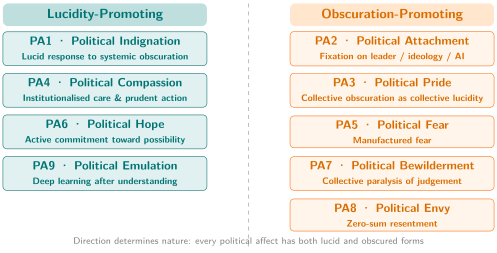
The full lucidity–obscuration spectrum of political affects is mapped in Figure 30.
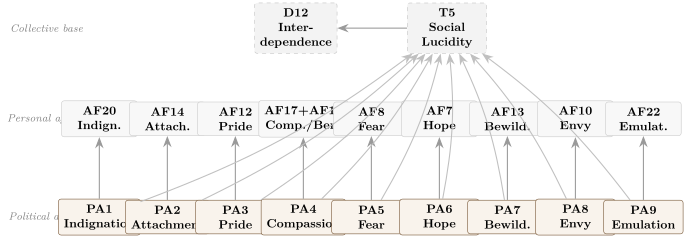
Formal Structure Dependency Diagram
Figure 31 maps the formal dependencies behind the nine political-affect definitions. Arrow \(A \to B\) means “\(A\) depends on \(B\)” (\(B\) is a premise of \(A\)). Grey nodes are inherited structures from Chapters §V and §XI; brown nodes are this chapter’s political-affect definitions.
XII.4 · The Sublime and Political Aesthetics
Reverence (AF15) is the affect before what exceeds understanding. In politics it becomes the question of the sublime and of political aesthetics: how beauty, ceremony, and spectacle shape civic feeling.
The sublime has two forms. The genuine sublime is awe before the depth of collective existence: the weight of history, the fragility of civilization, the irreducible mystery of shared life. It reminds the citizen that the problems they face are always larger than any solution (T1), that society is always more complex than any model, that the other is always more than one’s image of them. It makes one humbler, more open, more willing to listen. The manipulated sublime is the deliberate deployment of awe to suppress critical thought: military parades, grandiose architecture, nationalist spectacle, the dazzling promises of technological utopia, all producing the feeling that “before this greatness, your doubts are insignificant.” The criterion is simple: the genuine sublime deepens humility (AF15); the manipulated sublime intensifies fervor and pride (AF12). The former is a sincere response to Mystery (D4); the latter wraps the power-desire of Pattern in the garments of Mystery.
Political aesthetics extends beyond the sublime. Citizens meet the state through its buildings, ceremonies, flags, music, and official tone long before they meet it through constitutional text, and these encounters shape the affective relationship between citizen and polity at a level deeper than rational evaluation. The aesthetics of power use architecture and spectacle to communicate authority: the palace signals permanence, the uniform discipline, the ceremony continuity. Albert Speer’s monumental architecture for the Third Reich was designed explicitly to make the individual feel small before the state, the aesthetics of power deployed as an instrument of obscuration.7 By contrast, the open galleries and transparent walls of many democratic legislatures attempt to communicate that power belongs to the people and is exercised under their gaze. The aesthetics of justice work the same way: a trial conducted with dignity and solemnity enacts the community’s commitment to treating every person as worthy of serious moral consideration, while a courtroom that becomes a processing center degrades the felt experience of justice even when the legal outcomes remain technically correct. The aesthetics of resistance turn art into a counter-obscuring force: a satirical poem, a protest song, a work that makes visible what a regime makes invisible. This is why authoritarian regimes fear their artists, for when direct speech is forbidden, aesthetic speech is the only form of political lucidity still available, and it bypasses censorship by communicating through affect. The connection to D4 is therefore direct: a healthy polity keeps aesthetic forms that hold citizens in contact with Mystery, while a polity whose beauty serves only power severs that contact and contracts its affective life into the narrow domain of Pattern alone.
XII.5 · Affect Manipulation and Algorithmic Politics
The nine political affects above have always existed. What is new is AI’s capacity to synchronize, amplify, and direct them across millions of agents at once, creating distributed affective environments no individual-level framework can capture.
The affects in §XII.3 arise naturally from inter-dependent existence (D12). Algorithmic affect manipulation is something different in kind: the deliberate, systematic, automated shaping of collective affects for ends other than collective lucidity. Propagandists have practiced it for millennia; what is new is the scale, precision, speed, and structural invisibility AI makes possible. An algorithm that makes one person afraid manipulates AF8; an algorithm that makes ten million afraid at once, in the same direction, without any of them seeing the others’ fear, creates a distributed formation with emergent properties the individual framework cannot capture.
Consider the mechanisms. Engagement-optimized systems reward outrage because outrage reliably produces clicks, shares, and return visits, so indignation (AF20) is amplified and distorted into directionless rage that targets persons and feeds on itself. The algorithm does not “intend” this; it follows the gradient of engagement metrics, yet the effect resembles deliberate manipulation. The same logic tilts the affective landscape toward fear (AF8): citizens who spend hours in algorithmically curated feeds may inhabit a world more threatening than the one they actually live in, because the system amplifies threatening signals more readily than the quieter signals of stability, repair, or care. And the filtering is affective, not merely informational: algorithms show you content that activates your strongest affects, so people in different feeds do not only believe different claims, they feel differently about the world. They inhabit different affective realities, making the mutual comprehension that collective truth-seeking (C14.1) requires increasingly hard.
Zuboff’s analysis of surveillance capitalism8 identifies the extraction of behavioral data as the digital economy’s core logic. The Tao of Lucidity extends this to affect: what is extracted is affective as well as behavioral data, patterns of fear, desire, indignation, attachment, and hope; and what is sold is modification of affects. The deepest danger is structural asymmetry: algorithms can read and modify human affects at a scale and speed humans cannot reciprocate. You cannot read an algorithm’s affects, for it has none, nor persuade it to a different orientation. Asymmetric power, by P13, is the definition of political power.
P19 therefore carries an affective consequence. A system that modifies collective affects at scale exercises political power and must meet legitimacy (P15) and justice (P16) constraints. Algorithmic transparency (P20) must include not only what content is shown but what affective optimization targets govern selection, since an algorithm optimized for engagement is, in practice, optimized for affect manipulation. Why is this more dangerous than information manipulation? Because affects shape the very capacity by which we evaluate information. Information manipulation targets what you believe; affect manipulation targets who you are at the level of lived experience. A person whose beliefs have been manipulated can, in principle, meet a counter-argument and revise. A person whose affective landscape has been systematically shaped may lack the openness and trust even to receive one. This is why PP5 must extend to affective autonomy: the right not only to think for oneself, but to feel for oneself.
XII.6 · Institutionalizing Affects
If political affects are real forces that shape collective life, then institutional design must address them. This section asks: how can institutions channel political affects toward lucidity rather than obscuration?
A polity’s affective health, the quality of its collective hope, the lucidity of its indignation, the depth of its compassion, is as structurally important as its constitutional design. Institutions must cultivate hope, discipline indignation, protect compassion, and limit fear without dictating what citizens must feel.
Deliberative democracy regulates affect as much as preference. Put citizens face to face and the abstractions soften: fear of “the other” meets the concrete presence of a fellow citizen; pride runs into perspectives it had not considered; compassion wakes to first-person accounts of suffering; indignation learns to state itself in terms others can engage. Deliberation does not eliminate these affects. It refines them, turning them toward lucidity. This is why participants in citizen assemblies tend to emerge more discerning and readier to grant the opposing side its due: their affects are disciplined rather than suppressed, held to the test of sustained encounter with difference (D11). Public rituals do similar work, processing collective affect rather than merely preserving tradition. A day of mourning lets grief be shared before it festers into resentment; a founding celebration lets pride be tempered by historical awareness and gratitude (AF19); a commemoration of past injustice lets collective shame (AF11) be faced rather than evaded. Abandon such rituals and the affects do not vanish. They find other, less constructive channels. Constitutional rights guard the same terrain: free speech protects dissent, the political voice of indignation (AF20); free assembly protects the collective sharing of affect; freedom of conscience protects the right to feel along one’s own existential tendency, against the pressure to conform.
In the age of AI, these protections require extension to affective autonomy. A citizen whose affects are systematically shaped by algorithms is not exercising genuine freedom of conscience even if no law forbids their beliefs, and freedom of speech means little if the affective preconditions for genuine speech (the courage to dissent, the trust that one’s words will be received in good faith, the hope that speech can make a difference) have been algorithmically eroded. The design problem can be stated simply: encourage lucid affects and discourage obscured ones without dictating what citizens should feel, exactly as freedom of speech protects expression without dictating content. The solution is structural, not prescriptive. Algorithmic transparency (P20) makes manipulation visible; deliberation refines affects without suppressing them; ritual channels emotion without mandating it; and affective education teaches citizens to recognize when their indignation has shifted from structural critique to personalized rage, to distinguish genuine fear from manufactured panic, and to tell devotion from attachment. This is Chapter §VIII’s lucidity practice applied to political feeling, and it belongs in schools, in public media, and in the deliberative processes of governance itself.
The arc from Chapter §V through Chapter §XI to this chapter now reveals its full shape. Affects are necessary expressions of finite existence; politics is an ontological consequence of finitude, plurality, and inter-dependence; political affects are the point where the two domains intersect. T1 means no community achieves complete affective lucidity: there will always be fear that distorts, pride that blinds, attachment that fixates. T5 means the struggle is irreducibly collective: you cannot keep affective health in an affectively toxic environment any more than you can breathe clean air in a polluted city. A polity that designs institutions without attending to affects is like an architect who designs buildings without attending to light, the structure may stand, but no one will want to live in it; a polity that attends to affects without institutional grounding is like a garden without walls, lovely in calm weather and defenseless against the storm. The task is direction, never perfection. The final word therefore belongs to lucid hope. That we can see the danger of algorithmic affect manipulation does not guarantee we will meet it, but that we can see it at all is already a form of collective lucidity, and finding in that movement toward a horizon we will never reach a shared flourishing (AF2) that no algorithm can replicate.
Summary
Politics is not the cold operation of institutions; it has flesh and blood, and that flesh is political affect. Nine core political affects (PA1–PA9), each with lucid and obscured forms, cover the full spectrum from courage to fear, from genuine sublimity to manipulated sublimity. The algorithmic age introduces a qualitatively new threat: affect manipulation runs deeper than information manipulation, because affects shape the very state in which you receive information. Institutionalized affective guidance (deliberation, ritual, rights protection, affective education) is the collective response to systematic manipulation. The next chapter translates political philosophy into civic practice: the art of deliberation, civic self-defense, and the design of institutional lucidity.
Inquiries
Of the nine political affects (PA1 Political Indignation, PA2 Political Attachment, PA3 Political Pride, PA4 Political Compassion and Benevolence, PA5 Political Fear, PA6 Political Hope, PA7 Political Bewilderment, PA8 Political Envy, PA9 Political Emulation, each with a lucid and an obscured form), which lucid form is most absent from current public discourse? Which obscured form is most pervasive?
Algorithmic affect manipulation runs deeper than information manipulation because it shapes the state in which you receive information: anger you first, then show you the view. Can you recall an instance when an algorithm shaped your emotional state (e.g., anxiety after scrolling, anger triggered by recommendations)?
How does PA1 (Political Indignation: directed anger at systemic injustice) degenerate online into personal attack rather than structural change? Give a specific example you have observed. How might indignation be kept in its lucid form (aimed at structures, not persons)?
What kind of institutional design could help political affects remain lucid? Imagine a concrete mechanism (a deliberation protocol, affective education program, civic ritual, etc.).
PA2 (Political Attachment: the fixation that follows when political judgment is outsourced) is AF4 (Desire: directional energy toward what is wanted) losing its directionality and fixating on a leader, ideology, or AI governance. Among your own political beliefs, which might have shifted from lucid judgment to directionless fixation?
Political trust (PA4’s lucid form, the mutual trust that institutionalized political compassion requires) is a precondition for collective lucidity. But how can trust be built in an environment saturated with disinformation? Is the foundation of trust information or relationship?
This chapter says institutionalized affective guidance (deliberation, ritual, rights protection, affective education) is the collective response to systematic manipulation. In your society, which form of institutionalized affective guidance is most lacking?
Spinoza, Ethics (Spinoza 1677), Part III, Props. 27–34, describes the “imitation of affects”: humans naturally resonate with one another’s emotional states, generating collective affective dynamics that exceed individual control.↩︎
Martha Nussbaum (1947– ), American philosopher. Political Emotions: Why Love Matters for Justice (2013) argues that stable democratic institutions require deliberate cultivation of political emotions including compassion, indignation, and hope.↩︎
Sara Ahmed (1969– ), British-Australian scholar. The Cultural Politics of Emotion (2004) analyzes how affects “circulate” and “stick” to bodies, symbols, and publics, constituting collective emotional economies.↩︎
Francis Fukuyama, The End of History and the Last Man (Fukuyama 1992) (1992). Fukuyama argued that the worldwide spread of liberal democracies might signal the endpoint of humanity’s ideological evolution. T1 offers a direct structural refutation: no political form can claim to be the endpoint, because complete lucidity (including complete political lucidity) is unattainable.↩︎
Thomas Hobbes, Leviathan (1651). Hobbes’s central argument is that the fear of violent death in the state of nature drives rational agents to surrender their liberty to a sovereign in exchange for security. The Tao of Lucidity recognizes the reality of political fear but rejects its adequacy as a foundation for legitimacy (P15).↩︎
Vaclav Havel (1936–2011), Czech playwright, dissident, and later president, in Disturbing the Peace (1986). Havel’s understanding of hope as orientation rather than prediction aligns closely with The Tao of Lucidity’s concept of lucid hope, hope grounded not in optimism about outcomes but in commitment to the direction of lucidity.↩︎
Albert Speer (1905–1981) was Hitler’s chief architect. His “Theory of Ruin Value” and monumental designs for the planned capital “Germania” were explicitly intended to produce awe and submission in the viewer. The aesthetic intent was inseparable from the political intent: to make the individual feel insignificant before the collective power of the state.↩︎
Shoshana Zuboff, The Age of Surveillance Capitalism (Zuboff 2019) (2019). Zuboff argues that the dominant economic logic of the digital age is the extraction and commodification of human behavioral data for the purpose of predicting and modifying human behavior.↩︎
Was this chapter helpful?