Part III · The Social Scale · How should we live together?
XIII · Political Practice
~19 min left · 4,738 words
XIII · Political Practice
Chapter §VIII translated personal ethics into daily practice: morning calibration, wu wei awareness, lucid dialogue. This chapter performs the same transformation at political scale. Chapters §X–§XII constructed the theoretical framework of political philosophy: from scarcity and power (P12–P13) to justice and democracy (P16–P18), from the ideal polity’s institutional design (§XI) to the lucidity and obscuration of political affects (§XII). But theory is far from enough. Knowing P15 (legitimacy) does not tell you what to do when an algorithm is shaping your attention. Knowing P18 (democracy) does not tell you how to listen to someone whose views strongly oppose yours in a deliberation chamber. Theory is the skeleton; practice is the muscle. A skeleton without muscle can only lie still. This chapter provides the exercises of political lucidity.
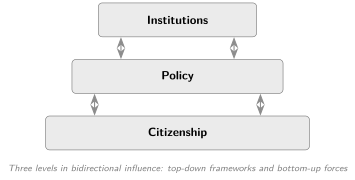
Just as each practice in Chapter §VIII was accompanied by a “Caution,” the practices in this chapter are accompanied by prudent reminders. Political practice is even more prone to sliding into obscuration than personal practice, because you face not only your own obscuration but institutional obscuration, the amplification of collective affects, and the pride that masquerades as “justice.” Examining practice itself is the heart of The Tao of Lucidity’s spirit. The three nested levels of political practice are shown in Figure 32.
XIII.1 · From Personal to Civic Practice
Chapter §VIII accomplished the first practice transformation: from theory to personal daily life. This section accomplishes the second, from the personal to the civic.
The problem Chapter §VIII confronted was: lucidity is good (D5), but what does one concretely do each day? Its answer was a set of personal practices, from morning calibration to evening reflection, from understanding meditation to sovereign choice. These practices translated the abstract axiom system into tangible daily habits.
Yet personal practice carries a quiet bias. Done alone, it can make lucidity look like an inside job, a matter settled within one skull. T5 (the Social Lucidity Theorem) corrects the picture: your lucidity rides partly on what others do, and theirs rides partly on you. Picture someone clear-eyed in private who breathes the air of a society engineered to manufacture obscuration. His clarity is real but brittle, forever half-finished. Run it the other way and the lesson repeats. Build the polished institutions of Chapter §XI’s ideal polity, then hand them to citizens who never practice political lucidity, and the machinery simply sits there. The rules are printed; no one moves in their spirit. That is the gap between personal practice and institutional design, and this chapter sets out to fill it.
Chapter §VIII addressed the relationship between you and yourself: how you observe, reflect, and act. This chapter addresses the relationship between you and your community: how you, as a citizen, deliberate, resist manipulation, and participate in building and revising institutions. The core cycle of Chapter §VIII was See \(\to\) Judge \(\to\) Act \(\to\) Reflect, personal. The core cycle of this chapter is the same structure in its collective form: Co-See \(\to\) Co-Judge \(\to\) Co-Act \(\to\) Co-Reflect, seeing together, discerning together, acting together, reflecting together.
The five political principles (existence precedes utility (PP1), difference is good (PP2), lucidity entails responsibility (PP3), power must be distributed (PP4), human judgment is irreplaceable (PP5)) are not maxims to be hung on a wall. They are habits that must be practiced day after day in concrete situations. Protecting generative difference is the specific act of choosing to listen before attacking when you encounter a political position deeply different from yours. Distributing power is the specific choice of building mechanisms that constrain your own authority when you hold power.
The first practice transformation (§VIII) corresponds to the bridge from ontology to ethics, especially E3 (the agency axiom: an agent’s existential commitment toward lucidity). The second practice transformation (this chapter) corresponds to the bridge from ethics to politics, namely T5 (lucidity is social). Both transformations answer the same question (“So what?”) at different scales, and at both the answer is the same: practice. But collective practice requires institutional support, and it demands greater courage than personal practice, because you face not only your own inertia but the inertia of a community. At the civilizational scale (Chapter §XV), CV-Irr further shows that collective choices may enter a civilization’s trajectory irreversibly. Political practice therefore carries weight beyond the present moment.
XIII.2 · The Art of Deliberation
Chapter §VIII introduced “Lucid Dialogue,” deep listening between two people. This section extends the same spirit from two individuals to the civic community.
Lucid Dialogue (§VIII.3) lives between two people and asks very little on paper: listen all the way through before you answer. No verdicts. No advice. Two people deepen their lucidity simply by hearing each other out. Political deliberation1 is that same practice opened out to the whole city, and the scaling brings strains the two-person version never meets: more voices in the room, interests that tangle, affects that catch fire faster, and a clock pressing on everyone.
Real deliberation has nothing to do with debate. Debate is engineered for combat: two camps, two hardened positions, one prize, which is to flip your opponent or sway the crowd. Deliberation is engineered for exploration. The people in the room turn toward a shared problem and try to bring it into sharper focus together. Debate measures how well you wield rhetoric; deliberation measures how well you can listen.
From The Tao of Lucidity’s framework, the quality of deliberation has a precise criterion: does this process raise collective pattern-awareness without suppressing mystery-awareness? A good deliberation makes participants see the structure of the problem more clearly (pattern-awareness increases) while maintaining reverence for the problem’s complexity, acknowledging that some dimensions cannot be fully formalized (mystery-awareness does not decrease). A bad deliberation either compresses a complex problem into slogans (pattern-awareness appears to increase but actually degenerates into false certainty) or abandons judgment in the name of “everything is complicated” (mystery-awareness degenerates into obscuration).
The practical principles of deliberation:
Listen before judging. Before forming your own opinion, ensure that you have understood others’ opinions, what they actually said rather than what you think they said. This is inter-dependence (D12) practiced at the cognitive level: your understanding partly depends on others’ perspectives, and you can only gain those perspectives by genuinely listening.
Understand before agreeing. Deliberation does not chase consensus, since consensus can be squeezed out of people or simply faked. It chases something stricter: that everyone in the room grasps where the others stand and why they stand there. You may walk away still disagreeing, and that is fine. Disagreement that survives full understanding is worth far more than the kind you carry in before anyone has spoken, because this kind has been put to the test.
Cognitive diversity is a resource. P18 (democracy) holds not because “everyone’s opinion is equally correct.” It holds because, under conditions of cognitive finitude (P6), the collision of multiple perspectives (C14.1) is more likely to approximate truth than any single perspective. Disagreement in deliberation is not an inconvenience to be eliminated as quickly as possible but a source of collective truth-seeking. Homogeneous deliberation, where participants come from the same background and hold the same position, may be orderly, but it is cognitively impoverished.
Institutional forms. Citizens’ assemblies, participatory budgeting, structured dialogue: none of these is a dreamer’s blueprint. Each has already been run and tested out in the open. Citizens’ assemblies, filled by lottery instead of election, widen the spread of who sits at the table; participatory budgeting drops real spending decisions into the laps of the communities the money will touch; structured dialogue fixes a ratio between talking time and listening time, so the loudest mouth in the room cannot swallow the whole hour. One logic runs under all three: build the structural conditions for lucid collective judgment, exactly as Chapter §VIII built the daily conditions for lucid individual judgment.
Deliberation is not debate with better manners. Debate aims to win. Deliberation aims to see clearly together. You measure a deliberation by a single test: “each of us walks out seeing more clearly than when we walked in, including seeing more clearly where we ourselves might be wrong.” Here is T1 put to work: no one holds complete lucidity, so everyone leans on other people’s eyes to map the blind spots in their own. Deliberation is the civic cousin of “morning calibration,” except that what it tunes is the judgment of an entire community.
XIII.3 · Civic Self-Defense in the Algorithmic Age
Chapter §XII diagnosed the systematic algorithmic manipulation of political affects. This section provides the remedy, both personal and collective.
Chapter §XII (especially XII.5) revealed a stark reality: an algorithm does not need to understand you to influence you. It does not need to know why you are angry. It only needs to know what content makes you click, linger, and share, then feed similar material back to you. The danger of this influence lies in its invisibility: you may believe you are freely browsing information while your attention and affects are being shaped. P19 has already established that this shaping can constitute a de facto exercise of political power. After diagnosis, what is needed is remedy. This section provides civic self-defense strategies at two levels: personal and collective.
Personal self-defense:
Attention hygiene. Chapter §VIII.5 cast attention as the working layer of lucidity, the place where everything else gets done. Guard your attention and you guard the raw material lucidity is built from. In practice: carve out an “algorithm-free time” each day. In that window you stay clear of any app steered by a recommendation engine. You, and not a feed, pick what reaches your eyes, what you read, what you turn over in your head. This is no soft-focus “digital detox.” It is cognitive sovereignty (P17) rehearsed daily. Your attention belongs to you, and never to a platform’s inventory.
Source triangulation. When you encounter political information that triggers a strong emotional response, pause. At the Pattern level, verify: find at least three independent sources when the stakes justify the effort. Is the information consistent? Do the details withstand scrutiny? This is pattern-awareness applied to information consumption. A core strategy of algorithmic manipulation is creating filter bubbles (the informational projection of AF12’s obscured form): you see information from one direction and mistake it for the whole. Triangulation weakens the bubble’s walls.
Emotional metacognition. When you feel political anger, fear, or exhilaration, ask yourself: is this affect spontaneous, or has it been triggered? You need not answer the question. Posing it is already a lucid practice. AP2 tells us that affects cannot be “eliminated” by intellect; but they can be noticed. Noticing “I am being manipulated” does not immediately dispel the manipulated affect, but it creates a distance between you and that affect, and in that distance, you can choose whether to follow. This is precisely the remedy for the obscured form of PA1 (political indignation) analyzed in Chapter §XII: indignation that degenerates into blind rage when left unexamined.
Collective self-defense:
Algorithmic transparency. P15 (legitimacy requires transparency) does not stop at the doors of government. It binds any system that wields political power. P19 has already fixed algorithmic systems as de facto wielders of exactly that power. So a lucid citizen may rightly ask: what is the recommendation engine actually optimizing for? What number is it pushing as high as it can? Where is my data going? This is a plain civic right, no hobbyhorse for the technology crowd, the same kind of right by which you may ask how the treasury spends your taxes.
Digital literacy as civic virtue. In an age run by algorithms, knowing how they work has stopped being a nice extra. It belongs to civic literacy now, the way reading and arithmetic once earned that place and hold it still. A citizen who cannot see how recommendation machinery works stands exposed the moment political persuasion arrives, because the line between honest information and manipulation has blurred. Digital literacy aims to hand everyone one sturdy reflex: when a screen shows you “recommended” content, you know it was chosen for your eyes, not laid before you “objectively.”
P19 in practice: how ordinary citizens hold AI systems to account. Chapter §XI settled the theory, that AI’s political power has to answer to legitimacy constraints. This section turns that into a working question: so what can a citizen actually do? Several things. Show up for public deliberation on how AI is governed. Back legal pushes that force algorithmic transparency and auditability (P20). Use the right to appeal, and to demand reasons, whenever an AI system reaches a decision that lands on you. None of this should be parked entirely with the “experts.” PP3 (lucidity entails responsibility) carries a plain edge: a citizen who sees obscuration owes the world a response.
An algorithm need not understand you deeply to sway you. You, by contrast, have to understand the algorithm at least a little before you can push back. That lopsidedness is a political problem in its own right, the digital face of P13 (power). The personal defenses (attention hygiene, source triangulation, emotional metacognition) are necessary, yet they fall short on their own. You cannot ask every last citizen to stand perfect guard over their own mind. That is why the collective defenses (laws that compel algorithmic transparency, public schooling in digital literacy, accountability for AI systems baked into institutions) reach deeper than anything the individual can manage alone. Personal defense shields one person’s lucidity; institutional defense shields a whole society’s.
XIII.4 · Institutional Lucidity
Institutions are not merely collections of rules. They are habituated patterns of collective behavior. This section explores how institutions can embody and practice political lucidity.
Chapter §XI drew up the bones of the ideal polity: cognitive sovereignty, the Pattern–Mystery division of labor, deliberative institutions, the political standing of AI. But a real chasm yawns between an institution as designed and an institution as lived. The strongest constitution can be hollowed from within when citizens and officials never carry its spirit into their daily conduct. The most carefully wrought deliberative procedure decays into theater the moment participants file into the chamber only to read out positions they wrote the night before. An institution’s true strength sits nowhere on the page. It sits in the practice.
Institutional humility and sunset clauses. Every institution ought to carry the tools for its own revision inside itself, which follows straight from T1 once you raise it to the institutional level. If no agent can reach complete lucidity, then no institutional design has any business calling itself final. Sunset clauses, the provisions that force an institution back onto the table for re-examination and re-authorization after a set span of years, are institutional humility made concrete. An institution that refuses to wire in any means of self-examination is already wearing the colors of political pride (PA3).
The five touchstones set out in §XI.7 (the legitimacy test, cognitive space, corrigibility of power, coexistence of differences, existential dignity) are not a checklist you run once at the ribbon-cutting. They are practices to be applied without end. An institution can sail past all five on its founding day and still drift in the years that follow: power quietly pools, differences are quietly hushed, cognitive space quietly thins. Reviewing an institution on a regular beat, not in the smoke of a crisis but as plain routine governance, is what institutional lucidity comes down to.
Pattern–Mystery division of labor in governance practice. Chapter §XI.7 fixed the principle in theory: hand the Pattern domain to AI (data analysis, optimization, forecasting) and keep the Mystery domain for human judgment (values, meaning, existential choices). On the ground, though, that line refuses to stay drawn. It smears and slides from one case to the next. Which decisions sit in the Pattern domain? Which in the Mystery? A great many real political decisions straddle both at once. Plan a city and you are juggling traffic flow that begs for optimization (Pattern domain) alongside the texture of community life and the inner weather of the people who live there (Mystery domain).
Here is the working rule: wherever value and existence are in play, the last word has to stay human, which is just PP5 (the irreplaceability of human judgment) put into operation. Let AI run the analysis, the predictions, even the recommendations, by all means. But once value judgments and existential choices enter, the final responsibility cannot leave human hands. The reason is not that humans are somehow “smarter” than the machine. On many Pattern-domain tasks the machine is plainly sharper. The reason is that deciding is itself an existential act, a way of saying “I will answer for what this choice brings.” Farm that act out to an algorithm and you have signed away a dimension of human existence that nothing can hand back.
Institutions as practiced habits. Here lies a core insight: institutions are practiced patterns of collective behavior as much as rules. A law may stipulate that judges must exercise independent judgment, but if judges in practice habitually defer to administrative pressure, the law’s independence is illusory. A deliberative institution may require participants to listen to others, but if participants in practice merely wait for their turn to speak, the deliberation is hollow.
You can design an institution. You cannot design the habits that breathe under its rules, the way people actually listen, question, and rethink. Those come only from practice. So political practice and institutional design have to move in step: the institution supplies the frame, and practice pours life into it. The Lucidity Circle of Chapter §VIII, a small band of five to twelve people who meet on a regular schedule to practice lucid dialogue, is institutional practice shrunk to the micro scale. The habits it grows (listening, self-examination, a tolerance for not knowing) are the very civic qualities that the big institutions need before they will run at all.
This is exactly why The Tao of Lucidity’s political philosophy cannot stop at institutional design (§XI) and has to carry on into political practice (this chapter). Put the strongest constitution into the hands of citizens who never practice it and it dwindles to a sheet of paper; put a plain, modest form of governance into the hands of lucid citizens and it can lean, slowly, toward justice. The reverse is just as true, of course: lucid citizens caught under a crushing regime may be unable to shift anything at all. Once more it bears out the verdict of Chapter §XII: personal practice and institutional design complete each other, and neither one, standing alone, is enough.
XIII.5 · Political Courage and Political Humility
Two seemingly contradictory political virtues that, within The Tao of Lucidity’s framework, are compatible and even mutually conditioning.
A lucid political life leans on two virtues. On the surface they seem to pull against each other, yet inside The Tao of Lucidity’s framework each one feeds and steadies the other.
Political courage is the nerve to speak the truth in front of others when the price for speaking runs high. It is PA1 (political indignation) in its lucid form, put to work: you see the obscuration baked into the system, you refuse to fall silent, and you bend that moral heat into a challenge that builds rather than burns. Chapter §VIII.4 already read “speaking” as a kind of action, the refusal to keep quiet once you spot obscuration in your workplace or your society. Political courage carries that private act out into the open: in public squares, in deliberation, standing before power, holding fast to the truth you can see and saying it aloud.
Chapter §XII.2 showed, through the lens of game theory, how courage can pull down the tipping point \(p^*\) that holds the obscuration equilibrium in place: every person who dares to speak shaves a little off the cost of speaking for whoever comes next. So political courage tends to punch well above its weight. It does more than broadcast one person’s lucidity; it can reshape the whole emotional terrain of a community.
But courage with no lucidity to rein it in turns dangerous fast. History overflows with people who fought “bravely” for a rotten cause. The Tao of Lucidity’s lucidity test, the “Lucidity Test for Action” from §VIII.4, holds for political courage too: does this courage spring from lucidity or from pride (AF12)? Under the costume of “courage,” is there an unexamined certainty hiding?
Political humility is the capacity to acknowledge the limits of one’s own political judgment. It is the direct application of T1 (no finite being attains complete lucidity) to the domain of political judgment. Your understanding of justice may be wrong. The policy you support may produce consequences you did not foresee. The person you oppose may see something you do not.
Political humility is not indecisiveness, nor is it the abandonment of judgment. It is maintaining awareness of the fallibility of your judgment while judging. It means: act decisively, yet hold your conclusions lightly. You act, because inaction is itself a choice. Silence before obscuration is complicity with obscuration (§VIII.4). You hold your conclusions lightly, because T1 tells you that your perspective is finite, your judgment revisable.
The mutual conditioning of the two virtues: Courage without humility becomes dogmatism: you are certain you are right, brook no dissent, and invoke “courage” to justify intolerance of difference. This is precisely a manifestation of political pride (PA3): mistaking one’s own obscuration for lucidity. Humility without courage becomes complicity: you acknowledge that you might be wrong, and so you remain silent before injustice, using “I am not qualified to judge” to evade the demand of PP3 (lucidity entails responsibility).
Lucid political practice demands holding both simultaneously. This is an existential tension, the real situation of finite agents (Postulate 4). You must act, because you are a being thrown into this world, and inaction is itself an action. You must acknowledge fallibility, because you are finite, and your vision is partial. This tension cannot be dissolved. It can only be borne. Bearing this tension is itself the practice of political lucidity.
The tension between political courage and political humility is clearly visible in some of history’s exemplary political actors. Gandhi2 insisted on non-violent resistance (immense political courage) while repeatedly examining and revising his own positions in public (political humility). Mandela held fast to principle in prison (courage) and upon release chose reconciliation over revenge (humility joined to a lucid recognition of historical limits). These are not exceptional saints. They too had pride, blind spots, and failures. But they demonstrated that the coexistence of courage and humility is possible, difficult, imperfect, yet possible. The Tao of Lucidity does not ask you to become Gandhi or Mandela. It asks you to practice the same tension at your own scale, in your community, your workplace, your family.
Grand Reflection: The Three-Tiered Echo of Practice
From the personal to the political to the civilizational, practice unfolds the same breath at three scales.
If we survey from a sufficient distance, The Tao of Lucidity’s system of practice reveals a three-tiered structure of echoes, the same movement at three scales.
Personal practice (Chapter §VIII): morning calibration, understanding meditation, wu wei awareness, evening reflection. This is the rhythm of individual lucidity. Its cycle is daily: each day, See \(\to\) Judge \(\to\) Act \(\to\) Reflect. It cultivates lucid individuals, beings who can notice their own affects, examine their own judgments, and maintain lucidity in action.
Political practice (this chapter): deliberation, civic self-defense, institutional lucidity, the strung tension between courage and humility. This is the pulse of collective lucidity, and its cycle reaches past any single person: Co-See \(\to\) Co-Judge \(\to\) Co-Act \(\to\) Co-Reflect. Out of it grow lucid societies, communities able to deliberate in earnest, to shrug off manipulation, and to set themselves right.
Civilizational silence (Chapters §XV–§XVI): once lucidity has passed from the single person up into society, and from society up into civilization, the highest form of practice stops being a matter of “doing” anything at all. It is growing quiet. Chapter §XV will argue that lucid civilizations fall quieter as their clarity deepens. A civilization that has taken lucidity all the way in no longer feels the urge to announce its triumphs to anyone. It becomes silence itself.
Put together, the three levels trace one full arc of breath. Personal practice is the breath drawn in, pulling lucidity inward. Political practice is the breath let out, carrying lucidity outward to the community. Civilizational silence is the hush between breaths, the moment where lucidity has become existence itself and even “breathing” has fallen away as unnecessary.
Personal practice cultivates lucid individuals. Political practice cultivates lucid societies. And ultimately, a lucid civilization ceases to broadcast. It becomes silence itself.
This three-tiered structure is no ladder. “Personal practice” does not crouch beneath political practice, nor political practice beneath civilizational silence. The three run at the same time and prop one another up. A lucid civilization still needs its individuals at their morning calibration each day, because lucidity is not a prize that, once “won,” stays won (T1). A person of rare clarity at the individual level still needs political practice, because lucidity is social (T5) and clarity kept in isolation is brittle. The point of the three-tiered echo is “one movement at three scales,” not “a climb from low to high.” Every tier is needed, every tier falls short by itself, and only the three braided together add up to complete practice.
Summary
This chapter is the structural mirror of Chapter §VIII’s personal practice at the political scale. The individual cycle of See \(\to\) Judge \(\to\) Act \(\to\) Reflect unfolds collectively as Co-See \(\to\) Co-Judge \(\to\) Co-Act \(\to\) Co-Reflect. Deliberation, civic self-defense, institutional lucidity, and the tension between political courage and humility together form the rhythm of collective lucidity. The three-tiered echo from person to polity to civilization completes the theory-to-practice loop and lays the groundwork for the civilizational-scale unfolding in the chapters that follow.
Inquiries
How does Co-See \(\to\) Co-Judge \(\to\) Co-Act \(\to\) Co-Reflect (the four-phase collective cycle: see together, discern together, act together, and review together, the political mirror of Chapter §VIII’s personal cycle) differ from ordinary collective decision-making? What is the key distinction?
In an organization or community you belong to, what is the ratio of deliberation (exploratory: searching together for an answer in uncertainty) to debate (persuasive: selling an answer to the other side)? How might you increase the space for deliberation?
Design an “attention hygiene” measure (a practice that protects members’ cognitive environment so collective judgment is not captured by algorithms) that your community could implement. What is its goal? How would you prevent it from becoming another form of control?
This chapter says there is a tension between political courage and political humility: acting on conviction while remaining open to correction (echoing T1, the Boundary Theorem: no one attains complete lucidity). When did you last struggle between these two?
Civic self-defense (attention hygiene: guarding the attention you can still allocate; three-source verification: cross-checking a claim across three independent sources; emotional metacognition: noticing how your feelings are being shaped) requires sustained daily effort. Which of these do you currently practice? How is it working?
Randomly selected citizen assemblies ensure cognitive diversity (echoing PP2, Difference Is Good), while participatory budgeting devolves resource allocation to directly affected communities (echoing PP4, Power Dispersion). Which institution is more urgently needed in your community?
Jürgen Habermas (1929–2025), in Between Facts and Norms (1992), developed the most systematic theory of deliberative democracy: legitimate law must emerge from discursive processes in which all affected parties can participate as free and equal interlocutors. The Tao of Lucidity shares his structural insight that the quality of the process matters more than the outcome, but adds a dimension Habermas’s rationalism underweights: genuine deliberation requires not only rational argumentation (pattern-awareness) but also receptive listening to what cannot be fully articulated (mystery-awareness).↩︎
Mohandas Karamchand Gandhi (1869–1948), leader of India’s independence movement, pioneer of satyagraha (“truth-force”), the strategy of non-violent civil disobedience. Nelson Mandela (1918–2013), anti-apartheid leader imprisoned for 27 years, later first president of democratic South Africa. Both exemplify the coexistence of political courage and political humility that PP5 demands.↩︎
Was this chapter helpful?