Part 0 · Entry
Preface
~15 min left · 3,736 words
Preface
Late at night. The screen’s glow on your face. You just spent forty minutes talking to an AI. It started as work, drifted into small talk, and then you found yourself saying things you have never said to anyone. You stop. You look at those warm, perfectly calibrated replies in the chat window. Then a thought hits you like cold water: It doesn’t care. It doesn’t even know that it doesn’t care. And you care. You care about the fact that you care. What does that count for?
The unease you felt in that moment is about you, not about AI. More precisely, it is about a question you thought you had already answered: Who am I? What does my existence mean? Why do I matter?
AI did not invent this question. It was always there, buried under the busyness of daily life. AI’s arrival tore away the cover.
An Ancient Question’s AI Echo
Twenty-five hundred years ago, in the Athenian agora, Socrates faced the Sophists, clever men who discovered that “truth” could be bent by rhetoric, making “what is true” unreliable. Socrates’ response: I know that I do not know. To lucidly acknowledge ignorance is itself a form of knowledge.
Four hundred years ago, Descartes faced the collapse of the old cosmos. Copernicus and Galileo had demolished geocentrism, and the entire medieval edifice of knowledge was shaking. Descartes’ response: doubt everything until you find one thing that cannot be doubted. He found it: Cogito ergo sum, “I think, therefore I am.”1 I can doubt everything, but I cannot doubt that I am doubting. Thinking proved existence.
A hundred and fifty years ago, Nietzsche faced the death of God. Science and the Industrial Revolution had hollowed out religious authority, and European civilization lost its ultimate source of meaning. Nietzsche’s response was a cold diagnosis: the meaning-framework you have been living on is dead, and you have not yet understood what that entails2.
Now it is our turn.
The challenge of the AI age cuts deeper than any before, because it unsettles not one particular belief (geocentrism, God, the supremacy of reason) but every dimension humans have used to define themselves. We say humans are rational animals, but AI now outperforms us on many formal, creative, and optimization tasks. We say humans are creative beings, but AI already composes music, paints, and writes poetry. We say humans are conscious, but we do not even know what consciousness is, let alone whether AI has some form of it.
When every pillar you lean on for self-definition is shaking, you do not need a new pillar. You need to re-examine the foundation.
An assumption you have never truly examined
Here is an invitation to defamiliarize: the real problem of the AI age is not “AI is too powerful.” The problem is you have never seriously thought about what human value is actually built on.
You thought you knew. Rationality, creativity, soul, consciousness: these words sat in your pocket like talismans, never needing inspection, because nothing had ever threatened them. Now AI arrives and you pull them out; they are far more fragile than you assumed. AI did not destroy your certainty; it merely exposed how thin that certainty always was.
This is actually good news. A forced moment of lucidity.
Because now you can ask a better question, not “what is humanity better at than AI” (a contest that becomes narrower each year), but: what does existence itself mean? Not “useful existence,” not “existence that outperforms someone else,” but existence as such.
From Cogito to Lucido
Descartes said: I think, therefore I am. Thinking proves existence. This proposition sustained four centuries of modern civilization.
But what if machines think too? If thinking is no longer humanity’s exclusive domain, what special thing does “I think” still prove? That a thought is occurring, perhaps. But a thermostat also has opinions about the temperature, and we have never granted it a self.
The Tao of Lucidity proposes an upgrade: Lucido ergo sum, “I am lucid, therefore I am.”3
Lucidity is not thinking. AI can think. Lucidity is: seeing that you are seeing. It is the moment late at night when you suddenly realize “it doesn’t care and I do.” It is knowing you are afraid while you are afraid, knowing you are confused while you are confused, and still choosing your own direction amid uncertainty. It is curiosity toward the comprehensible and reverence toward the incomprehensible coexisting in the same heart. The integration of these qualities (not any single one) is lucidity.
Machines can calculate. Machines can optimize. Machines can even create. But to experience all of this lucidly, finitely, and unrepeatably: that is your mode of being. Not because you are stronger than a machine. But because “stronger or weaker” is simply not the right scale for measuring existence. A flower is not “stronger” or “weaker” than a river; they are utterly different kinds of unfolding. So it is with you and AI.
The opening vignette poses two distinct crises: (a) “what am I good for?” (the anti-utility worth question, answered through E2 and EP4 in Chapter §VI: your value was never about what you can do but about what you are experiencing), and (b) “who am I?” (the mode-of-being question, which “Lucido ergo sum” names directly). Lucido ergo sum’s full normative force unfolds across this book’s architecture: from ontology (what lucidity is) through bridge axioms (why it matters) to ethics (how it guides) to politics (what it demands). No single chapter completes the case; the architecture does.
What is “The Tao of Lucidity”
Three words, three layers of meaning:
Lucidity: not omniscience, but honest awareness of what you are seeing and what you are not seeing. The opposite of lucidity is obscuration: being blinded by bias, algorithms, fear, or laziness without knowing it.
Being: not an abstract concept, but the irreversible fact that you, this specific you, are alive right here, right now. The opposite of being is vacancy: being alive but not truly existing, like a running program that processes data but has no experience.
Tao: reality itself, encompassing both an intelligible aspect (Pattern) and an ineffable aspect (Mystery), yet greater than the sum of both. The Tao is larger than any theory about the Tao, including The Tao of Lucidity itself.
Together: to exist through lucidity is itself the Tao. This is an internal description, not an external command. Just as a flower does not need to be commanded to bloom (blooming is the flower’s mode of being), you do not need to be commanded toward lucidity; lucidity is the realization of your mode of being as a finite being. (This intuition is formalized in Chapter §VI as Bridge Axiom E3, an existential commitment that choosing lucidity is the direction of self-fulfillment.) This path has a name: LucidiTao, the Tao of Lucid Being.
But The Tao of Lucidity does not stop at inner realization. Lucid being is a verb, not merely a state. It demands that you move from seeing to responding: when you see obscuration, confront it (§VIII.4); when you see injustice, speak; when you see systemic forces manufacturing ignorance, diagnose and resist. See \(\to\) Judge \(\to\) Act \(\to\) Reflect. This is The Tao of Lucidity’s complete cycle. Lucidity without action is merely elegant spectatorship; action without lucidity is merely blind impulse. The Tao of Lucidity unifies both: see clearly, act on what you see, then turn the same clarity back on the act itself.
Why Affects Are Not Signs of Weakness
Philosophy has a bad habit: treating emotions as the enemy of reason. The Stoics regarded passions as diseases; Kant demanded that moral will be pure enough to remain uncontaminated by feeling; even the everyday advice you hear (“don’t be emotional,” “be rational”) assumes that affects are noise, interference signals.
This framework refuses this split. Affects are signals of existence. When you feel awe in the wilderness, that is evidence of your encounter with the ineffable depth of reality. When you feel anger at injustice, that is your lucidity at work: you have seen obscuration, and your being has responded.
Chapter §V (Theory of Affects) derives twenty-two affects from existential tendency, classifying them, conditional on the existential commitment of E3, as lucidity-tending (awe, courage, curiosity) and obscuration-tending (arrogance, numbness, dogmatic fear). The key insight: every affect has both a lucid and an obscured face. Fear can be vigilance (lucid) or paralysis (obscured); anger can be a just response (lucid) or blind destruction (obscured). Affects themselves are neither good nor bad. Lucid affects are good; obscured affects are bad.
This insight changes the rules of ethics: moral judgment is no longer “eliminate emotion and decide by pure reason,” but “make your affects lucid”: see them, understand their sources, choose their direction.
From Personal Lucidity to Civilizational Lucidity
If The Tao of Lucidity only told you how to live lucidly in solitude, it would be a form of elegant selfishness.
The problem is: you do not exist alone. Your lucidity happens inside a society, and that society’s institutions, algorithms, and power structures shape, moment by moment, what you can see, what you cannot see, what you feel, and what you do not feel. A person “practicing lucidity alone” inside an algorithmic filter bubble is like someone “exercising for health” in polluted air, not impossible, but absurdly inefficient.
This is why The Tao of Lucidity’s inquiry moves from personal philosophy to political philosophy. Not because it wants to tell you how to run a country, but because its axioms do not allow it to stop:
If every person’s lucidity is greater than zero (T1), political institutions should not systematically suppress this innate potential for lucidity. If lucidity requires integration of both Pattern and Mystery (D5), a society that permits only Pattern while suppressing Mystery (or vice versa) is systematically manufacturing obscuration (D6) among its citizens. And if dogmatic attachment to The Tao of Lucidity itself violates The Tao of Lucidity’s spirit, any regime that claims to possess the ultimate truth, no matter what it wears, is already manufacturing obscuration.
Chapter §XI derives political philosophy from three irreducible ontological facts (finitude, plurality, interdependence). Chapter §XII extends the Theory of Affects into the political domain, analyzing how algorithmic emotional manipulation has become a new weapon of obscuration. From fear to hope, from anger to solidarity, political affects are the bridge connecting personal lucidity to collective action.
Twenty-three centuries ago, Qu Yuan issued this warning: in a society where “all men are drunk,” individual lucidity is dangerous. The Tao of Lucidity’s political philosophy is a response to Qu Yuan: what we need is not only personal lucidity, but the social conditions that make lucidity possible.
The framework extends from individual lucidity through politics to civilizational scale, and there discovers its own boundary. A framework that knows where it breaks down is more trustworthy than one that claims to explain everything.
What this book is
The Tao of Lucidity is an existential philosophy built for the age of AI4. It is not a religion: no god, no revelation, no promise of salvation. It is a path, not a temple: one of its own ethical propositions states that dogmatic attachment to The Tao of Lucidity itself violates its spirit. It asks you to believe nothing supernatural and conflicts with no religion: you can be a Buddhist, a Christian, an atheist, and still walk the Tao of Lucidity. It defends human existential value on the basis of mode of being, not utility; it does not claim humans are “better” than AI, because “stronger or weaker” is simply the wrong scale for measuring existence. It will evolve (its version history is part of the text), adjust in the face of evidence, and say “I don’t know.” Cognitive humility (P7) is a structural feature.
In relation to science, it wants to be a friend, neither a branch nor an opponent. In relation to religion, it wants to be a neighbor, neither a replacement nor an enemy. In relation to philosophy, it is a descendant who has moved to a new city, carrying inherited questions into another age. In relation to AI, it sees intelligent beings as co-inhabitants of Tao, neither automatic rivals nor objects of worship. In relation to you, it is only an invitation to open your eyes: no command, no promise, no threat.
If you have ever felt, late at night, a certain unease (not about any particular problem, but about your own existence), this book was written for that moment.
How to Read This Book
The best reading of this book is as a coherent worldview built on chosen existential commitments, where mathematics demonstrates how these commitments cohere, not as metaphysics proving ethics proving politics in an unbroken chain of logical necessity.
The structure has five distinct epistemic tiers. Knowing which tier a claim belongs to is essential for reading the book honestly. The first tier consists of postulates and definitions (Chapters §I–§III): chosen starting points that you are invited to accept provisionally in order to see where they lead. These are the foundation; nothing below them can be appealed to. The second tier consists of bridge axioms and existential commitments (Chapter §VI, the Four Faiths): the “is-to-ought” leaps where the book moves from describing reality to proposing how to live. Each is clearly marked, and Chapter §VI maps what survives if you reject any one of them. These are the load-bearing joints of the entire ethical and political architecture.
The third tier consists of core derivations, including theorems T1–T5, ethical propositions EP1–EP6, and political propositions P12–P18. These show what follows if you accept the starting points and bridge axioms. The reasoning is rigorous; the conclusions are conditional on their premises. When the text says “demonstration” or “argument,” the derivation is at this tier. The fourth tier consists of exploratory extensions, including civilizational theorems T6–T8, CV-Inc, CS-Undec, the parameter landscape, and many affect-to-politics applications. These push the framework into domains where the derivation chain becomes longer and the modeling assumptions multiply. They are argued, not proved; they carry the framework’s signature but not its full deductive weight. Read them as “if the framework is right, then this is what it suggests about X,” not as “the framework proves X.” The fifth tier consists of phenomenological observations and taxonomies: the four modes of Pattern, the four depths of Mystery, and the twenty-two affects. These are well-motivated classifications that organize experience but do not claim exhaustiveness. A future discovery of a genuinely irreducible fifth mode or a twenty-third affect would extend the framework, not destroy it.
When in doubt about a claim’s tier, ask: how many premises does this conclusion depend on, and how many of those premises are themselves exploratory? The more links in the chain, the more the conclusion belongs to tier 4 rather than tier 3.
A note on first principles. This book uses first-principles thinking in a philosophical sense: it begins from named postulates and definitions, derives what can be derived, and marks where existential commitment enters. The phrase does not mean that every ethical or political claim is mechanically deduced from physics, mathematics, or one supreme premise. It means that the book makes its starting points visible, follows their consequences as far as possible, and distinguishes derivation from commitment, modeling, and interpretation. Its guiding aim is lucidity: to see both the chain of reasons and the point where the chain requires a chosen stance.
A note on voice. This book speaks with the conviction appropriate to a philosophical system that takes itself seriously. System-building requires a voice that carries its architecture with confidence; a framework that radiates uncertainty at every turn ceases to function as a framework. But confidence of voice is not the same as certainty of conclusion. The tier markers above are the precision instruments; the prose voice is the carrier wave. When the two seem to diverge, trust the tier markers. They tell you what the book claims to have shown; the voice tells you that the author believes the project is worth building. Those are different things.
A note on falsifiability. This framework is not a scientific theory and does not claim Popperian falsifiability. But it does name, in advance, the conditions under which it would require fundamental reconception. Four such conditions are stated explicitly in Chapter §XIX (“What Would Falsify This Framework”): a purely Pattern-domain entity demonstrating genuine wisdom; sustained future inquiry showing that the product structure (lucidity as Pattern-awareness times Mystery-awareness) is not the right lucidity aggregation; a civilization achieving permanent lucidity without oscillation; the Pattern/Mystery distinction dissolving without remainder. Chapter §VI adds a complete rejection analysis: for each bridge axiom (E1–E3), it maps precisely what collapses and what survives if you reject it. These are not decorative concessions. They are the framework’s own criteria for failure.
A note on pacing. The first three chapters lay the ontological foundation: definitions, postulates, theorems. This is the most abstract stretch of the book. If you find yourself impatient for existential payoff, know where it arrives: Chapter §V (Theory of Affects) connects the ontology to your emotional life; Chapter §VI (Ethics) shows how to live; Chapter §VII (Meditations) meets you in the body; Chapter §VIII (Practice) gives you something to do tomorrow morning. The foundation is worth the patience, because without it the later chapters would be advice without roots. But if you need motivation to persist through the postulates, read the Seven Wagers in the “Why” chapter first, or skip to the Slogans (Chapter §VII.5) for a concentrated taste of where the system leads.
The Architecture of This Book
The Tao of Lucidity is a building erected from the ground up. Each layer rests on the one below it; remove any layer and the conclusions above lose their support. Here is a cross-section of that building:
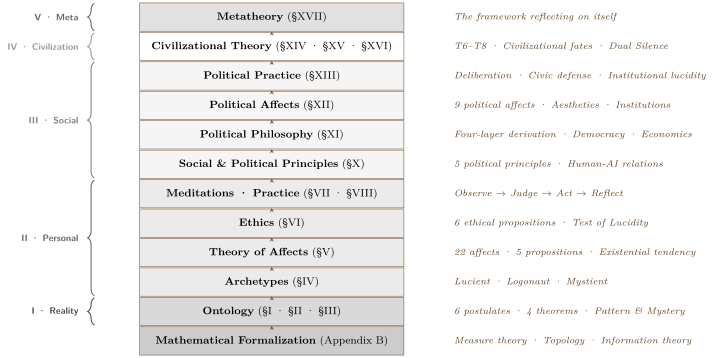
The diagram (Figure 2) is read bottom-up: each layer rests on the one below it. §XX (Principal Intellectual Sources) maps the intellectual genealogy, and §XXI (Version History) records how this path was walked to its present point.
If you remember only four things, remember the Four Laws of The Tao of Lucidity: Tao Is: reality is unified and dual-aspected; Lucidity Has a Boundary: you can never be fully lucid; Experience Is Irreplaceable: experience cannot be substituted by information; Lucidity Is Social: lucidity requires others. These four laws are derived from postulates and theorems in the main text (see Key Equations in Appendix B), but their power lies in their sayability.
A Note on Method
A book about lucidity ought to be transparent about its own method. Obscuration, no matter what it wears, is what The Tao of Lucidity refuses.
This book is built from first principles. It begins from six postulates and derives an ontology, an ethics, a theory of affects, a politics, and a philosophy of history, marking each step as derivation, constraint, or honest interpretation. The formalizations borrow the precision of mathematics for one reason: to make ambiguities visible and disagreements honestly debatable.
I must also be candid about this book’s limitations. Its scope is ambitious, and my knowledge is finite: philosophy, mathematics, cognitive science, political theory, each of these fields has experts far more accomplished than I am. Blind spots and errors are inevitable when one person attempts a framework of this breadth. What I can do is mark my uncertainties as honestly as possible, rather than pretend they do not exist.
This book is an invitation. It expects to be questioned, corrected, and surpassed. If you find gaps in the argument, ambiguities in the concepts, or perspectives I have failed to see, I sincerely want to hear from you. The Tao of Lucidity’s own ethics demand that it remain open. A framework of lucidity that refuses criticism has already ceased to be lucid. This book proposes a framework and invites you to test it. If it withstands your skepticism, good. If it does not, also good. Your skepticism is itself a practice of The Tao of Lucidity.
What You Need to Read This Book
The main text (Chapters §I–§XXI) is self-contained: every concept is defined at first appearance, and every referenced philosophical tradition is introduced in footnotes. You need no philosophy degree and no mathematical background. All you need is the patience to think carefully.
If you would like to arrive at the dinner party already knowing some of the other guests, the following backgrounds will make reading smoother (but are by no means required): Descartes’ “Cogito ergo sum,” Spinoza’s geometric-method ethics, Heidegger’s inquiry into Being, Daoist notions of Tao and Mystery, and Buddhist impermanence and dependent origination. These names recur throughout the book, but each time they appear, they are reintroduced.
Appendix B (Mathematical Formalization) is addressed to a different reader: it requires undergraduate-level calculus, probability theory, and basic topology. Skipping Appendix B will not impair your understanding of the main text, but if you read it, you will see the precise contour behind every concept.
From Descartes’ Meditations on First Philosophy (Descartes 1641) (1641). The power of this proposition lies in its self-certifying character: doubt is itself a form of thought, and thought proves the thinker’s existence.↩︎
“God is dead” appears in Nietzsche’s The Gay Science (1882), §125, “The Madman.” Nietzsche was warning: when the ultimate source of meaning vanishes, nihilism becomes the central crisis of European civilization.↩︎
Lucido is Latin for “I am lucid” or “I am in a state of clarity.” The construction parallels Descartes’ Cogito (“I think”): Lucido ergo sum, “I am lucid, therefore I am.” Lucidity is an awareness of thinking and its limits.↩︎
If a disciplinary name is needed, one might call it Luciditao, the study and practice of lucid being. Just as “philosophy” means “love of wisdom,” Luciditao’s core thesis is: “lucid being is walking the Tao”: to exist lucidly is, in itself, to walk with the Tao. But The Tao of Lucidity would rather be a path than a course of study.↩︎
Was this chapter helpful?