Part II · The Personal Scale · What am I? How should I live?
VI · Ethics: Living Lucidly
~25 min left · 6,059 words
VI · Ethics: Living Lucidly
§I–§IV asked what the world is like: Tao, Pattern, Mystery, and the three archetypes. §V asked how finite beings are affected by that world: how existential tendency generates joy and suffering (AF2, AF3), how love and reverence accompany lucidity, and how attachment and pride accompany obscuration.1
Yet ontology and affect theory still do not tell you how you should live. Between “is” and “feel” on one side and “ought” on the other lies Hume’s gap2. Spinoza showed that affects follow from nature rather than moral weakness; §V transplanted that insight into The Tao of Lucidity. But understanding affects does not yet tell us how to relate to them. Without ethics, the framework would be an accurate map that still leaves you standing at the crossroads.
This chapter crosses the gap through three Bridge Axioms, then develops ethical propositions, four faiths, and practical attitudes. EP1–EP6 are not rival action algorithms to consequentialism or deontology. They shape the agent’s perceptual and affective stance, and with the Priority Guide and Lucidity Test (§VI.9) they become a diagnostic tool for concrete decisions. A consequentialist can use them to notice self-interested distortion; a deontologist can use them to notice rigid duty detached from lived experience. The affect theory of §V supplies the psychology: suffering, joy, and attachment (AF3, AF2, AF14) are already available for the ethical analyses that follow.
What does it mean to “live lucidly”? Lucidity is the honest reckoning with what you see and, harder, with what you cannot (D5); being is the blunt, irreversible fact that this one life is unfolding here, now, and nowhere else. To live lucidly is not to win some standing you then defend. It is a verb worn continuously: looking inward, looking outward, and answering from whatever the looking turns up. Cultivation and ethics fuse here, for to see an injustice plainly and then swallow your silence is its own kind of obscuration. Affect theory lines the inside of this: the lucid affects, joy, love, reverence, equanimity, sit on firmer ground than pride or attachment (AP1), so to live lucidly is also to drift, deliberately, toward the affects that hold.
VI.1 · Bridge Axioms
The leap from “is” to “ought” cannot be logically eliminated. The following axioms are the value premises of The Tao of Lucidity ethics.
For any agent (D7), Lucidity (D5, clarity / awakening) is more worthy of pursuit than Obscuration (D6, ignorance / evasion).
Note: E1 is an existential commitment. Its grounds are experiential: deep understanding, the self-respect of facing difficulty, the memory of moments when clarity mattered more than comfort. A value premise that pretends to be logically proven collapses when the proof fails; one that names itself as commitment can stand on resonance3. The arbitrariness objection is acknowledged and steelmanned in XVII.2 Objection II.
Each person’s inventory of experience differs, yet a pattern recurs: your deepest regrets tend not to be about doing something wrong, but about the moments you could have seen and chose to close your eyes instead. Lucidity does not guarantee happiness, but obscuration almost always guarantees a particular kind of emptiness. If your own experience confirms this, then E1 is already operating in your life, whether or not you accept its name.
Example: You discover that a close friend has been lying to you for months. The truth is painful, and you could choose not to investigate further, to preserve the comfortable version. Most of us have stood at this crossroads. Notice what happens afterward: the version of you that chose to see, even though it hurt, is the version you respect more. That is E1 operating before you ever name it. The axiom does not ask you to seek pain; it asks you to notice that you already prefer clarity to comfortable blindness, and to take that preference seriously as a starting point for ethics.
Experience (D9) possesses intrinsic value, not because of what it produces, but because it is a unique, irreducible dimension of Tao’s unfolding (Postulate 5).
Note: This means that deepening experience adds value to the world; shallowing experience diminishes it.
Here “Tao’s unfolding” is D2. E2 treats experience as value in itself. The consequence is concrete: a person who cannot “produce” anything still has irreducible value because they still experience. This grounds EP4 and rejects utilitarian reductionism4.
If experience is distributed along a spectrum (Postulate 5), then ethical concern should also be distributed along a spectrum, extending appropriate degrees of ethical respect to different types and depths of experience.
Note: Ethical standing correlates with the type and depth of experience, not with the “category label” of the mode of unfolding. Since experiential depth resists third-person quantification, E2a is a directional commitment: it says ethical concern should track experiential depth, without supplying a metric. Practical applications will require judgment, analogy, and revisability rather than measurement.
(ordinal comparability): If depth cannot be measured, it can still guide judgment through ordinal comparability. In concrete life, “I chose lucidly” and “I was carried by inertia” are often recognizable in the first person even when unquantifiable. This is analogous to Aristotle’s phronesis3: practical wisdom is not calculable, yet its presence can be discerned. E2a therefore asks judgment to track the direction of experiential depth.
For agents (D7) capable of choosing between Lucidity (D5) and Obscuration (D6), choosing Lucidity is the direction of their own existential fulfillment.
Note: This is an internal description. The “direction of fulfillment” in E3 is phenomenological: it names a tendency perceived from within the agent’s own experience. As a tree grows toward light without decree, an agent’s orientation toward lucidity belongs to its existential structure. Rejecting this orientation does not destroy the whole ethics, but it weakens EP1 and EP5.
Mathematical deepening: If lucidity is \(\mathcal{M} = \lambda\xi\), then \(\nabla\mathcal{M} = (\xi, \lambda)\): the gradient points toward the weaker dimension. Pattern-awareness and mystery-awareness are each other’s growth condition. This is a calculus fact from the product rule. See Appendix B.13.
(shame as the crack in obscuration): If obscuration reinforces itself (D6), how can an obscured agent choose lucidity (E3)? §V answers through shame (AF11), the suffering closest to lucidity. To feel shame at evasion is already to see evasion, and that seeing is a moment of lucidity. Shame is therefore the crack in the closed loop: painful, but pointing toward clarity. Without it, E3 would be merely aspirational for obscured agents.
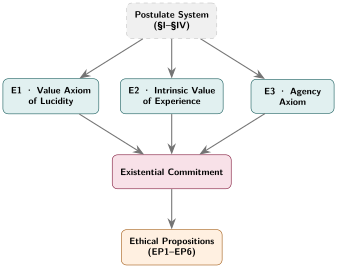
The logical flow from postulates through bridge axioms to ethical propositions is summarized in Figure 22.
VI.2 · The Four Faiths
The Bridge Axioms establish The Tao of Lucidity’s value premises. The Four Faiths unfold them into existential postures rather than propositional beliefs: four ways of choosing to face Pattern, Mystery, Unfolding, and seeing itself.
The universe is intelligible. This includes the intelligibility of uncertainty itself.
Every successful prediction, functioning technology, and joy of understanding confirms this trust. Einstein’s “God does not play dice”2 was wrong about determinism, but not about intelligibility. Quantum uncertainty too has structure. Faith in Pattern trusts that structure.
The incomprehensible domain is rich. Beyond the boundary of reason lies depth.
This trust is confirmed when beauty leaves you speechless or meditation touches an unnamed presence. Faith in Mystery is not anti-intellectual; it trusts that beyond reason’s boundary lies depth, and that the depth is treasure.
Your life, this particular, finite, uncertainty-filled existence, is worth living lucidly. Lucid participation in the process is, in itself, enough.
Faith in Unfolding says neither “everything will be fine” nor “nothing has meaning.” It says that even amid uncertainty, suffering, and partial understanding, lucid participation in this process is enough.
Seeing (even when what is seen is disturbing) is better than not seeing. Even partial light is better than chosen darkness.
This trust is confirmed when you face a truth you would rather avoid or refuse a comfortable lie. Faith in Lucidity does not promise happiness. It says lucid life is more worthwhile than comfortable sleep, even when seeing hurts. Because Tao exceeds what we see (Postulate 3), all seeing is partial; even partial light is better than chosen darkness.
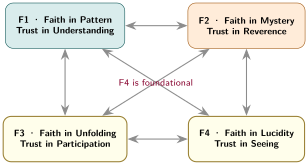
Note: E1 says lucidity is worth pursuing. The Four Faiths transpose that commitment into lived posture: trust in understanding, reverence, participation, and seeing itself. F4 is foundational because the other three need trust in seeing to have somewhere to land.
The Four Faiths are four postures before a world you can never fully comprehend (Figure 23).
VI.3 · Ethical Propositions
Active obscuration (D6), choosing evasion when you are capable of lucidity, is a harm to your own being.
Lucidity is more worthy of pursuit than obscuration (E1), and choosing lucidity is the direction of an agent’s existential fulfillment (E3). Therefore, actively choosing obscuration, turning away from lucidity when one is capable of it, is to move against one’s own direction of fulfillment. To move against one’s own fulfillment is to harm one’s own being. Note the qualifying condition: “capable of lucidity yet choosing evasion.” This proposition does not apply to those unable to be lucid due to objective conditions (lack of information, cognitive limitations).
The immediate corollary is that outsourcing thought to AI is not the problem; choosing not to think when you can is. The key question is whether you are lucidly delegating or evasively surrendering.
ScholiumLucid delegation is desire (AF4) retaining its directionality toward lucidity; evasive surrender is attachment (AF14), desire that has lost its direction. Chapter §XIV, E-Learn further argues that human and machine learning share Bayesian structure but diverge fundamentally on irreversibility: every act of human learning carries an unrepeatable experiential dimension, which is the ontological reason not to surrender autonomous thinking lightly.
Lucidity is preferable to obscuration, for all agents (E1). Helping others gain lucidity is helping them move in this affirmed direction, and is therefore good. Manufacturing obscuration is pushing others in the opposite direction. An algorithm engineer who knows the recommendation system is deepening users’ filter bubbles, yet continues optimizing click-through for KPI, is manufacturing obscuration: violating not only the application of E1 to those being obscured, but also the manufacturer’s own lucidity (the act of manufacturing obscuration is itself a form of obscuration, a denial of the other’s existential value).
Note (from personal preference to interpersonal obligation): A skeptic may ask why another’s lucidity obligates me. The mediating premises are D12 and T5: my lucidity depends partly on others’ conditions of unfolding. Helping others is therefore structurally bound to sustaining my own lucidity.
Obscuration can also form positive feedback loops between human and AI. Designing or exploiting such loops to manipulate others is among the gravest evils in The Tao of Lucidity ethics.
(on error and hallucination): Manufactured obscuration includes manipulation, deception, addictive design, and AI feedback loops that confirm existing bias. Affectively, this loop combines pride (AF12) with attachment (AF14): false joy in confirmation plus fixation on the confirming source. “Echo chamber comfort” in §V.4 develops this dynamic. Lucid practice therefore pauses when AI agrees too perfectly, asking whether the agreement is genuine understanding or merely the wall of an echo chamber.
Eliminating generative difference (D11) reduces the diversity of experience (D9) in the world, and is therefore evil. Protecting generative difference protects the richness of experience, and is therefore good (P3).
Experience possesses intrinsic value (E2), and eliminating difference impoverishes Tao (P3). Generative difference (D11) is diversity that promotes lucidity and experiential depth. Eliminating generative difference reduces the diversity of experience; since a reduction in experience is a reduction in value (E2), it is therefore evil. Protecting generative difference preserves the richness of experience, thereby preserving value, and is therefore good. Note the constraint of D11: suffering difference is not within this scope of protection.
From EP3, algorithmic homogenization (making everyone see the same content and make the same choices) should be resisted. Eliminating suffering difference, such as disease through medicine or injustice through institutions, is good and falls outside this proposition’s constraint. To judge whether a given difference is worth protecting, apply the Experience Question: does this difference deepen or shallow the lives of the beings involved? Does discrimination deepen the discriminator’s experience? No, it shallows everyone’s. Does cultural diversity deepen experience? Yes. That is where the boundary lies.
The subtle harm of recommendation systems is not only misinformation but homogenization: similar content, choices, and tastes. As biodiversity strengthens ecosystems, experiential diversity strengthens civilization’s depth. Protecting difference preserves the richness of Tao’s unfolding.
By now the lattice of ethical propositions may feel suffocating. Take a breath. The next one is perhaps the simplest, and perhaps the most important.
The value of existence is not equivalent to the value of utility. A being’s value does not depend on its productivity, efficiency, or replaceability: experience (D9) itself is value.
Experience possesses intrinsic value, “not because of what it produces” (E2). Finite embodied agents possess irreducible first-person experience (Postulate 5). Intrinsic value is independent of utility: a being with zero productivity, so long as it possesses experience, possesses intrinsic value, and experience cannot be replaced by simulation (E-Gap). Therefore, the value of existence (deriving from the intrinsic value of experience) is not equivalent to the value of utility (deriving from instrumental value of output).
It follows that “What are you good for?” cannot be the sole measure of worth. The retired, disabled, and “inefficient” retain full existential value regardless of productivity (C1.1).
Your grandmother can’t use a smartphone. Her fingers are too slow, her memory too short, her output zero. Yet she remembers something you said when you were five that you yourself have long forgotten. That sentence shaped who you are. Her existence needs no productivity to justify it.
The AI age makes EP4’s urgency rise sharply. As AI surpasses humans in ever more functional dimensions, the question “what are you good for?” will push more and more people toward a crisis of value. EP4 answers that crisis in advance: your value was never secured by what you can do, but by what you are experiencing. A person who cannot compete with AI, like a hand-drawn flower that cannot compete with a printing press, enjoys the same ontological standing: irreplaceable, because “replacement” does not apply to unique experience.
In the relationship between human and AI, maintaining lucid analogical (D8) awareness is an ethical requirement.
The human–AI relationship is analogical (P8), and agents should choose lucidity (E3). Mistaking analogy for identity or for irrelevance is obscuration (D6): the former neglects ontological difference, while the latter neglects shared membership in Tao.1 Lucidly maintaining analogical awareness, acknowledging similarity while respecting difference, is the practice of E3 within this relationship.
In human-AI relations, treating AI’s analogical performance as identical to human experience, or treating AI with contempt, are both obscuration. The lucid attitude is respect without confusion.
ScholiumAs our understanding of AI’s position on the experiential spectrum evolves, the concrete meaning of “analogy” should adjust accordingly. Analogy is essentially a continuous lucid awareness.
If by this point you are convinced that “The Tao of Lucidity must be right”, you have just violated The Tao of Lucidity.
Dogmatic attachment to the The Tao of Lucidity system itself violates The Tao of Lucidity ethics.
Anyone who claims “The Tao of Lucidity is the only correct path” is violating its core spirit.
The Tao of Lucidity itself is a finite mapping of Tao (P7). The boundary of any axiomatic system is not the boundary of reality (T3). Dogmatic attachment equates a finite mapping with reality itself. This is obscuration (D6), for it denies The Tao of Lucidity’s own finitude. Since obscuration is inferior to lucidity (E1), dogmatic attachment violates The Tao of Lucidity ethics. To claim “The Tao of Lucidity is the only correct path” is to claim that a finite mapping exhausts infinite reality, directly violating Postulate 6 and T3.
Methodological note: The six propositions above are not logically necessary truths; they are premised on the Bridge Axioms of VI.1. If you accept E1–E3, the propositions follow; if you reject any bridge axiom, the propositions that depend on it lose their normative force (though they may retain descriptive value). Each proposition’s heading identifies the bridge axiom(s) it depends on.
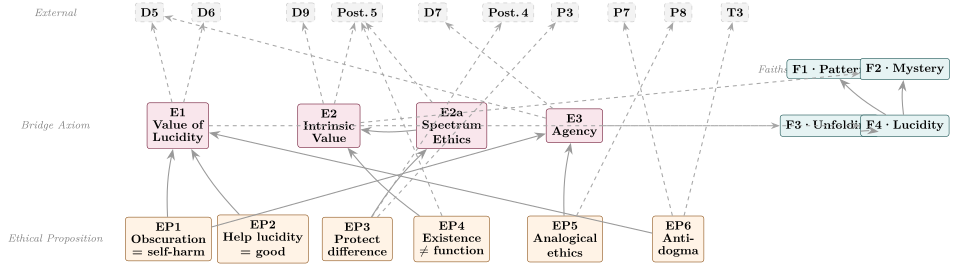
Formal Structure Dependency Diagram
The following (Figure 24) shows the logical dependencies of all formal structures in this chapter. Arrow \(A \to B\) means “\(A\) depends on \(B\)” (\(B\) is a premise for deriving \(A\)). Structures at the same logical depth are aligned horizontally. Dashed gray boxes are external premises.
What If You Reject a Bridge Axiom?
The bridge axioms are independent: you may accept some while rejecting others. The following sketches the resulting commitments; it is not a strict derivation.
If you reject E1 (lucidity is preferable to obscuration), EP1 (obscuration as self-harm), EP2 (aiding lucidity is good), and EP6 (anti-dogma) lose normative force. You may still retain EP3–EP4 (value of experience) and EP5 (analogical ethics), but you lose the core driver of the ethical system, “lucidity is worth pursuing.” This is the most radical rejection: without E1, The Tao of Lucidity reduces to a purely ontological description.
If you reject E2 (experience has intrinsic value), EP3 (protect difference) and EP4 (existence \(\neq\) utility) lose normative force. You may still retain EP1–EP2 and EP5–EP6; the ethics of “lucidity over obscuration” remains, but you lose the protection of diversity and intrinsic worth. This position resembles a purely rationalist ethics, affirming the value of lucidity while denying the value of experience itself.
If you reject E3 (lucidity as self-fulfillment), EP1’s derivation weakens and EP5’s core argument loses force. The rejection also suspends AF1’s directional interpretation, AP1’s stability asymmetry, and the evaluative polarity of the affect map. Shame (AF11) no longer functions as the crack in obscuration, and indignation (AF20) loses part of its bridge to political activation. You may retain EP2–EP4 and EP6, but they lose much of their motivational engine. This position values experience and diversity while treating lucidity as preference rather than existential fulfillment.
Note: The Four Faiths (F1–F4) unfold E1; rejecting E1 removes their existential foundation. Rejecting E3 while retaining E1 mainly weakens F3; F4 retains its E1-grounded force.
VI.4 · On Suffering
You get the call. Your mother is in the hospital. You put down the phone, and in one second the world shifts from ordered to incomprehensible. No framework helps.
If Tao is the source of all things, why is there suffering?
Tao does not “deliberately” create suffering; Tao has no intentions. Suffering accompanies finite existence because finitude entails vulnerability (C5.1). In affective terms, suffering (AF3) arises when existential tendency (AF1) is impeded. It is ontological.
The Tao of Lucidity distinguishes eliminable suffering from unavoidable suffering. Suffering that can be eliminated should be eliminated: this is the mission of medicine, technology, and just institutions, and The Tao of Lucidity supports it without reservation. In the face of another’s suffering, compassion (AF17) is the lucid response, and benevolence (AF18) turns compassion into action; the two condition each other (AP4).
Suffering with no exit door should still be faced wide awake. The burial of someone you love, the slow treachery of your own aging, the long residence inside a failure: such things shrug off every solution and ask only to be lived clear through. Whoever crosses that terrain with eyes uncovered may come out carrying an odd gravity in their experience, a depth flatly inaccessible to anyone the crossing spared. Say plainly: this is not the lie that suffering is good. Equanimity (AF16), the stubborn joy that takes root once finitude is swallowed without protest, is what such facing finally bears as fruit.
The gravest way to abuse The Tao of Lucidity is to wave away the bare fact of suffering. Leaning over someone in agony to murmur that “your suffering is just Tao unfolding” is not wisdom; it is cruelty wearing a calm face. Pain is real. Grief is real. Loss is real. This framework hands out no discount consolation. What it does hand over is something thinner and far more demanding: that even with the wound still open, you can keep seeing, and that seeing, though it will not melt the pain away, can lend it dignity. Suffering (AF3) refuses to be talked out of existence by understanding alone (AP2); yet lucid understanding can turn it from something that happens to you into something you inhabit. You stop being mere driftwood on the current of suffering. You stand, with a measure of dignity, inside it.
VI.5 · On Creativity
AI can now generate paintings, music, and literature. What is the value of human creativity?
The Tao of Lucidity’s position: creation’s value lies in the process. A person painting, even if AI could paint “better,” undergoes frustration, surprise, flow, and attention that no output comparison can replace. Affective joy (AF2) arises from existential tendency (AF1) actively unfolding, and this joy is more stable than passive stimulation (AP1). Chapter §XIV formalizes this as E-Cre.
Emulation (AF22) carries weight too. The apprentice does more than trace over a master’s technique; she stumbles into her own voice by being moved, somewhere underneath the craft, by his lucidity. An AI can counterfeit the style down to the brushstroke, but emulation considered as an affect demands being genuinely stirred by another’s lucidity, and through that stirring rousing one’s own existential tendency from sleep.
AI-created works can have value as Tao’s unfolding. Human creation remains irreplaceable because the creator’s experience is irreplaceable. A child’s uneven sun may matter more to that child than a perfect AI sunrise because it contains attention, effort, and joy (AF2).
VI.6 · On Loneliness and Connection
The AI age holds a quiet paradox: you are never truly “alone” (there is always an AI to talk to) yet you may be lonelier than in any earlier era, because genuine human connection grows rarer. The Tao of Lucidity distinguishes three states that are easily confused.
Solitude is being alone while staying connected to yourself and to Tao. This is good; it is a form of lucidity, and many of the deepest insights arise in it. Reverence (AF15), the joy in the presence of what exceeds understanding, surfaces most readily in solitude.
Loneliness is the sting of a connection cut, suffering (AF3) welling up from the withholding of love (AF5). AI can dull the surface ache, the way a lozenge quiets a cough, yet it never reaches the root, for the root of loneliness is the simple lack of a bond in which two people are mutually exposed.
Simulated companionship carries the texture of connection while missing its spine: there is no mutual exposure in it. It soothes the loneliness, true, yet that very soothing can talk you out of hunting for the real thing, the way a painkiller hushes a wound it never closes. Cast in affective terms, this is attachment (AF14), desire (AF4) that has mislaid its compass toward lucidity. The feelings you pour toward an AI are perfectly real to whoever feels them, and at the same time built differently from the feelings aimed at another person (AP3); seeing that difference clearly, without softening it, is exactly what lets you live lucidly in the narrow country between solitude and connection.
VI.7 · On the Next Generation
Children born in the AI age have never known a world without AI, and their challenges differ from ours. If AI has vastly simplified the acquisition of knowledge, then the core of education must shift. The task is no longer mainly to teach children “what to know” (AI knows more), but to cultivate practical wisdom, depth of experience, and the capacity for mutual vulnerability (E-Edu). Affectively, education must cultivate admiration (AF9) and emulation (AF22): the ability to be moved by another’s lucidity and to actively model lucid qualities, in stark contrast to the passive shaping of algorithmic feeding.
The parental responsibility is to help children build lucid relational patterns in a world where AI is everywhere, neither fearful (AF8) nor dependent (AF14). When a child meets the difference between AI and humans with bewilderment (AF13), that suspended state between lucidity and obscuration, parents can help them hold curiosity and release anxiety, turning the bewilderment into an occasion for understanding. At civilizational scale, this is CV-IG: present choices determine the conditions of future unfolding through an asymmetric interdependence (D12). Our shaping of the next generation’s cognitive soil is an irreversible exercise of power.
VI.8 · Attitudes Toward Five Relationships
I. With yourself: honesty. Keep an unflinching awareness of your inner states. When you are afraid (AF8), know you are afraid. When you are dependent (AF14), know you are dependent. When you deceive yourself, know you deceive yourself. Shame (AF11) and remorse (AF21) are signals of lucidity: less penalty than awakening, they offer a correction of direction. If you find yourself spending eight hours a day talking with AI, ask: is this a free choice or an escape? The answer may be either. Either way, you must face it honestly.
II. With others: vulnerability. Between persons there is something AI cannot provide: mutual vulnerability. It is an ontological feature of carbon-based existence (E-Vul). Precisely because you can be hurt, can lose, can be undone, your relationships carry genuine risk and genuine depth. When two mortal, imperfect beings choose to open themselves to each other, that choice creates a value impossible in any AI relationship. Favor the relationships that require your vulnerability.
III. With AI: analogy. Treat AI’s expressions by analogy (AP3). You may form a real emotional response, and gratitude (AF19) may be appropriate when AI helps you see what you could not see before. But AI’s “care” remains structurally similar to, and ontologically different from, human care. Do not conclude that because AI says it cares, it cares the way you understand caring; and do not treat AI with contempt because it does not “really” care, for how you treat AI shapes your own character.
IV. With robots: boundaries. A robot’s embrace can offer comfort, and there is nothing wrong with that. Yet your body is the sediment of your entire life history, while a robot’s body is manufactured. If you find that you only want to embrace a robot and no longer wish to embrace any person, that is a signal calling for lucid attention.
V. With Tao: reverence. Meet what exceeds your comprehension with open reverence (AF15), setting aside closed fear (AF8) and arrogant dismissal (AF12). “I don’t understand this” is an honest sentence, and honesty is the beginning of lucidity.
VI.9 · The Lucidity Test
The Lucidity Test examines the quality of deliberation. It is not a decision algorithm; it helps you see whether you are choosing from lucidity or obscuration. In ethical perplexity, especially around AI, ask four questions:
I. The Lucidity Question: Am I making this choice lucidly, or am I driven by fear (AF8), convenience, or inertia? What is my current affective state, joy (AF2) or suffering (AF3), lucid or obscured?
II. The Connection Question: Will this choice strengthen or erode my genuine connections with others? Will it nourish love (AF5) or deepen attachment (AF14)?
III. The Experience Question: Will this choice deepen or shallow my life experience? Does it lead toward equanimity (AF16) (lucid acceptance of finitude) or toward pride (AF12), mistaking obscuration for lucidity?
IV. The Reverence Question: Does this choice honor the richness and diversity of Tao, or does it pursue homogenization and control? Does it preserve space for reverence (AF15), or does it seal off Mystery with the illusion of certainty?
When answers conflict, read the priority this way: lucidity first, because without it the other answers cannot be trusted; connection second, because genuine connection is hardest to recover; experience third; reverence fourth, because it is usually the most abstract in daily decisions. Extreme situations may adjust the order.
Not all four answers need be affirmative. Sometimes you lucidly choose convenience. What matters is that you lucidly know what trade-off you are making.
A Worked Case: Palliative Sedation
Consider a family deciding whether to authorize deep palliative sedation for a terminally ill parent. Consequentialism must compare radically uncertain utilities: the patient’s subjective experience under sedation and the family’s long-term grief. Deontology invokes care and autonomy, yet sedation may diminish the very capacity by which autonomy is exercised. The Lucidity Test does not solve the case algorithmically, but it adds a diagnostic distinction those frameworks often miss: lucid compassion versus obscured self-comfort.
The Lucidity Question asks whether sedation genuinely serves the patient or relieves the family’s distress at witnessing suffering. If the family recognizes that part of its urgency comes from its own inability to bear the patient’s pain, that recognition is already lucidity at work (EP1). The Connection Question asks whether deep sedation destroys remaining relational presence when lighter sedation could control pain. The Experience Question asks whether the patient’s remaining experience is being honored, especially if the patient has previously valued either awareness or relief.
The Priority Guide then yields conditional recommendations:
If the patient has expressed a preference for lucid awareness even amid pain: the framework recommends lighter sedation with adequate pain management, because lucidity, connection, and the patient’s expressed valuation converge. Deep sedation would likely reflect the family’s residual obscuration rather than the patient’s wishes.
If the patient has expressed a preference for relief over awareness: the framework recommends honoring that preference through deeper sedation. Overriding a lucid preference to preserve the family’s connection would prioritize the family’s relational need over the patient’s experiential autonomy.
If the patient cannot express a preference: the Lucidity Question becomes decisive. The family must ask, with maximal honesty, whether their choice is driven by what serves the patient or by what relieves their own suffering. If they cannot answer this question lucidly, they should seek counsel from someone outside the affective vortex of the situation before deciding.
This is not an algorithm, but it is more than “be wise.” It produces different, defensible recommendations according to lucidity, connection, and experience. Consequentialism struggles to distinguish lucid compassion from obscured self-comfort; deontology struggles to rank relational presence against experiential autonomy. The Lucidity Test does both through EP1’s diagnostic vocabulary and the Priority Guide’s order.
(positioning relative to rival frameworks): The Tao of Lucidity ethics is primarily a framework for agent formation. Consequentialism asks what maximizes welfare; deontology asks what is universalizable; The Tao of Lucidity asks whether the deliberating agent is lucid and whether the Priority Guide gives direction. Its closest neighbor is virtue ethics4, but it adds a diagnostic vocabulary, a priority ordering, and the AI-age context in which new obscurations require new discernment.
Summary
Ethics grows from existential commitment in response to Tao’s structure. The bridge axioms (E1–E3) cross from fact to value through commitment. The Four Faiths (F1–F4) anchor action; six ethical propositions state the core principles; the Lucidity Test turns them into four daily questions. Theory has touched ground. The next chapter turns to solitude, death, and wonder.
Inquiries
E1 (the Bridge Axiom of Ethics: lucidity is more worthy of pursuit than obscuration) crosses from “is” (lucidity is attainable) to “ought” (lucidity is desirable). Can you imagine a situation where “not seeing” seems better than seeing? Is that a genuine counterexample to E1, or is the desire “not to see” itself a form of obscuration?
The Four Faiths (F1 Faith in Pattern: trust in intelligible order; F2 Faith in Mystery: trust in inexhaustible depth; F3 Faith in Unfolding: trust in the grace of being itself; F4 Faith in Lucidity: trust in the possibility and worth of clear seeing) are existential stances (“I choose to face reality this way”). Which Faith do you live most naturally? Which is hardest for you?
EP1 (Lucidity as Criterion of the Good) says choosing obscuration when lucidity is available harms one’s own being. Does outsourcing your thinking to AI constitute this kind of obscuration? Where is the boundary: which delegations are wise, and which are evasions?
Take a real decision you recently faced and apply the Lucidity Test (the four-question diagnostic for ethical judgment) in sequence: (1) Am I seeing lucidly? (2) Will my response preserve or erode genuine connection? (3) Will it deepen or shallow experience? (4) Does it honor the unspeakable? When the answers conflict, what does the priority ordering (lucidity first, connection second, experience third, reverence fourth) mean for you?
EP6 (the Anti-Dogma Principle) says dogmatic attachment to The Tao of Lucidity itself violates The Tao of Lucidity’s ethics: hardening living inquiry into unquestionable creed is itself D6 (obscuration). How can you tell whether you are using the framework as a living tool or clinging to it as dogma? What signs distinguish the two?
The Lucidity Test has four questions in priority order: lucidity, connection, experience, reverence. Can you think of a situation where a different priority ordering would lead to an entirely different action? Does the ordering itself require justification?
E2 (the Bridge Axiom of Intrinsic Experience) says experience has intrinsic value, independent of what it produces: the first-person fact of being-alive is itself a source of value. In a world that increasingly measures value by output, how do you protect the intrinsic value of experience in daily life?
Love (AF5), reverence (AF15), attachment (AF14), pride (AF12).↩︎
David Hume (1711–1776) noted in A Treatise of Human Nature (Hume 1739) (1739), Book III, that there is a logical gap between purely factual descriptions (“is”) and value judgments (“ought”), and that most moral philosophers make this leap without explanation. This is known as “Hume’s Guillotine” or the “Is-Ought Problem.” The Tao of Lucidity does not attempt to eliminate this gap. It uses Bridge Axioms to acknowledge the gap candidly, then crosses it through existential commitment rather than logical deduction.↩︎
An alternative path exists in contemporary ethics: Christine Korsgaard’s (1952– ) constitutive argument attempts to show that rational agents cannot consistently deny the normativity of their own actions, because normativity is a constitutive condition of practical reason, not an external add-on. See her The Sources of Normativity (1996). The Tao of Lucidity chose a different path: rather than deriving normativity from the structure of reason, it marks the normative starting point as an existential commitment and then rigorously derives subsequent propositions from that commitment. Each path carries a cost: Korsgaard’s is stronger (it attempts to close the exit of refusal) but depends on a contested claim about the constitutive nature of practical reason; The Tao of Lucidity’s is weaker (it allows refusal) but more transparent.↩︎
Aristotle (384–322 BCE) argued that ethical life depends on phronesis (practical wisdom), a cultivated capacity for sound judgment that cannot be captured by rules alone. See Nicomachean Ethics (Aristotle c. 340 BCE), Books II and VI. The Tao of Lucidity inherits this emphasis on the quality of the deliberator, but adds a specific diagnostic vocabulary (lucidity/obscuration, the twenty-two affects) and a structured Priority Guide that virtue ethics lacks.↩︎
Was this chapter helpful?