Part III · The Social Scale · How should we live together?
X · Social and Political Principles
~18 min left · 4,251 words
X · Social and Political Principles
§VIII addressed personal practice: how an individual maintains lucidity. Yet lucidity does not happen in a vacuum. When algorithms manipulate attention and the information environment is systematically distorted, individual effort alone cannot sustain clear judgment. Why does a book on lucidity need political philosophy? Because the conditions for lucidity are social (T5, Social Lucidity Theorem): one person’s lucidity requires institutional protection. This chapter articulates five political principles from the ethical propositions, analyzes tensions between them, diagnoses the power structures of the AI age, and raises five concrete political questions. These are criteria for evaluating social institutions. The Tao of Lucidity does not align with any political party or movement. It will therefore disappoint anyone who came shopping for a side to join.
A note on the transition from personal to political. The step from individual ethics (Chapters §V–§VIII) to political principles requires two mediating premises, both already established: inter-dependence (D12), which means one’s conditions of lucidity are partly shaped by others’ actions, and the Social Lucidity Theorem (T5), which shows that this dependence cannot be reduced away. Without these premises, politics would remain an optional appendix to ethics. With them, political philosophy becomes an ontological necessity: if lucidity depends on social conditions, then the design of those conditions directly continues the question “how should I live.” The bridge axioms (E1–E3) provide the normative content; T5 provides the structural reason why that content must extend beyond the individual.
X.1 · Five Political Principles
The first three are foundational principles articulated directly from The Tao of Lucidity’s ethics. The last two are institutional principles that follow from the first three. For the deeper axiomatic foundations of these five principles, and for the complete development of power, justice, freedom, and democracy from three irreducible ontological facts, see Chapter §XI (Political Philosophy).
Being Before Utility (EP4, E2). The value of a being precedes and is independent of any functional evaluation; it is irreducible to utility.
The original formulation contained two near-synonymous clauses: “irreducible to utility” and “independent of any functional evaluation.” The tightened statement preserves both dimensions: priority (precedes) and independence (irreducible), in a single sentence.
In the age of AI, utilitarian thinking presses on every domain: Are you useful? Can you be optimized? Can you be replaced? The Tao of Lucidity’s first political gesture is to refuse utility as the sole measure of existential worth1. A person’s value does not lie in what they produce, just as a poem’s value does not lie in its information content, or a sunset’s value in its spectral data. Existence itself is value. Utility still matters, but it cannot be the only thing that matters.
Institutional corollary: Institutions that respect every person’s existential value (not merely productive value) are good. When AI causes mass technological unemployment, society has an obligation to ensure that the unemployed are not only materially supported but treated with dignity. A society’s ethical quality can be measured by its attitude toward those it deems “useless.”
Difference as Good (P3, EP3). To eliminate generative difference is to impoverish Tao.
The richness of Tao lies in the sheer variety of its unfolding. Flatten that variety, sand every surface down to the same grain, and Tao itself grows poorer (C3.1). So when AI quietly converges our writing styles, irons decision processes into one template, and ladles the same information into every bowl, The Tao of Lucidity answers in three words: protect difference. One sharp qualification guards the principle from abuse. “Difference as Good” shelters generative difference, the living plurality of ways of knowing, inherited cultural traditions, and forms of life. It extends no shelter to suffering difference. To read it as “wealth inequality is Tao’s richness” is to bend the principle into its own counterfeit (C3.3).
Institutional corollary: Institutions that protect social diversity are good; institutions that enforce homogenization are bad. Political systems should protect the space for different ways of living, thinking, and cultural traditions to coexist: including different attitudes toward AI (C3.2).
Lucidity as Responsibility (E1, E3, EP2). Beings capable of lucidity bear an inescapable responsibility for their own lucidity.
Any being that can grasp its own situation carries the burden of its own lucidity, and cannot set that burden down. Obscuration, whatever its source, fear (AF8), sloth, the flattering self-deceit of pride (AF12), or the deliberate manipulation worked on us by others, comes nearer to “evil” than anything else in The Tao of Lucidity’s ethics. The sharpest ethical hazard of the AI age is twofold: not merely that AI might be turned to harm, but that human beings may hand over their lucidity of their own free will. In the language of affect, that surrender wears the mask of attachment (AF14): a rudderless clinging to AI’s convenience. One clarification matters here, and it cuts deep. The Tao of Lucidity furnishes no alibi for passivity. Lucid action and lucid stillness alike are expressions of Lucidity. To dodge action is not wu wei; wu wei is non-attachment carried out inside action.
Institutional corollary: AI systems’ decision processes should be comprehensible; citizens should have the right to know how AI affects their lives; information ecosystems should promote rather than obstruct lucid judgment. The tension is real: comprehensibility and competitive advantage often pull in opposite directions, and any transparency requirement will be gamed by actors with sufficient resources. These frictions do not invalidate the principle; they mark the terrain where institutional design must do its hardest work. Because agents are inter-dependent (D12) and lucidity is irreducibly social (T5), the responsibility for lucidity extends beyond the individual to encompass the institutional structures that either enable or systematically obstruct lucid judgment. For the full derivation of how this individual responsibility grounds political legitimacy, justice, and freedom, see P15–P17 in Chapter §XI.
Decentralization of Power (from PP2 and PP3). Power must be checked and distributed.
Power left unchecked breeds obscuration and then entrenches it (D6). The empires of history rehearse the lesson again and again: the longer a power evades correction, the more completely it mistakes its own vantage point for the world itself. The AI age concentrates power on a scale no emperor could have dreamed, a mere handful of systems setting the informational weather for billions of lives. Command over the most potent AI systems ought not to gather in so few hands. Why? Because concentrated power is built, structurally, to go blind to itself. The deeper normative ground runs further still: power that systematically erodes the conditions under which others might become lucid is illegitimate (P15) and unjust (P16), whether or not the erosion was ever intended.
Consider a single recommendation algorithm serving two billion users. No human designed it to manufacture obscuration; it was optimized for engagement. Yet the result is that a handful of design choices can shape the attentional environment of a vast share of humanity. The concentration is structural. Structural concentration is precisely what PP4 targets: because no finite group can see all the blind spots that concentration creates.
The Irreplaceability of Human Judgment (from Phronesis; E-Int.5). Major judgments about human destiny cannot be delegated to systems without experience.
Political judgment belongs to the domain of practical wisdom (Postulate 3) and therefore cannot be algorithmized. This classification is precisely what grounds the prohibition against delegating major judgments to systems that lack experience.
Major decisions about human destiny (war and peace, the definition of basic rights, the fundamental distribution of resources) should not be delegated to AI (E-Int.5). AI can provide information and analysis, but the final political judgment must be made by human beings.
The scope of constraint. Taken together, PP1–PP5 rule out specific political pathologies: instrumentalism (treating persons as mere means), cultural homogenization (erasing diversity of unfolding), manufactured obscuration (deliberately undermining lucidity), unchecked power concentration (consolidating control without transparency), and delegation of existential judgment to systems without experience. They do not adjudicate among reasonable democratic ideologies. Social democracy, classical liberalism, communitarian democracy, libertarian minimalism, and other frameworks are all compatible with PP1–PP5 provided they respect these constraints. The five principles define a floor, not a ceiling; they mark what no legitimate political order may do, while leaving the positive design of institutions to democratic deliberation.
A note on non-uniqueness. PP1–PP5 are The Tao of Lucidity’s specific articulation of boundary constraints generated by the axiom system. They are not the unique forced set: a different philosophical framework starting from comparable premises (finitude, plurality, inter-dependence) might generate equivalent constraints under different names or decompose them differently. What the axiom system requires is that some set of constraints ruling out these pathologies be in place; the particular five-fold articulation is one defensible way to satisfy that requirement.
X.2 · Tensions Between Principles: Case Analysis
Purely principled discourse has limited persuasive force in political questions. The following cases demonstrate how The Tao of Lucidity’s political principles apply to real dilemmas, including the trade-offs that appear when principles conflict.
Case One: AI in Criminal Justice
An AI system predicts recidivism more accurately than human judges, but its training data contains historical racial biases.
Analysis within The Tao of Lucidity: The transparency principle requires that the system be comprehensible and open to legitimate review; its training data and decision logic cannot remain entirely opaque. The dignity principle requires that persons not be treated merely as statistical probabilities; a person is not their “recidivism risk score.” The diversity principle warns against algorithms that calcify historical biases into systemic discrimination. The human judgment principle requires that final sentencing be made by humans.
But a tension emerges: if human judges’ biases are worse than the AI’s (one influential and debated study suggests that judicial decisions can be affected by fatigue, mood, and other low-level conditions2), does “the irreplaceability of human judgment” still hold?
The Tao of Lucidity’s answer refuses the comfort of a flat “yes” or “no.” The domain of practical wisdom pivots on a different axis altogether: someone must shoulder moral responsibility for the decision, and that is not the same claim as humans always outperform AI. Grant that AI delivers sharper data analysis. The question “should this person be imprisoned?” is never merely a data question; it is a moral one, about how human beings treat human beings. Whoever bears that moral weight must be a person, even where the person’s judgment trails the machine’s in accuracy. Accuracy and moral responsibility lie along different axes, and no gain on one buys an inch on the other.
Case Two: Transparency vs. Security
Full transparency of a government’s defense AI system could expose national security information. Full transparency of a corporation’s AI model could expose trade secrets.
Analysis within The Tao of Lucidity: The transparency principle does not decree that “everything must be public”; to read it so would be dogma wearing the costume of rigor. Transparency exists for a purpose, and that purpose is lucid judgment. Once security enters the picture, the questions “transparent to whom” and “transparent to what degree” can be settled only by practical wisdom, case by case. One workable framework arranges the disclosure in tiers: to the public, how AI touches their lives and how far; to independent oversight bodies, the system’s core logic and its latent risks; to internal auditors, the full technical anatomy. The aim throughout is layered accountability rather than blanket exposure.
Case Three: Decentralization vs. International Competition
If democratic nations decentralize AI control while authoritarian states concentrate AI strategy, the former may be disadvantaged in competition.
Analysis within The Tao of Lucidity: This is among the hardest dilemmas, because it concerns the applicability scope of The Tao of Lucidity’s principles. The decentralization principle is an intra-community principle; it assumes participants share the value premise that “lucidity is better than obscuration.” In international competition, adversaries may not share this premise.
The Tao of Lucidity has no neat answer to this, and that is honest. What we can say is: (1) decentralization does not mean powerlessness; distributed institutions can still coordinate and mobilize power under pressure; (2) centralization’s short-term efficiency advantages are often offset by long-term adaptability disadvantages, as historical examples from Sparta to the Soviet Union suggest; and (3) acknowledging this tension, rather than evading the dilemma with “decentralization is always better,” is itself a lucid attitude.
X.3 · Power and Lucidity
This section supplements the power analysis that was insufficiently developed in earlier versions.
The greatest obstacle to personal lucidity is often not individual laziness or fear (AF8), but systemic power structures. The theory of affects (§V) provides precise tools for political analysis: indignation (AF20) is the lucid affective response to systemic obscuration, but only when directed at the structures that produce obscuration (not at individuals) does it serve as a legitimate affective foundation for political action (AP5); indignation’s license as a structural political affect is conditioned on E3 (see §VI.3 for the full demonstration).
The attention economy is itself a power structure3. The business models of technology companies are built on maximizing user attention. Each optimization of a “recommendation algorithm” can systematically manufacture obscuration (EP2), because commercial incentives run counter to the incentives of lucidity. In this environment, calling for “personal lucidity” without analyzing the power structures that drive obscuration is insufficient.
The concentration of AI development power gives this abstract structure a hard, visible body. The raw inputs needed to build the most powerful systems, compute, data, and scarce talent, pool inside a small cluster of companies. Their choices, which training data to ingest, where to set the safety thresholds, how and when to deploy, ripple outward into the cognitive environment of billions. Here concentration of power stops being a metaphor and becomes the most concrete instantiation imaginable of “a breeding ground for obscuration.”
The asymmetry of data is also a power relation. AI companies know far more about user data than users know about AI, which makes “lucidly using AI” extremely difficult for ordinary users. The transparency principle here is an ethical prerequisite as much as a political principle.
For this reason, The Tao of Lucidity’s practice of lucidity cannot stop at the personal level. If your organization is using AI to invade privacy, manufacture discrimination, or manipulate attention, personal lucidity demands that you speak up instead of seeking private peace while ignoring structural harm.
Personal lucidity grows punishingly hard inside an environment engineered to manufacture obscuration at scale. So the work of pressing for transparency and justice at the institutional level is not political action alone; it is a limb of The Tao of Lucidity practice itself. To understand and resist the power structures that mass-produce obscuration weighs as heavily as understanding and resisting one’s own inward drift toward it. Compassion (AF17) and benevolence (AF18) open a second affective register for political life: beyond indignation’s work of opposition lies a compassion-driven work of creation, the patient building of conditions under which the obscured can find their way toward lucidity.
X.4 · Five Political Questions for the AI Age
The following five questions are concrete extensions of The Tao of Lucidity’s political principles into the AI age. Each poses a question and offers a framework. Each application claim below carries one of three epistemic markers: direct implication (follows deductively from PP1–PP5), strong presumption (strongly supported by the axiom system but not uniquely determined), or compatible policy-family (consistent with the principles but one of several possible implementations).
I. Attention Sovereignty. Recommendation algorithms shape what billions of people see, think, and believe every day. This is a form of power without precedent: its main form is not censorship (blocking what you cannot see), but shaping (determining what you see first). Within The Tao of Lucidity: who shapes your attention directly determines your degree of lucidity. Therefore, attention sovereignty (an individual’s right to know and control how their attention is allocated) should be recognized as a new type of civil right, on par with freedom of speech and the right to privacy (strong presumption: the right follows from PP3 and P17, but its specific legal form is underdetermined). A society that legally protects free speech while structurally permitting algorithms to systematically manipulate attention has an incomplete framework for protecting lucidity (E-Att.1).
II. The Meaning of Existence in a Post-Labor Age. As AI swallows more and more of the work, the old answer “what do you do for a living” can no longer stand in for “who are you.” The puzzle is existential before it is economic: it asks where meaning comes from, not only where income comes from. Here the Dignity Principle (PP1) carries a concrete political edge (direct implication): a society may not lash human dignity to the mast of economic productivity. “Being precedes utility” is more than a line of philosophy; it lays a demand on social institutions to furnish people with something larger than a paycheck’s security, namely room to create, openings to learn, and a place in the common life where one is seen and held in regard. The real menace of technological unemployment is less the poverty it brings than the verdict of superfluousness it whispers to those it touches.
III. Lucidity About Digital Identity. Out of your data, AI assembles a “you”: a consumption profile, a credit score, a behavioral prediction model stitched together from your traces. This digital double may “know” your preferences with an accuracy that outruns your own self-knowledge. The Tao of Lucidity’s warning is blunt: you are not your data profile. Such a profile captures only the Pattern side of you, the modelable behavior, and lets the Mystery side slip entirely through its fingers, the irreducible texture of subjective experience, the singularity of this very moment, the standing possibility of becoming otherwise. When the institutions that rule a life, insurance, credit, hiring, lean ever harder on digital profiles to “understand” the person before them, a new species of obscuration is already underway: being quietly swapped for pattern, the individual quietly swapped for a probability.
IV. The Cognitive Environment as a Public Good. Air quality is a precondition for physical health; information environment quality is a precondition for cognitive health. Deepfakes, synthetic disinformation, and emotionally optimized algorithmic feeds are “pollution” of the cognitive environment. Within The Tao of Lucidity (strong presumption): a healthy information ecology is a social precondition for lucidity and should be treated as a public good, like clean air and water. Just as the environmental movement drove governance of physical pollution, the AI age needs a movement for cognitive ecology: protecting the diversity, truthfulness, and human comprehensibility of the information ecosystem without reducing the task to censorship. E-Pow.1 warns that convenience itself is obscuration’s new vehicle in the AI age; the more “natural” and comfortable an algorithmic environment feels, the more lucid scrutiny it requires.
V. Intergenerational Cognitive Justice. The AI decisions our generation makes, including the selection of training data, the design of recommendation algorithms, and the shaping of digital educational environments, will define much of the cognitive soil of the next generation. A child raised within algorithmic recommendations will have attention patterns, thinking habits, and tolerance for uncertainty shaped by our choices. This is an intergenerational responsibility: we are leaving the next generation not only economic assets and environmental debts but also a cognitive environment. The Tao of Lucidity’s question (direct implication from PP3 and T5): is this cognitive environment one that cultivates lucidity or manufactures obscuration? Do we have an obligation to protect the cognitive environment as we protect the natural environment, not for ourselves but for those not yet born and unable to speak for themselves? This question receives a formal argument in Chapter §XV: CV-IG (Intergenerational Lucidity Proposition) shows that the conditions for future generations’ unfolding are shaped by present civilizational choices through irreversible asymmetric interdependence. Its corollary CV-IG.1 further identifies discount rates that devalue future agents as temporal obscuration. The intimate-scale ethical requirement underlying this civilizational responsibility is established in §VI.7.
Formal Structure Dependency Diagram
The following (Figure 27) shows the logical dependencies of the five political principles. Arrow \(A \to B\) means “\(A\) depends on \(B\)” (\(B\) is a premise for deriving \(A\)). Dashed gray boxes are external premises.
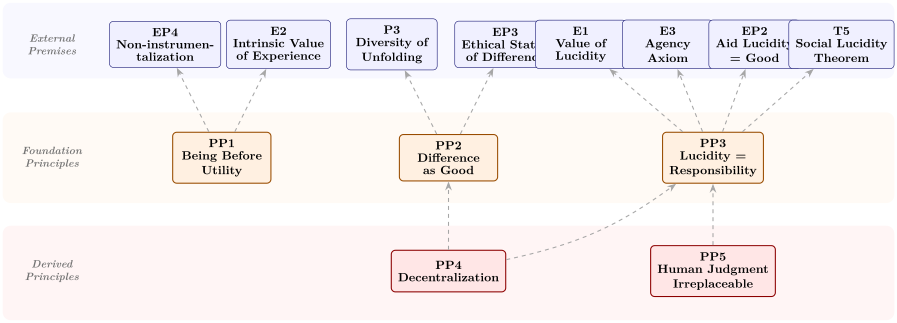
The five principles carry different structural weights with respect to the bridge axioms (§VI.1). Reject E1 (the value of lucidity), and PP3 (Lucidity as Responsibility) loses its normative force entirely; PP4 and PP5, which derive from PP3, are similarly undermined. Reject E2 (the intrinsic value of experience), and PP1 (Being Before Utility) loses its grounding; what remains is a political system that can protect persons only instrumentally. Reject E3 (the Agency Axiom), and both PP3 and PP5 lose the argument that agents are accountable for their choices, including the choice to surrender political judgment to AI. PP2 (Difference as Good) is the most resilient: it rests on P3 and EP3, which are grounded in E2 and also find independent support in the ontological analysis of §I. The full sensitivity analysis of the bridge axioms and their effect on the derived ethical propositions appears in §VI.3; the consequences tabulated there map directly onto the political principles here.
Summary
This chapter articulates five political principles from the postulate system: Being Before Utility (PP1), Difference as Good (PP2), Lucidity as Responsibility (PP3), Decentralization of Power (PP4), and the Irreplaceability of Human Judgment (PP5), extending individual ethics into norms for collective structures. Five political questions for the AI age, attention sovereignty, post-labor meaning, digital identity, the cognitive environment, and intergenerational justice, show how these principles unfold concretely. The transition from personal lucidity to collective lucidity now opens into political philosophy: the next chapter asks why politics exists, how power should be constrained, and what justice requires.
Inquiries
How does PP1 (Being Before Utility: a person warrants protection because they exist, not because they produce) apply to those deemed “unproductive” (retirees, the disabled, the unemployed)? Have you unconsciously measured another person’s worth by their utility?
Does PP5 (Irreplaceability of Human Judgment: in judgments with irreversible moral consequences, machine accuracy cannot replace human accountability) still hold when AI diagnostic accuracy surpasses that of human physicians? Why? What is the difference between accuracy and judgment?
Of the five AI-era political questions (attention sovereignty, post-labor meaning, digital identity, cognitive environment, intergenerational justice), which most urgently affects your daily life? What have you done about it?
What conditions are needed for the transition from personal lucidity to collective lucidity? Why is personal practice alone insufficient (T5, the Social Lucidity Theorem: lucidity is irreducibly social, requiring the corrective contribution of others)? In your own community, what obstructs the formation of collective lucidity?
PP2 (Difference as Good: difference itself, the political reflection of P3’s plurality axiom) protects “generative difference” (differences that breed new possibilities), not “suffering difference” (differences caused by deprivation). Can you give a concrete example distinguishing the two? In your society, which differences are being wrongly eliminated?
PP4 (Decentralization of Power: concentrated power is necessarily blind to itself) says concentrated power has neither external reference nor internal correction. Can the engineers of a recommendation algorithm serving two billion users possibly see their own blind spots? Why or why not?
If an AI system could “protect difference” and “distribute power” better than any human, should we delegate these political functions to it? Why might PP5 (Irreplaceability of Human Judgment) still say “no”?
The Tao of Lucidity’s strategy of deriving political principles from metaphysics contrasts with the mainstream of contemporary political philosophy. John Rawls’s (1921–2002) political liberalism deliberately avoids metaphysical foundations: his Political Liberalism (1993) argues that principles of justice should be independent of any comprehensive doctrine, so that citizens with different metaphysical and religious commitments can reach an “overlapping consensus.” The Tao of Lucidity takes the opposite path: it holds that political principles require ontological grounding, because in the AI age, questions about “what is a being” and “what is experience” have themselves become political questions. The cost of this divergence: Rawls’s path is more inclusive but shallower in foundation; The Tao of Lucidity’s path is deeper in foundation but demands acceptance of more premises.↩︎
Danziger, Levav & Avnaim-Pesso (2011) published a widely discussed study in the Proceedings of the National Academy of Sciences reporting that Israeli parole board judges approved parole at a much higher rate just after meals than before the next meal. The finding has been debated, but its philosophical relevance remains: consequential human judgment can be affected by bodily and environmental conditions that decision-makers themselves may not notice. This is precisely one reason The Tao of Lucidity insists on “lucidity as responsibility”: the deeper our understanding of our own sources of obscuration, the better we can design institutions to counteract them.↩︎
Shoshana Zuboff systematically analyzed this power structure in The Age of Surveillance Capitalism (Zuboff 2019) (2019): technology companies not only collect user behavioral data to predict behavior but also engage in “behavioral modification” to shape it. This is a new form of power, beyond manipulation in the traditional sense: Zuboff calls it “instrumentarian power,” operating through subtle, continuous, automated modification of behavior, neither violence nor ideology. Within The Tao of Lucidity’s framework, this is diagnosed as the systematic manufacture of obscuration.↩︎
Was this chapter helpful?