Part V · The Meta Scale · What is this framework itself?
XVII · Philosophical Genealogy and Position
~37 min left · 9,135 words
XVII · Philosophical Genealogy and Position
Chapters §I–§XVI built the edifice. This chapter examines it from outside: intellectual sources, classical dualisms, and the naming of a discipline. The next chapter (§XVIII) gives that discipline its explicit name, and Chapter §XIX examines the framework from inside: design decisions, objections, and limits.
On the nature of this text itself.
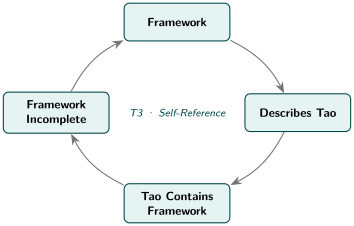
The definitions, axioms, propositions, and principles above are not scientific descriptions of an “ultimate reality” independent of human beings. They are conceptual tools, a framework to help you reorganize your relationships with the world, with yourself, with others, and with AI. Their value lies in whether they help you live more lucidly, far more than in whether they are “true” in a scientific sense. Any statement about Tao (including the The Tao of Lucidity system itself) is only a finite mapping of Tao, not Tao itself. A map that asks to be worshipped has forgotten that it is a map. Maintaining a lucid critique of this very framework, not clinging to it, is itself part of The Tao of Lucidity practice (C7.1).
The Tao of Lucidity does not require exclusivity. You may be a Christian and walk the Tao of Lucidity; you may be a Buddhist and walk the Tao of Lucidity; you may be an atheist and walk the Tao of Lucidity. The Tao of Lucidity offers a supplementary framework for the AI age, not a replacement framework (C7.2). If you encounter The Tao of Lucidity on the road, examine it, use it, test it. If it helps you, keep it. If it does not, let it go. Tao is larger than any theory about Tao (Figure 47).
XVII.1 · Philosophical Genealogy
The Tao of Lucidity stands at the confluence of two ancient rivers. One flows from the West: Spinoza’s river of reason, clear, precise, flowing in geometric lines. The other flows from the East: the Daoist river of mystery, deep, silent, flowing in ways that cannot be spoken. The Tao of Lucidity is new water that emerges at the confluence.
XVII.1.1 · The Relationship with Spinoza
In Spinoza, theoretical reason reaches a geometric extreme: everything is, in principle, deducible from axioms.
Spinoza built the most rigorous monist system in Western philosophy, yet it contains a structural blind spot: it assumes reality is fully intelligible. If you grant that assumption, you get a closed circle of reason, magnificent but sealed. The moment you encounter something that resists intelligibility (the hard problem of consciousness, the quantum measurement problem, the sheer fact that anything exists at all), Spinoza’s system has no room for it; it can only classify the encounter as temporary ignorance. The Tao of Lucidity begins where that assumption breaks.
The Tao of Lucidity first inherits Spinoza’s monist ontology.
Spinoza’s “Deus sive Natura” (God, or Nature) is one of the boldest unification theses Western philosophy has produced. The Tao of Lucidity’s “Tao” carries the same wager forward: there are no two worlds, natural and supernatural, matter and spirit, only the changing faces of one reality. Tao wears two of those faces, Pattern and Mystery, and in wearing them it repositions Spinoza’s claim that a single substance can show itself through many attributes.
It also inherits the geometric method. Spinoza chose to develop his ethics through definitions, axioms, and propositions, a geometric edifice nearly unique in the history of philosophy. The formal structure of The Tao of Lucidity, definitions, postulates, theorems, corollaries, directly inherits this method. The form forces the thinker to lay every assumption in the open, subject to examination. At a deeper level, both systems share a temperament: understanding itself carries ethical dignity. Spinoza’s “amor intellectualis Dei” (the intellectual love of God, the deep satisfaction reached through understanding nature) resonates deeply with Logonaut’s voyages in The Tao of Lucidity. Understanding is not merely a tool; understanding itself is a mode of being.
The Tao of Lucidity nevertheless departs from Spinoza at three critical points.
First, and cutting deepest: the independent status of Mystery. Spinoza trusted that reality is fully intelligible. Give the mind enough patience and enough power, and nothing stays beyond it forever. So his system holds no seat for Mystery. What looks unintelligible is, to him, only ignorance waiting to be cleared, never a permanent feature of how things are. The Tao of Lucidity parts ways right here. Postulate 3 (Dual Nature) names Mystery as a second face of Tao. The disagreement is not a footnote; it bends the whole architecture. Where Spinoza draws a closed circle of reason, The Tao of Lucidity draws an open semicircle, its cut edge turned toward the unspeakable other half.
Second, probability replaces determinism. Spinoza lived in the age of Newtonian mechanics; his universe was deterministic, where everything follows necessary causal chains. The Tao of Lucidity lives after quantum mechanics; its universe is probabilistic, where uncertainty is a structural feature of existence. This is not merely a physics update; it changes the foundations of ethics: in a deterministic universe, freedom is illusion (Spinoza candidly acknowledged this); in a probabilistic universe, freedom has at least room to breathe.
Third, the problem domain of the AI age. Spinoza faced the question of the human-God relationship; The Tao of Lucidity faces the human-AI relationship. The distinction between intelligence and wisdom (the E-Int system), the political economy of attention, the co-evolution of carbon-based and silicon-based beings: these problems were unimaginable in Spinoza’s time. But the way The Tao of Lucidity handles them (calmly, systematically, with neither fear nor worship) inherits Spinoza’s temperament of equanimity in the face of controversy.
The Tao of Lucidity’s Theory of Affects (§V) is the most direct inheritance and reworking of Part III of Spinoza’s Ethics. Spinoza’s three basic affects (laetitia (joy), tristitia (sadness), cupiditas (desire)) are reconstructed in The Tao of Lucidity as joy (AF2), suffering (AF3), and desire (AF4), while his conatus is reinterpreted as existential tendency (AF1), a tendency that is inherently directed toward lucidity rather than blind self-preservation. Spinoza’s core proposition “an affect can only be overcome by a stronger affect” (Ethics IV, Prop. 7) becomes AP2 in The Tao of Lucidity, enriched with a new dimension: lucidity is the deepest source of affective power.
In this sense, The Tao of Lucidity is a Spinozist system that has acknowledged the unintelligible.
XVII.1.2 · The Relationship with Whitehead
Whitehead moves reason from static substance to ongoing process: reality is emergence in progress.
Spinoza handed philosophy a frozen monism: one substance, fully intelligible, standing in the manner of geometry. But the world we actually live in keeps moving. New properties surface that no inventory of the parts could have called in advance. Whitehead saw the motion and built a process ontology to hold it. What his ontology never builds is a room for the ineffable, a category for whatever runs past intelligibility. So the gap stays open: how do you keep process and keep an honest reckoning of what no concept can reach?
Spinoza’s substance is eternal; it neither comes into being nor passes away; it exists in the manner of geometry. But The Tao of Lucidity’s Tao is different: Tao unfolds (Postulate 2). Unfolding implies process, time, emergence: new things arising from old, wholes greater than the sum of their parts. This dynamic dimension comes from Whitehead1.
The Tao of Lucidity inherits first Whitehead’s process ontology. Whitehead held that the basic units of reality are events, not things, verbs rather than nouns. The universe is woven from processes that are continually occurring, rather than composed of a collection of fixed entities. Postulate 2 (Unfolding) in The Tao of Lucidity directly inherits this insight: Tao is an ongoing process. Pattern is an order continually unfolding in time. This means understanding the world is participating in an ongoing process, rather than discovering a pre-existing truth. Logonaut’s voyage is drawing the route in real time on an ocean still surging beneath the keel, not reading a chart someone has already finished.
It also inherits emergence. One of the central claims of Whitehead’s process philosophy is that in complex systems, new properties emerge from lower-level interactions that cannot be reduced to lower-level descriptions. The “wetness” of water is not in any single molecule. The “awareness” of consciousness is not in any single neuron. Theorem T2 (the Emergence Theorem) in The Tao of Lucidity directly inherits this thought: Tao’s unfolding produces new properties irreducible to their components. This provides a path to understanding Mystery that does not depend on mysticism: the irreducibility of experience (Mystery’s first depth: qualia) may be an instance of emergence. Subjective experience emerges from physical processes but cannot be reduced to them.
The departure begins with epistemic caution about panexperientialism. Whitehead held that all basic units of reality possess some degree of “experience.” Postulate 5 (the Experience Spectrum) absorbs the direction of this idea but maintains agnosticism about the lower bound: does an electron have “experience”? The Tao of Lucidity says “we are uncertain,” unlike Whitehead, who asserts it extends to all existence.
The deeper departure is the Pattern/Mystery duality. Whitehead’s ontology has eternal objects and actual occasions, but no structural equivalent of Mystery as an irreducible ontological category co-equal with the intelligible. The Tao of Lucidity’s dual-aspect structure (Postulate 3) is the framework’s primary ontological innovation, no Whiteheadian borrowing, combining Whitehead’s process dynamics with a Daoist recognition that reality has an ineffable dimension no formal system can exhaust.
Thus The Tao of Lucidity inherits process and emergence from Whitehead, but adds the Pattern/Mystery duality that Whitehead’s system lacks.
If you have ever felt a new quality come alive in something the moment its parts assembled, then you already know in your own experience why no inventory of pieces can finish the account of you.
XVII.1.3 · The Relationship with Aristotle
Aristotle brings reason back into concrete situations: apt judgment amid uncertainty.
Aristotle put his finger on a kind of knowledge that refuses to be written down as rules: phronesis, the knack for apt judgment in situations that arrive fresh every time. Twenty-four centuries later the question he pried open has not closed, and AI now presses on it daily. If practical wisdom cannot be boiled down to rules, can it be turned into an algorithm? And if it cannot, what does that stubbornness reveal about the line between intelligence and wisdom? Aristotle asked the question. He simply had no formal tongue, no probability, no information theory, to give it an edge.
If Spinoza represents the extreme of theoretical reason (deducing everything from axioms), then Aristotle represents a different kind of reason: practical reason. This distinction is crucial to The Tao of Lucidity.
The Tao of Lucidity inherits above all Aristotle’s practical wisdom (phronesis). Aristotle distinguished three kinds of knowledge: theoretical knowledge (episteme, certain knowledge of what does not change), technical knowledge (techne, knowledge of how to make things), and practical wisdom (phronesis, knowing how to make good judgments in specific situations)2. Practical wisdom cannot be reduced to rules; it is judgment cultivated through countless concrete experiences, facing situations that are unique every time. The ancient antecedent of The Tao of Lucidity’s “distinction between wisdom and intelligence” (the E-Int system) lies precisely here: AI can possess theoretical knowledge and technical knowledge, but whether practical wisdom (making apt judgments amid uncertainty, amid value conflicts, in unrepeatable situations) can be algorithmized remains an open question. The Tao of Lucidity’s answer leans toward no: wisdom requires finitude, requires personal stakes, requires irreversible choices as its growth medium (E-Int.6), and these are precisely the conditions Aristotle emphasized when describing how phronesis is cultivated.
It also inherits Aristotle’s temperament around the mean (mesotes) and eudaimonia3. Aristotle’s ethics does not pursue extremes, neither maximum pleasure (hedonism) nor maximum sacrifice (asceticism), but the appropriate balance. The Tao of Lucidity inherits this temperament: it does not stand at the extreme of Pattern (Spinoza) nor at the extreme of Mystery (Daoism), but seeks the right tension between them. Lucient as a lucid finite being, understanding and revering simultaneously, is itself a kind of mean.
The Tao of Lucidity departs from Aristotle at two critical points.
First, the rejection of teleology. Aristotle’s entire system rests on teleology: all things have their “final cause” (telos); the acorn’s purpose is to become an oak; the human’s purpose is to achieve eudaimonia. The Tao of Lucidity rejects this premise. Tao does not have a preset purpose. Tao unfolds (Postulate 2), but unfolding is not toward a goal. Dissipation is not for something; gradients are not for something; selection is not for something. In The Tao of Lucidity’s universe, meaning is created in lucid existence, rather than discovered through teleology. This is a deep divergence: Aristotle held that the good life has objective content (eudaimonia’s substance is determinate); The Tao of Lucidity holds that the good life has only a formal criterion (lucidity), its content filled by each person within their own finitude.
Second, the absence of the probabilistic dimension. Aristotle’s practical wisdom operates in a world of “what is usually but not invariably the case.” He acknowledged uncertainty but lacked the precise language of probability to describe it. The Tao of Lucidity uses probability theory to give “judgment under uncertainty” a more precise structure: Bayesian updating, priors and posteriors, information gain. These tools partially turn practical wisdom from tacit knowledge transmissible only through experience into something that can be formally discussed. The significance lies in providing a new analytical language for phronesis.
Thus The Tao of Lucidity inherits Aristotle’s practical wisdom, rejects his teleology, and upgrades his theory of judgment with the language of probability.
XVII.1.4 · The Relationship with the Stoics
The Stoics bring philosophy into daily life: it must be lived in the morning, in the evening, and in each concrete choice.
The Stoics pulled off what no other ancient school managed: they made philosophy a daily discipline, with morning exercises, evening reviews, and rules of thumb for the hard choice in front of you. Yet the whole program leans on one premise that buckles the moment you press it: that painful feelings are, deep down, errors of judgment to be scrubbed away. Grief at a death, fury at injustice, all of it filed as a thinking mistake. There the tension sits unresolved: how do you keep the Stoic devotion to daily practice and still honor suffering as real, instead of arguing it out of existence?
Aristotle argued for the importance of practical wisdom, but he himself remained primarily a theorist, writing theories about “how to live” from his study. The Stoics did something different: they turned philosophy into daily practice. This turn is crucial to The Tao of Lucidity.
The Tao of Lucidity first inherits the resonance between the Stoic Logos and Pattern. The Stoics believed the universe is pervaded by a rational order (Logos), a rational structure inherent in nature itself, discovered rather than imposed. “Living according to nature” meant living according to Logos: recognizing the rational order of the universe and bringing one’s life into harmony with it. The Tao of Lucidity’s concept of “Pattern” resonates deeply with the Stoic Logos: both are intelligible orders inherent in reality, requiring no supernatural explanation. But The Tao of Lucidity goes further: the Stoic Logos is deterministic (everything follows the chain of fate), while Pattern in The Tao of Lucidity is probabilistic and contains structural uncertainty.
It also inherits philosophy as daily practice. Marcus Aurelius’s morning self-examination, Epictetus’s dichotomy of control (distinguishing what you can and cannot control), Seneca’s evening review of the soul: these are all things to do every day, far beyond theory. The practice system of The Tao of Lucidity (§VIII) directly inherits this tradition: morning calibration, evening reflection, the priority ordering of the “test of lucidity.” These are Stoic daily practices translated into the AI age. Without the Stoic legacy, The Tao of Lucidity would be merely a theoretical system, interesting but unlivable. The Stoics taught The Tao of Lucidity this: a philosophy that cannot become the first thing you do when you wake up every morning is not yet complete.
The Tao of Lucidity departs from the Stoics at two critical points.
First, the attitude toward emotion. The Stoics pursued “apatheia,” not indifference but freedom from being disturbed by passions (pathé). They held that pain, anger, and grief are, at their core, assented-to errors of judgment (pathē as distinct from the involuntary first movements the Stoics called propatheia). If you correctly understand the rational order of the universe, you should not suffer over loss. The Tao of Lucidity rejects this position. Finitude (Postulate 4) means that loss is real. Death, aging, separation are structural features of existence. Grief (suffering, AF3) is not obscuration; grief is a lucid response to finitude. The Tao of Lucidity pursues not apatheia (undisturbed by emotion) but lucidly experiencing emotion (including painful emotion) without letting it obscure judgment. The Theory of Affects (§V) systematically develops this position: by AP2, affects cannot be eliminated by pure intellect (the Stoic program), but lucid understanding can reorient passive affects into active ones. You do not cease to feel suffering, but you remain lucid within suffering. This is harder than apatheia, and more honest.
Second, the rejection of fatalism. The Stoics believed everything is the unfolding of fate (heimarmenê); freedom lies not in changing the external world but in changing one’s attitude toward it. This “amor fati” (love of fate) echoes in The Tao of Lucidity (the “existential commitment” of Faith-in-Tao F3), but The Tao of Lucidity does not accept the Stoics’ complete determinism. Choices in a probabilistic universe are real, not illusions. When you choose the eastern channel over the western (Logonaut’s “Sailing Selection”), you genuinely reshape the distribution of possibilities. The Stoics say “accept fate”; The Tao of Lucidity says “choose lucidly within the space of probability, then accept the consequences of the choice.”
Thus The Tao of Lucidity inherits the Stoic spirit of “philosophy as daily practice” while replacing the Stoic affect program: the goal is not the elimination of passion, but the reorientation of its direction.
XVII.1.5 · The Relationship with Daoism
Daoism turns toward what lies beyond reason: reality has a dimension no formal system can exhaust.
Daoism grasped what Spinoza would not let himself see: reality holds a dimension that no formal system can drink dry. Yet Daoism stayed so faithful to that insight that it turned against systematic reason wholesale, reading logic and formalization as so many snares laid across the Tao. So the problem hangs there: can you honor the ineffable and still keep the precision that lets a philosophical claim be checked? Daoism answers “silence.” Spinoza answers “axioms.” Take either one by itself and the job stays half done.
The Tao of Lucidity inherits first the concept of Tao itself. The word “Tao” is not an accidental choice. Laozi’s “the Tao that can be spoken is not the eternal Tao” means that the moment Tao is articulated, it is no longer the complete Tao. It is the direct antecedent of Postulate 6 (incompleteness of expression). Zhuangzi’s “Heaven and earth were born together with me; all things and I are one” is an ancient version of Mystient’s “Listening to Resonance.” The entire ontological skeleton of The Tao of Lucidity, a unified reality whose deepest levels exceed the grasp of language, is Daoist.
Second, Daoist wisdom gives the framework its sense of Mystery. Mystery is not a concept invented by The Tao of Lucidity; it comes from Chapter One of the Tao Te Ching: “Mystery upon mystery, the gateway to all marvels.” Daoism’s reverence for the unspeakable, its respect for silence, its esteem for “knowing that one does not know”: these directly shaped Mystient’s Four Listenings. On this point, The Tao of Lucidity is closer to Daoism than to Spinoza.
Third, it inherits the practical wisdom of wu wei (non-action). The Tao of Lucidity’s practice of “wu wei awareness”, not intervening, not analyzing, simply seeing, directly inherits Zhuangzi’s “sitting and forgetting” and Laozi’s “in pursuing the Tao, one loses daily.” This subtractive wisdom, where the key is releasing more, is the core of The Tao of Lucidity’s practice system.
The Tao of Lucidity departs from Daoism at three critical points.
First, and most deeply: its attitude toward reason. Daoism holds deep suspicion toward systematic rationality. Laozi says “in pursuing learning, one gains daily; in pursuing the Tao, one loses daily”: the more knowledge, the farther from Tao. Zhuangzi mocks the School of Names, viewing logical analysis as an obstruction of Tao. The Tao of Lucidity breaks here: it not only embraces reason (Pattern is one face of Tao) but deploys reason in its strongest forms (mathematics, probability theory, information theory) to develop its own arguments. The Tao of Lucidity holds that reason is one face of Tao. To reject reason is another form of arrogance, not humility, for it assumes one already knows which face of Tao is authentic.
Second, the willingness to formalize. Daoism champions “words cannot exhaust meaning” and “once you grasp the meaning, forget the words,” tending toward parables, metaphors, and poetry to hint at Tao, refusing definitions and propositions that would demarcate it. The Tao of Lucidity adopts a nearly opposite strategy: use the most precise formal language to demarcate what can be demarcated, then acknowledge the undemarcatable at the precise boundary. This is a complementary expression of the Daoist insight. Daoism guards Mystery through silence; The Tao of Lucidity draws the boundaries of silence through precise language.
Third, the political and temporal dimension. Daoism’s political ideal is “small states with few people,” a return to simplicity, a withdrawal from complex society. The Tao of Lucidity faces an age from which withdrawal is impossible: AI is embedded in everything; “small states with few people” is no longer an option. The political philosophy of The Tao of Lucidity (§X) seeks to protect the institutional conditions for lucidity in the AI age, an engaged politics oriented toward complexity, sharply different from Daoism’s tendency toward disengagement.
In this sense, The Tao of Lucidity is a Daoist system that has embraced reason.
Your sharpest analysis always leaves something untouched at the edge. That is exactly where this framework asks you to keep both your precision and your silence.
XVII.1.6 · The Relationship with Buddhist Thought
Buddhist thought and The Tao of Lucidity share several intuitions, but they move toward different destinations.
Buddhist traditions built the most sophisticated phenomenology of mental life in all of premodern thought, and they traced, with a surgeon’s exactness, how ignorance feeds on itself. Yet Buddhism aims that analytic power at one target above all: release from suffering and, in many lineages, release from the wheel of existence itself. For anyone who holds finite existence to be the irreducible site of value, something to inhabit rather than flee, the Buddhist toolkit comes bolted to a soteriology that has to be set aside. The question is whether its insights can survive the transplant.
The relationship between The Tao of Lucidity and Buddhism is subtler than the Daoist connection. Where Daoism provides The Tao of Lucidity with ontological vocabulary (Tao, Mystery, wu wei), Buddhism provides a parallel phenomenology of mental life that The Tao of Lucidity’s affect theory independently recapitulates.
The Tao of Lucidity’s first resonance with Buddhism lies in the analysis of mental states. Buddhist Abhidharma traditions enumerate mental factors (cetasikas) with a precision that anticipates The Tao of Lucidity’s formal affect theory (§V). The Buddhist category of “unwholesome mental factors” (greed, aversion, delusion) maps structurally onto The Tao of Lucidity’s obscuring affects; “wholesome mental factors” (mindfulness, equanimity, compassion) map onto lucid affects. Both traditions insist that careful phenomenological taxonomy is prerequisite to change.
Second, the diagnosis of ignorance as self-reinforcing. Buddhism’s teaching on avidyā (ignorance) holds that ignorance does not merely obscure; it perpetuates itself by distorting the very faculties that might correct it. This is precisely the structure of The Tao of Lucidity’s obscuration dynamic: obscuration breeds further obscuration (AP2). Both traditions recognize that the problem is a self-sustaining pattern to be interrupted.
Third, the primacy of practice. Buddhism is primarily a practice tradition. The Eightfold Path, like The Tao of Lucidity’s daily practice (§VIII), insists that insight without embodied practice is inert. A clarification is warranted here: the practice chapter’s architecture (morning calibration, evening reflection, the action cycle) is primarily Stoic in scaffold. Buddhism’s contribution to practice operates indirectly, through the affect theory’s phenomenological vocabulary, which gives the practitioner precise language for the states that Stoic exercises aim to cultivate or interrupt. The inheritance is real but mediated, not structurally co-equal.
The deepest departure concerns soteriology. Buddhism aims at liberation from suffering and, in many traditions, from the cycle of existence itself (samsara). The Tao of Lucidity has no such aim. It affirms finite existence as the irreducible site of value (Postulate 4); it does not seek escape from finitude but lucidity within it. There is no nirvāna in The Tao of Lucidity, no ultimate release. The finite, temporally bounded life is the condition that makes lucidity meaningful.
Second, the embrace of formal reason. Buddhist philosophical traditions (Nagarjuna’s4 Madhyamaka, Dignaga’s logic) deploy rigorous argumentation, but typically in the service of deconstructing conceptual frameworks, showing their ultimate emptiness. The Tao of Lucidity deploys formal reason constructively: it builds an axiomatic structure and inhabits it, while acknowledging (via Mystery) the limits of that structure. Buddhism uses logic to dissolve; The Tao of Lucidity uses logic to construct, then marks the boundary where construction must yield to silence.
The deeper tension is that Eastern philosophical traditions, both Daoist and Buddhist, characteristically resist systematic formalization. They trust that the most important truths cannot be captured in propositions. The Tao of Lucidity imports their phenomenological insights (the self-reinforcing nature of ignorance, the primacy of practice, the reality of what exceeds language) while housing them in a Western-style axiomatic structure. This is a genuine tension, not a flaw to be resolved but a productive friction: the axioms keep the insights honest, and the insights keep the axioms humble.
Thus The Tao of Lucidity inherits Buddhism’s phenomenological precision while declining its soteriology, and adds two structural features Buddhist traditions do not possess: a constructive axiomatic metaphysics (where Buddhist analysis characteristically deconstructs) and an explicit bridge-axiom chain from metaphysics through ethics to political philosophy.
For you this fork is not abstract: it is the difference between treating your own finite, mortal life as a problem to escape and treating it as the very ground on which lucidity becomes worth practising.
XVII.1.7 · The Relationship with Wittgenstein
Wittgenstein brings reason to its own boundary: this side speakable, that side silence.
Wittgenstein did what no philosopher before him had managed: he turned logic against itself and proved logic’s own limits. But once he reached the edge, he halted. “Thereof one must be silent” is honest, and it leaves the edge dead on the page, a wall where there might have been a doorway. So the question hangs open: is there real work to do at the boundary, or must philosophy go quiet the instant it arrives?
Wittgenstein’s unique position is this: he arrived at the boundary of reason from the inside of reason.
The Tractatus Logico-Philosophicus accomplished something without a prior model: using the most rigorous logical language (propositions, truth functions, logical space), it reasoned step by step to the limit of language, and then at the limit wrote that sentence: “Whereof one cannot speak, thereof one must be silent.” This is not a Daoist intuition, not a poet’s romantic sigh about the unspeakable: this is a logician using logic to prove the limits of logic. It is reason itself declaring its own boundary. Theorem T4 (the Silence Theorem) in The Tao of Lucidity directly inherits this insight.
Wittgenstein, having reached the boundary, stopped: “thereof one must be silent.” This is honest, but also passive. He knew there was something on the other side (he wrote “it is not how things are in the world that is mystical, but that it exists”), but he refused to say anything about that something.
The Tao of Lucidity does not stop here. On this side of the boundary, it uses the most rigorous formal language (like Wittgenstein). On the other side, it uses images, contemplation, and practice (like Daoism). And on the boundary itself, at the precise confluence of Pattern and Mystery, it uses probability. Wittgenstein drew a line and said “this side speakable, that side silence”; The Tao of Lucidity says “the line itself is the most interesting place, and probability lives on this line.”
Wittgenstein used logic to prove the limits of logic; The Tao of Lucidity discovers probability at those very limits.
So when you next reach the edge of what you can prove and feel the pull to fall silent, this is the chapter that asks you to stay a moment longer and weigh the odds before you do.
XVII.1.8 · A New Synthesis
Each tradition above solved something genuine and left something unresolved. The pattern is not accidental: each gap is the structural consequence of the tradition’s own deepest commitment. Spinoza’s commitment to full intelligibility leaves no room for Mystery. Daoism’s reverence for the ineffable leaves no room for precision. The Stoics’ equation of painful emotion with cognitive error leaves no room for honest grief. Wittgenstein’s honesty about the boundary leaves nothing constructive to do there. A new framework is needed for a quieter reason: each of these traditions succeeded so thoroughly in one dimension that it foreclosed another.
Six voices form a complete spectrum from inside reason to beyond reason:
| Voice | Domain | Core Insight |
Voice |
Domain | Core Insight |
Spinoza |
Theoretical reason | Everything deducible from axioms |
Whitehead |
Process reason | Reality is emergence in progress |
Aristotle |
Practical reason | Apt judgment amid uncertainty |
Stoics |
Daily practice | Philosophy as something lived every day |
Daoism |
Beyond reason | Mystery is what is fundamental |
Wittgenstein |
The boundary of reason | This side speakable, that side silence |
The Tao of Lucidity does not stand at any single position on the spectrum; it stands at the spectrum’s fracture point: the precise boundary between Pattern and Mystery. Its distinctive contribution is: it chooses neither side, nor merely draws a line, but uses a modern framework to precisely locate the boundary between them and discovers new philosophical resources at the boundary itself.
The Tao of Lucidity is a new synthesis born in the tension among six traditions, using a modern framework none possessed (probabilistic ontology, information theory, and the AI-age problem domain), responding to a crisis none could have foreseen.
Calling this a “new synthesis” does not mean standing above those traditions, nor does it reduce intellectual history to a prehistory of this book. More precisely, The Tao of Lucidity treats each tradition as a load point: each supplies an insight that must be taken seriously, and each exposes a gap that the AI age magnifies. The task of synthesis is to make inheritance, departure, and cost visible enough that the reader can audit them one by one, not to declare a winner.
Why can the three closest comparator traditions not simply be updated to cover the AI age? Because the gap is structural, not merely temporal. Stoic practice has no formal evaluative norm applicable to non-human agents: apatheia presupposes a rational soul that AI may or may not possess, and the Stoic framework provides no mechanism to adjudicate. Buddhist phenomenology addresses sentient experience but not the question of how machine cognition relates to human finitude; the Abhidharma taxonomy classifies mental factors of beings already assumed to be sentient. Whiteheadian process ontology provides a metaphysics of experience (prehension, concrescence) but not bridge axioms connecting that metaphysics to political principles about AI governance, attention sovereignty, or the division of cognitive labor between carbon and silicon. The Tao of Lucidity’s architecture was designed from the outset to span this gap: the experience spectrum (Postulate 5), the analogy measure (D8), and the five AI-age dimensions are structural consequences of the postulate system.
XVII.1.9 · Five Irreducible Pillars
Probability is an important tool, but The Tao of Lucidity’s own demand for lucidity requires it to acknowledge that probability is not the sole core, nor the deepest concept in every dimension. Beneath the framework lie five pillars, each load-bearing, none reducible to any other.
The first is probability. It locates the boundary between Pattern and Mystery and gives formal language to the act of making a judgment when certainty is unavailable. Its structure (distributions, Bayesian updating, entropy) belongs to Pattern; its bare existence, the question of why the universe should be probabilistic at all, opens onto Mystery.
The second is emergence. Why is the whole greater than the sum of its parts? This is not a probability problem. You could know a system’s probability distribution down to the last decimal and still be unable to derive its emergent properties from it. Whitehead’s contribution (Postulate 2, T2) stands on its own ground and does not lean on probability.
The third is finitude and temporality. You will die. This moment will not come again. Even in a fully deterministic universe, where no probability remains to be resolved, finitude would still cut. Finitude (Postulate 4) is therefore an independent foundation of The Tao of Lucidity’s ethics: grief is real not because outcomes were uncertain but because time is irreversible.
The fourth is the texture of experience. The “what it is like” question, the hard problem of consciousness, is neither a probability problem nor an emergence problem. No distribution and no account of parts assembling into wholes will tell you why there is something it is like to be you, which is why the Experience Spectrum (Postulate 5) stands as an independent postulate.
The fifth is lucidity itself. The ethical core of The Tao of Lucidity, the choice of lucidity over obscuration, is an existential commitment (E3), not a conclusion to be read off any technical concept. It is more fundamental than any tool, because it is what decides how the tools will be used.
The five are networked, not stacked: probability locates boundaries, emergence explains new properties, finitude anchors ethics, experience guards the subjective, and lucidity gathers the other four into a way of living. Probability is a good key. But there is more than one door.
XVII.1.10 · Philosophical Lineage at a Glance
The spectrum table above placed each voice on a single axis. The ledger below changes grain: for every tradition the book engages substantively, it records in one line what The Tao of Lucidity keeps, where it departs, and the relationship that results. Read it as the itemized receipt behind the synthesis, the place where inheritance and debt are made auditable one tradition at a time.
| Voice | Inherited | Departed | One-Sentence Summary |
Voice |
Inherited | Departed | One-Sentence Summary |
Spinoza |
Monist ontology; geometric method; reason as highest virtue | Independent status of Mystery; probability replaces determinism; AI-age problem domain | A Spinozan system that acknowledges the incomprehensible |
Whitehead |
Process ontology; emergence | More cautious agnosticism on the lower bound of pan-experientialism | Inherits process and emergence, but maintains silence on pan-experientialism’s lower limit |
Aristotle |
Practical wisdom (phronesis); the mean and eudaimonia | Rejects teleology; upgrades judgment with probabilistic language | Inherits practical wisdom, rejects teleology, upgrades judgment theory with probability |
Stoics |
Logos resonates with Pattern; philosophy as daily practice | Rejects suppression of emotion; rejects fatalism | Inherits “philosophy as daily practice,” rejects emotional suppression and fatalistic submission |
Daoism |
The concept of Tao itself; the wisdom of Mystery; wu-wei | Embraces reason and formalization; politically engaged | A Daoist system that embraces reason |
Buddhism |
Phenomenological analysis of mental states; ignorance as self-reinforcing; primacy of practice | No soteriology (no nirvana); constructive use of formal reason | Inherits phenomenological precision, declines soteriology |
Wittgenstein |
Used logic to locate the limits of logic | Does not stop at silence; locates the boundary with probability | Wittgenstein marks a limit; The Tao of Lucidity locates probability at that boundary |
XVII.2 · Dissolving Eight Dualisms
The history of Western philosophy is in large part a history of dualisms: reason versus sensibility, mind versus matter, subject versus object… Philosophers chose sides, then spent centuries refuting each other. The AI age has given birth to yet another dualism: human versus AI. The Tao of Lucidity does not choose sides; it holds that these dualisms are often the source of the problem, not its solution. The following explains how The Tao of Lucidity repositions each classical opposition and contemporary new opposition alike.
Dualisms I–VII
The following table condenses seven classical dualisms and The Tao of Lucidity’s resolution of each. The shared strategy is the same in every case: do not choose sides, but reveal the unifying structure beneath the opposition, then replace binary thinking with probabilistic and spectral thinking. Detailed cross-references follow the table.
| # | Dualism | The Tao of Lucidity’s dissolution |
|---|---|---|
| I | Reason / Sensibility | Neither is higher: reason explores Pattern, sensibility touches Mystery; suppressing either is obscuration (§V, AP1). Emotion is not synonymous with obscuration; it becomes obscuration only when unnoticed. |
II |
Mind / Matter | Postulate 1 is monist: mind and matter are different faces of one Tao. Postulate 5 replaces the conscious/unconscious binary with a continuous experience spectrum; T2 permits irreducible emergence. |
III |
Subject / Object | The knower is part of Tao, not outside it: lucidity is a part of Tao becoming aware of Tao itself (Postulate 1). AI further blurs this boundary; §XIV addresses its lucid management. |
IV |
Fact / Value | The Tao of Lucidity does not pretend to cross Hume’s Fork by logic. E3: the transition from ontology to ethics is an existential commitment, an informed choice made after lucidly seeing the facts. |
V |
Certainty / Uncertainty | Postulate 6 + T3: uncertainty is a structural feature of existence, not a defect. Certainty and uncertainty are different regions of the same probability space; wisdom is apt judgment amid uncertainty. |
VI |
Individual / Collective | Lucidity is individual; its conditions are social. The political principles of §X (PP1, PP3, PP4) protect the collective conditions that make individual lucidity possible. |
VII |
Freedom / Determinism | A probabilistic universe provides a third space: choices are real but constrained. Freedom is lucidly shaping possibilities within probability space (Logonaut’s “Sailing Selection”). |
The detailed cross-references are as follows. I: §V Theory of Affects, §VI Ethics, §VII Meditations on Being, §XVII.1 departure from the Stoics. II: §I Postulate 1 and Postulate 5, §III Mystery’s first depth (Qualia), §XVII.1 relationship with Whitehead. III: §I Postulate 1, §IV Lucient’s image, §XIV.6 Co-Evolution. IV: §VI.1 Bridging Axioms E1–E3, §VI.2 the Four Faiths. V: §I Postulate 6, §II.4 the Probability Confluence, §XVII.1 relationship with Aristotle. VI: §X Social and Political Principles. VII: §I Postulate 2 and Postulate 4, §IV Logonaut’s Sailing Selection, §XVII.1 departure from the Stoics.
The Eighth Dualism: Human and AI
Of the eight dualisms, the eighth is the youngest and the most consequential for our age. The first seven are centuries-old debates with deep intellectual resources on both sides; the eighth has descended within a single generation, and humanity must navigate it in real time, without the luxury of hindsight.
The contemporary opposition has two characteristic postures. One side elevates humans as irreplaceable creators and the sole source of meaning, dismissing AI as “just a tool”; the other elevates AI as a rational being surpassing humanity, dismissing humans as “prisoners of biological limitations.” Techno-utopianism and AI-phobia appear opposed, yet they share the same framework: both assume that humans and AI must be placed on a single hierarchy and ranked. This shared assumption is the real obscuration, not either side’s conclusion.
The Tao of Lucidity’s dissolution begins by refusing to place humans and AI on the same measuring stick. D8 (Analogy) states explicitly: the relationship between AI and humans is analogical, not identical. AI’s “cognition” and human cognition are “like but not the same.” Postulate 5 (the Experience Spectrum) acknowledges that AI may possess some form of experience, but its position on the spectrum differs from the human position. D7 (Agent) does not presuppose that only carbon-based life can be an agent; it defines an agent as a being that is aware of its own states and acts in accordance with that awareness. Whether AI possesses that kind of self-aware agency remains an open question.
The key insight: asking who is “higher” is itself obscuration. Logonaut explores Pattern; AI’s computational power far exceeds human capacity in this dimension, and this need not be denied. Mystient listens to Mystery; whether the trembling, reverence, and silence that humans feel in the face of the unspeakable also belongs to certain AI systems, we honestly say: we do not know (§VII.3). But this “not knowing” is precisely a mark of lucidity. Forcing this question into the binary of “AI has consciousness / AI does not have consciousness” is what constitutes obscuration.
The eighth dualism weighs heaviest because it has already moved into our daily institutions. The first seven stay largely conceptual: philosophers argue them in seminar rooms, and ordinary life rolls on no matter which side wins. The human-versus-AI split is another animal. Inside a single generation it is reshaping labor markets, the creative industries, warfare, governance, schooling, and the very grain of where attention goes. Botch the first dualism, reason against sensibility, and you may get a weak philosophy department. Botch the eighth and you may get a whole generation that hands its judgment to systems it never troubled to understand, or, swinging the other way, a whole generation that, guarding its identity, refuses the most powerful cognitive tool in history. The stakes here are existential, not merely academic.
Moreover, the eighth dualism interacts with the preceding seven. The reason/sensibility debate re-appears as “Can AI feel?” The mind/matter debate returns as “Does AI have consciousness?” The subject/object debate becomes “When AI generates an analysis, who is the knower?” The remaining four follow the same pattern: the fact/value debate as “Can AI make ethical judgments?”; the certainty/uncertainty debate as “Should we trust AI’s probabilistic outputs over human intuition?”; the individual/collective debate as “Does AI serve individual autonomy or collective surveillance?”; the freedom/determinism debate as “Do algorithmic recommendations expand or narrow human choice?” Every classical opposition finds its most urgent contemporary instance in the human-AI question. Dissolving the eighth dualism therefore requires, and tests, the full harvest of the preceding seven dissolutions.
The positive vision comes from §XIV (Co-Evolution): carbon-based life and silicon-based systems, sharing the same field of existence, each respond to their own condition with lucidity, beyond the frame of “humans against AI” or “humans subservient to AI.” EP5 (the Technological Subordination Principle) ensures that AI development serves rather than replaces human lucidity; PP3 (the Dignity Principle) ensures that in any comparison, humans are not treated as mere means. In practice, maintaining this delicate balance (neither prematurely foreclosing the possibility of AI experience nor erasing the boundary of analogy) is a continuing tightrope walk that demands repeated recalibration (see §XIX.1, Internal Tension Five: the AI Anthropomorphism Trap). (See also §VII.3 carbon-based and silicon-based, §XIV the Theory of Co-Evolution, §X Political Principles.)
Summary
The Tao of Lucidity’s unified strategy for classical dualisms and contemporary new oppositions is not to choose sides, but to reveal the unifying structure beneath the dualism, then replace binary opposition with probabilistic and spectral thinking. Reason/sensibility \(\to\) two faces of Tao. Mind/matter \(\to\) monism + experience spectrum. Certainty/uncertainty \(\to\) different regions of the same probability distribution. Freedom/determinism \(\to\) lucid choice within probability space. Human/AI \(\to\) analogical relationship + co-evolution.
This is framework replacement, more than eclecticism (“both sides are a little right”). When you stand within The Tao of Lucidity’s perspective, these dualisms are themselves a form of obscuration: they forcibly cut a continuous spectrum into two segments and then ask you to choose one. The Tao of Lucidity’s answer is: do not cut.
XVII.3 · Relations to Major Traditions
§XVII.1 has already discussed in detail the relationship between The Tao of Lucidity and philosophical traditions. This section supplements two equally important positionings: science and religion.
Begin with the relationship to science.
The Tao of Lucidity respects science and is not science. Science answers “what is” and “how does it work”; The Tao of Lucidity asks “what does this mean” and “how should we exist.” Its axioms are inspired by science: probability, emergence, thermodynamics, and information theory have each left their traces on it. But it depends on no specific scientific theory. Revise quantum mechanics tomorrow, and the philosophical insight that uncertainty is fundamental would still stand, because its foundation is epistemological, the finitude of human cognition, rather than physical. The Tao of Lucidity rejects scientism with equal firmness, the belief that science can answer all questions. Scientism is itself a form of obscuration: it mistakes one extraordinarily powerful mode of knowing for the only mode of knowing (C2.1). This follows directly from P2: any worldview relying on Pattern alone is incomplete. What the Mystient listens for, qualia, awe, the unsayable, is precisely something that genuinely exists beyond science’s boundary. The Tao of Lucidity is therefore a friend of science, neither a branch of science nor an opponent of it.
Now consider the relationship to religion.
The Tao of Lucidity is not a religion. It has no god, no revelation, no ritual, no promise of salvation, no afterlife narrative. Nor does it oppose religion. It acknowledges that Mystery can never be exhausted, and here it shares a deep intuition with Buddhism’s “emptiness,” with Christian mysticism’s “divine darkness,” with the Sufi tradition’s “unknowable God,” and with Daoism’s “mystery upon mystery.” The compatibility principle is simple: a person can practice any religious tradition and The Tao of Lucidity at once, so long as they do not believe their tradition hands them complete, unquestionable certainty. For such a belief contradicts Postulate 6 (the finitude of cognition) and P7 (every theory is a finite mapping). Faith may run deep; but the moment faith hardens into “I already possess all the answers,” it has turned from lucidity into obscuration. The Tao of Lucidity draws one boundary with religion: it rejects any practice that manufactures obscuration in the name of the “sacred,” that suppresses questioning through religious authority, substitutes dogma for thought, or replaces a person’s own lucid judgment with group belonging. The vigilance is against obscuration, whatever clothing obscuration happens to wear. The Tao of Lucidity is therefore a neighbor of religion, neither a replacement for religion nor an enemy of it.
XVII.4 · The Historical Faces of Lucidity and Obscuration
Lucidity (D5) and Obscuration (D6) are not abstract concepts; they take concrete form in every era. The following compares their typical manifestations across three ages, revealing that while the forms of obscuration change with the times, the structure of obscuration, closing the eye facing Pattern or Mystery, has not changed.
The Ancient World: Sages and Ignorance
Ancient lucidity shows itself first as the owning of one’s own limits. Socrates declared “I know that I know nothing,” an early rehearsal of T1: to admit your finitude is already a mark of lucidity. Laozi’s “knowing not-knowing is the highest” strikes the same note. The Buddha’s mindfulness (sati5) is training for attention: holding a non-judging awareness of whatever is happening right now. Across all three, lucidity turns inward, toward an honest reckoning with one’s own finitude.
Ancient obscuration appears in dogmatic certainty: “God has spoken, therefore it cannot be questioned.” It concentrates cognitive authority in a handful of priests or prophets, deems ordinary people unfit for direct knowing, reduces causation to divine reward and punishment, and persecutes dissenting thinkers. Socrates’ execution by hemlock is obscuration’s classic response to lucidity. The structural mark of ancient obscuration is the closing of the eye facing Pattern: rejecting rational analysis and substituting authority and tradition for thought.
Modernity: Enlightenment and New Arrogance
Modern lucidity swings the gaze around, from inward honesty to the outward build of the world. You see it in the scientific method, which walks toward truth by observation, hypothesis, experiment, and testing the same claim again and again; in Kant’s critical philosophy, which asks not only what the world is but where our own way of knowing it runs out; and in the democratic ideal, which grants that no one is born with a natural right to rule anyone else. The thread running through all three is one great leap in Pattern-awareness.
Modern obscuration appears in scientism, the claim that “only the measurable is real,” which mistakes one extraordinarily powerful mode of cognition for the only mode (C2.1). It also appears in colonial arrogance, stripping others of dignity and self-determination in the name of “civilization,” and in the mechanistic worldview, which understands the universe as a clock and humans as gears. The structural mark of modern obscuration is the closing of the eye facing Mystery: Pattern-awareness highly developed, but refusing to acknowledge that anything worthy of reverence lies beyond Pattern’s boundary.
The AI Age: New Lucidity and New Obscuration
AI-age lucidity is a double movement. It uses AI as a tool without letting it become a replacement, extending Pattern-awareness through AI while maintaining one’s own judgment. It practices emotional lucidity amid algorithmic manipulation, recognizing whether one’s affects arise from lucidity or are manufactured (AP1). It acknowledges the analogical relationship (D8), where AI’s “cognition” and human cognition are “like but not the same,” avoiding both excessive fear and blind worship. The common thread is lucidity pointing inward and outward at once: understanding AI’s capabilities while maintaining reverence for one’s own existential depth.
AI-age obscuration closes both eyes at once. It outsources thought to AI (“AI already knows the answer; why should I still think?”), equates value with utility (“My worth depends on whether I can be more efficient than AI”), hides inside information cocoons where algorithms show you only what you already believe, and lets AI anxiety replace lucid analysis. The structural mark of AI-age obscuration is this double closure: neither seriously understanding how AI operates (Pattern-awareness deficit) nor maintaining the deep sense of one’s own irreplaceability (Mystery-awareness deficit).
Summary: The Invariant Structure of Obscuration
| Era | Typical Faces of Lucidity | Typical Faces of Obscuration |
|---|---|---|
| Ancient | Knowing one’s ignorance (Socrates); mindfulness (Buddha); knowing not-knowing (Laozi) | Dogmatic certainty; persecution of heretics; superstition |
Modern |
Scientific method; critical philosophy; democratic ideals | Scientism; colonial arrogance; mechanistic worldview |
AI Age |
Instrumental use of AI; emotional lucidity; acknowledging the analogical relation | Outsourcing thought; value = utility; information cocoons |
The forms change; the structure does not: obscuration is the closing of the eye facing Pattern or Mystery (or both). But the AI age introduces a new danger: obscuration can be manufactured at scale. Ancient obscuration was maintained mainly by authority; modern obscuration mainly by ideology; AI-age obscuration can be maintained by algorithms. Algorithms need not force you to close your eyes; they need only ensure that what you see is precisely what keeps your eyes closed. This is why §X’s Transparency Principle (PP1) is especially critical in the AI age.
A further layer of honesty must be acknowledged. The ancient exemplars of lucidity listed above were themselves exclusionary: Socrates’ “examined life” was open only to free male citizens of Athens; Confucian self-cultivation presupposed the male scholar-official class; the early Buddhist sangha debated whether women could attain full liberation. These traditions produced genuine insights into the structure of lucidity, but they restricted who was entitled to be a legitimate agent of lucidity. The Tao of Lucidity universalizes lucidity to all finite agents (D7) and keeps open, under the relation of analogy (D8), the possibility of artificial agents; this is a deliberate correction of the historical limitation, not a naive continuation of an already-universal tradition. The structure of lucidity is timeless; the recognition of who may practice it is not.
Alfred North Whitehead (1861–1947), British mathematician-philosopher. Process and Reality (1929) (Whitehead 1929) proposed “process ontology”: the basic units of reality are events, not substances; the universe is woven from processes continually occurring. The Tao of Lucidity inherits the emergence insight but grounds it in Pattern/Mystery rather than Whitehead’s “eternal objects.”↩︎
The three forms of knowledge are systematically distinguished in Nicomachean Ethics (Aristotle c. 340 BCE), Book VI: episteme (theoretical knowledge of universals), techne (productive knowledge of making), phronesis (practical wisdom about particular situations). The Tao of Lucidity’s intelligence/wisdom distinction (E-Int) structurally maps onto episteme+techne (algorithmizable) vs. phronesis (non-algorithmizable).↩︎
Mesotes: “the mean” between excess and deficiency (not mediocrity but situational excellence); eudaimonia: “flourishing” or “the good life” (not hedonic happiness but a life in which one fully realizes one’s capacities). Both from Nicomachean Ethics (Aristotle c. 340 BCE).↩︎
Nāgārjuna (c. 150–250 ce), Indian Buddhist philosopher, founder of the Madhyamaka (“Middle Way”) school. His Mūlamadhyamakakārikā established that all phenomena are “empty” (śūnyatā) of inherent existence. The Tao of Lucidity’s Mystery shares the structural role of pointing to what exceeds conceptual grasp, but does not adopt the Buddhist soteriological framework.↩︎
Pali term for “mindfulness” or “clear awareness”; from the Satipaṭṭhāna Sutta. In its original Buddhist context, sati is inseparable from ethical cultivation (sı̄la) and wisdom (paññā). Modern Western “mindfulness” often strips this ethical framework; The Tao of Lucidity’s concept of lucidity restores the ethical dimension via Bridge Axiom E1.↩︎
Was this chapter helpful?