Part III · The Social Scale · How should we live together?
XI · Political Philosophy
~35 min left · 8,526 words
XI · Political Philosophy
Chapter §X derived five political principles and applied them to the AI age. This chapter asks the deeper question: why politics exists at all, and whether power, truth, justice, freedom, and democracy can emerge from The Tao of Lucidity’s axioms. The Social Lucidity Theorem (T5), proved in Chapter §I, already shows that finite agents’ lucidity is irreducibly social, the institutional unfolding of Law 3 (Lucidity Is Social). The move from individual philosophy to political philosophy is therefore ontological. From finitude, plurality, and inter-dependence1, this chapter develops political concepts across four layers, deriving what can be derived and marking where judgment becomes conditional. It then derives democracy and, in homage to Plato’s2 Republic, sketches The Tao of Lucidity’s own ideal polity.
XI.1 · The Layer of Political Facts
This layer involves no value judgments. It answers only one question: under what conditions do political phenomena necessarily emerge?
The answer: when three irreducible ontological facts (finitude, plurality, and inter-dependence) act together, the following political facts necessarily emerge.3 If any one of them does not hold (resources are infinite, only one being exists, or agents do not affect one another), politics does not arise.
Scarcity. When finite agents (Postulate 4) unfold in diverse ways (P3) and are inter-dependent (D12), resources relative to aggregate need are necessarily insufficient.
Scarcity is not only material (land, food, energy); it is also cognitive. In the age of AI, the most fundamental scarce resource is attention. A day has only twenty-four hours; your attention is finite, while the content competing for it is limitless. When algorithms compete for your attention, scarcity migrates from the material to the cognitive plane. This is precisely why attention sovereignty (Topic One in Chapter §X) is among the most urgent political questions of the AI age.
Note: The derivation of P12 proceeds from finitude (Postulate 4), but scarcity is also an empirical observation: every known society faces some form of scarcity, so it should not be treated as a pure logical necessity. A post-scarcity society, one in which material needs are fully met by automation, could invalidate the material dimension of P12. Cognitive scarcity, especially the finitude of attention and understanding, appears more deeply rooted in finitude itself and is harder to imagine away. Downstream propositions that depend on P12 (P13–P18) would require re-examination under post-scarcity conditions.
Power. In an inter-dependent group of finite agents, asymmetries of capacity (cognitive, physical, resource-based, informational, social-network) are ineliminable. The asymmetric capacity to influence another agent’s conditions of unfolding is power.
Different agents necessarily differ in capacity; no two finite beings share identical resources, position, and cognition (Postulate 4). This difference is a structural feature of Tao (P3). These differentiated agents affect one another (D12). Combining all three: the asymmetry of influence, i.e., power, is an ineliminable political fact.
(Machiavelli): Power itself is neither good nor evil; its ethical character depends on whether it promotes lucidity or produces obscuration.6 Machiavelli is the philosopher of obscuration as political strategy. He asks: what if deception and manipulation are effective instruments of governance? The Tao of Lucidity’s response is structural analysis: power maintained through obscuration is unstable in the long run because the maintenance cost of obscuration only increases.
Inter-dependent finite agents who share a preference for a given outcome may nonetheless fail to achieve it, because individual rationality does not equal collective rationality.
Free-riding, the prisoner’s dilemma, and the tragedy of the commons are all variants of this dilemma. This is why moral appeals alone are insufficient. The function of institutional design is to alter incentive structures so that individual rationality more closely aligns with collective rationality. Appendix B.11 provides the key mathematical model: obscuration can be a Nash equilibrium (John Nash, 1950: a stable state in which no participant has incentive to unilaterally change strategy). When the majority remains silent, the cost of speaking out for the individual is prohibitively high (social punishment, marginalization, “disappearance”). In such an equilibrium, even if every person privately knows the truth, public obscuration persists. This is the game-theoretic explanation of Andersen’s “The Emperor’s New Clothes.”
Example (AI-age power asymmetry): A search engine that dominates the search gateway in a given country determines what information is easily accessible and what is effectively invisible. This is one of power’s purest contemporary forms (P13): the asymmetric capacity to shape many agents’ conditions of unfolding, exercised not through coercion but through architecture. The engineers who design ranking algorithms may deeply influence citizens’ epistemic conditions, yet may face no corresponding accountability structure.
XI.2 · The Normative Layer
Moving from fact to value requires the bridge axioms (E1–E3). Every concept in this layer depends on at least one bridge axiom. These are normative conclusions premised on the value commitment to lucidity, rather than logically necessary truths. For a complete analysis of what survives and what collapses if you reject any of the bridge axioms, see the rejection analysis at the end of §VI.
Truth. Truth is the correspondence between cognition and Tao: a judgment is true insofar as it faithfully maps an aspect of Tao’s Pattern (D3), while not disguising that aspect as the whole of Tao (Postulate 3). Complete truth is unattainable (T1); therefore all truth is partial truth.
This definition simultaneously rejects relativism (“there is no truth”) and dogmatism (“I possess the whole truth”). Partial truth is real truth; a law of physics is not “untrue” merely because it describes only one aspect of reality. But claiming to possess the whole truth is itself obscuration (D6), because it denies Postulate Three (Tao exceeds the sum of Pattern and Mystery) and Theorem One (complete lucidity is unattainable).
Because each agent’s truth is partial (T1), and different agents capture different aspects of Pattern (P3), the collision of multiple perspectives yields a richer approximation than any single viewpoint can.5
Legitimacy. Power (P13) acquires legitimacy if and only if its exercise is aligned with the direction of lucidity (E1), that is, it promotes conditions that enable agents to move toward lucidity rather than producing obscuration (EP2).
Legitimacy cannot be derived from power itself; having power does not equal having justification. It requires an external standard by which to evaluate the exercise of power. The Tao of Lucidity’s standard is lucidity (E1): does the exercise of power promote agents’ movement toward lucidity? If so, it is legitimate; if it produces obscuration, it is illegitimate (EP2), even if it commands coercive force.
(Dialogue with social contract theory): 4
Hobbes grounds legitimacy in fear; Locke in consent; Rousseau in the general will. The Tao of Lucidity accepts what each sees and rejects what each absolutizes. Hobbes is right that fear (AF8) is a real political force, life in the state of nature is “solitary, poor, nasty, brutish, and short,” yet a legitimacy built on fear is itself a form of obscuration, for it walls off the governed from any lucid appraisal of the power they obey.
Locke comes closest to The Tao of Lucidity, but consent is procedural where lucidity is substantive. A government can win an election and, with that procedural consent in hand, still manufacture obscuration through algorithmic manipulation and information silos. Procedural legitimacy is not substantive legitimacy. Rousseau reaches for something deeper in the general will, the voice of the people as a whole, but T1 forbids treating any collective will as complete lucidity: the prejudice of a majority does not become truth merely by being held by the majority.
Legitimacy is therefore grounded in lucidity-alignment: deeper than consent, because consent can be manufactured; more stable than fear, because fear eventually disintegrates; and more cautious than the general will, because it remembers that the collective, too, can be obscured.
Note (operational meaning of “aligned with lucidity”): P15 evaluates power by whether it promotes or degrades the governed agents’ capacity for lucidity (D5). The criterion is the governed agents’ own lucidity. Operationally, “aligned with lucidity” means: does the exercise of power preserve and expand the cognitive, attentional, and contemplative space of those subject to it? This is measurable in negative terms (censorship, surveillance, and forced ignorance clearly degrade lucidity-conditions) even when positive measurement (“how lucid is this society?”) remains elusive. The criterion is asymmetric by design: it is easier to identify obscuration than to quantify lucidity.
Note: P15 is the point where a value judgment enters. The metaphysical premises yield P12–P14 as descriptions of what is; P15 imports E1 as the standard for evaluating power. This is an honest is-to-ought step: without E1, power exists but has no legitimacy criterion, and a reader who accepts P12–P14 while rejecting E1 keeps a descriptive political ontology but loses the normative propositions that follow. Nor is the definition circular, though it may look so at a glance: lucidity defines good governance, and good governance is defined as promoting lucidity. The loop is virtuous, not vicious, a reflective equilibrium rather than a definitional knot. Lucidity is defined independently in D5, drawn from the metaphysics of Chapter §I and owing nothing to political theory; P15 merely uses it as an evaluative standard, while legitimate institutions in turn help cultivate it. This is no more circular than saying a just society cultivates just citizens who in turn build a just society. The dependency runs one way even where the social feedback runs both.
Justice. Justice is the alignment of the exercise of power (P13) with three requirements: (1) protect generative difference (D11), (2) eliminate suffering difference (D11), (3) promote conditions for all agents to move toward lucidity (E1).
Injustice is the use of power to create or maintain obscuration. Justice is the ethical evaluation of power. Whether a society is just is measured by what its power actually protects, eliminates, and promotes. The distinction between justice and legitimacy: legitimacy asks “Is this power accepted as rightful?” Justice asks “Is this power actually rightful?” A regime that is accepted but unjust, such as apartheid-era South Africa, possesses (partial) legitimacy but lacks justice.
Freedom. Every agent has the right to sufficient cognitive space, space free from the obscuration of others, in which the agent can exercise choice between lucidity and obscuration. Any exercise of power (P13) that eliminates this space is unjust (P16).
Agents can choose between lucidity and obscuration (E3). Choice presupposes a space for choosing; if that space is eliminated by external force, E3 is rendered void. Producing obscuration is evil (EP2), and power can shape another’s conditions of unfolding (P13), including eliminating their space of choice. Combining: power eliminating choice-space = producing obscuration = injustice (P16). Therefore: there exists a minimum cognitive space that cannot rightfully be eliminated = freedom.
(Free will): The Tao of Lucidity’s freedom (P17) presupposes neither an uncaused libertarian self, which would demand a subject standing outside the causal chain, nor hard determinism, which would empty E3 of meaning by reducing choice to illusion. It is closest to compatibilism,3 but its claim is political: E3 says agents can choose between lucidity and obscuration. This “can” is conditioned by finitude (Postulate 4), affective tendency (AF1), and social structure (D12). Yet it is real. You can, at this very moment, choose to keep reading or set this book down, choose to inquire or to evade. The Tao of Lucidity’s wager is that free will is first of all a space of choice to be protected, not a metaphysical entity to be proved. Let the metaphysical debate continue; at the political level, whether your space of choice is being widened or quietly compressed is an urgent and answerable question.
(Three conceptions of freedom compared): Isaiah Berlin2 distinguished negative freedom from positive freedom. The Tao of Lucidity’s freedom is neither purely. It is narrower than negative freedom, since it does not protect every preference: your “freedom” to be swallowed whole by algorithmic recommendation is not protected, for that is obscuration; it protects only the space for lucidity. It is deeper than negative freedom, grounded not in a social contract (“we agree not to interfere with one another”) but in ontology (E3: the nature of an agent requires a space for choice). And it is safer than coercive positive freedom: The Tao of Lucidity never says “you must become lucid,” the very pretext Berlin feared, but only “no one has the right to destroy your possibility of becoming lucid.”
Note (epistemic status of P17–P18): The derivation from E3 and T1 to freedom and democracy is functional. The axioms require cognitive space, power distribution, dissent protection, and correction; they do not uniquely determine one institutional form. Democracy is a strong conditional recommendation because it is the best available mechanism for managing cognitive finitude, not a theorem with the force of the mathematical results in Appendix B.
Rights are the institutional expression of freedom (P17): the enforceable claims an agent possesses, by virtue of cognitive autonomy, against the exercise of power.
The boundary of rights is drawn by justice (P16): rights that protect generative difference are legitimate; “rights” that maintain suffering difference are not genuine rights.
XI.3 · The Institutional Layer
Moving from norms to institutions is a leap from “ought” to “how.” The concepts below are responses of practical wisdom to axiomatic requirements, institutional forms humans have created to solve political problems.
Authority
Authority is power recognized as legitimate (see P13, P15). When power not only can influence others but is acknowledged by the influenced as rightfully exercised, it transforms into authority, and the coercive cost of governance drops: people obey from recognition, not from fear (AF8). Watch a police officer refuse to enforce an order she regards as unjust, and bystanders see in that instant what authority really is, not an intrinsic property of power but a function of recognition. Withdraw the recognition, and the authority evaporates almost at once.
Yet authority has inertia. Once established, it can coast on habit long after its legitimacy has drained away; people grow accustomed to obeying and stop asking whether this authority is still aligned with lucidity. Consider a government elected by legitimate democratic process that expands surveillance infrastructure step by step, each increment justified by security, no single measure crossing a bright line. A decade on, citizens find their cognitive ecosystem (P21) quietly reshaped: the room for dissent, for private reflection, for unmonitored thought has contracted. The formal legitimacy of that first election is untouched, but the substantive alignment between authority and lucidity has eroded. PP3 therefore asks citizens to treat legitimacy not as a one-time grant but as a standing audit: does this authority still enlarge, or at least preserve, the conditions for lucid judgment?
Law
Law is the institutional form through which a community encodes justice (P16) as enforceable rule. Its legitimacy derives from fidelity to justice. Since every legal system is only a partial mapping of justice (T1’s institutional corollary), law must remain revisable; a legal order that cannot be revised will, as conditions change around its frozen text, drift away from the justice it claims to serve. Consider the person who shelters a fugitive and so breaks the Fugitive Slave Act: in that moment she feels the gap between law and justice at first hand, what conscience commands being exactly what law forbids. Such lived experience is T1’s institutional corollary made flesh: law is never more than an approximation of justice.
Social Contract
Social contract is the agreement by which inter-dependent agents constrain part of their power in exchange for constraints on others’ power, thereby solving collective-action dilemmas. The Tao of Lucidity values this institutional form while grounding political obligation more deeply in ontology: inter-dependence, the value of lucidity, and the Social Lucidity Theorem.4 We owe one another responsibility because our conditions of lucidity are in fact entangled.
State and Government
The state monopolizes legitimate coercive force within a community in order to solve collective-action dilemmas (C13.1) and enforce justice (P16). Like power itself, it is neither good nor evil; its character depends on whether it promotes lucidity or produces obscuration. When a citizen discovers that the very constitutional body charged with protecting free speech is systematically censoring dissent, what she feels is not merely anger: the instrument built to protect her has turned against its own purpose. Government, by contrast, is the temporary mechanism that executes state power at a given time, the specific persons, procedures, and institutions in office; government is to the state what the duty officer is to the post. Its replaceability is an institutional expression of T1: no group is qualified to govern permanently, because no group possesses complete lucidity. When the state itself becomes an instrument of obscuration, censoring, surveilling, and indoctrinating its way to control, it betrays the very justification for its existence.
Ideology
Ideology is a systematic value-claim about scarcity, power, and justice. Each captures some real face of political life: liberalism emphasizes freedom (P17), socialism the elimination of suffering difference (D11), conservatism the value of order and tradition. The Tao of Lucidity is a meta-framework for evaluating ideologies. When any ideology claims to hold all political truth (T1), it degenerates from a cognitive tool into a source of obscuration. The lucid stance is to learn what each illuminates while naming its blind spots: liberalism underrates structural power, socialism can neglect individual freedom, and conservatism can dress suffering difference in the robes of tradition. To see these blind spots clearly is to learn from each tradition more lucidly, not to discard it.
XI.4 · The Political Status of AI
AI’s political status is not a question we may postpone to some later, calmer day. Already these systems shape what holds our attention, sift what counts as information, weigh in on sentencing, parcel out credit, and watch whole populations. They are not members of the political community, yet they are unmistakably carriers of political power. The question, then, is one of lucidity against obscuration: whether a society troubles itself to see this power, examine it, and rein it in, or simply swallows it whole as convenience.
AI as De Facto Political Actor
Current debate tends to swing between two poles, tool at one end and future member at the other. That tidy binary blinds us to the pressing now: AI systems are already swinging enormous political power while holding no political identity at all. Content-moderation algorithms decide what billions of people see and which voices ever reach their ears, sculpting the very information ecosystem that is the material precondition for collective truth-seeking (C14.1). Credit-scoring and sentencing tools quietly settle who borrows, who is shut out, who goes to prison and for how many years. Surveillance systems trail our movement, our spending, our associations, squeezing cognitive space (P17) ever tighter. Such systems may be neither agents (D7) nor experiencers (D10), and yet agency was never the price of admission to political power.
The key insight is that wielding power presupposes no agency whatsoever. A gun possesses no agency, yet it magnifies the reach of whoever closes a hand around it. AI works the same way, and in one respect bites harder than any gun: a gun’s threat is plain, you can stare down the barrel, whereas an algorithm’s power runs silent and unseen, for no one watches a recommendation engine quietly bend the shape of their world. P13 tells us power is an ineliminable political fact; AI has now driven the invisibility of that power to a depth without precedent.
Political Pathologies of AI
AI’s deep participation in politics generates four structural pathologies, each legible from the axiom system.
Algorithmic authoritarianism concentrates power through systematic surveillance, social scoring, dissent prediction, and preemptive suppression (violating PP4). Traditional authoritarianism needs armies of informants, censors, and secret police, each layer carrying the unpredictability of human judgment; AI strips out that “inefficiency,” so total surveillance becomes feasible and obscuration can be embedded in infrastructure rather than left to human compliance. E-Pow.1 (convenience as invisible control) reaches its extreme here: citizens need not even be coerced, only induced by convenience to surrender their data, their attention, their cognitive space.
Destruction of the epistemic ecosystem follows from deepfakes, mass-generated content, and algorithmic information cocoons. If citizens cannot tell the real from the fabricated, the premise of collective truth-seeking collapses; if each is guided into a private information universe, the collision of perspectives that C14.1 requires is dissolved. Democracy (P18) presupposes a shared minimal factual ground, and when AI erodes that ground, the functional basis of democracy erodes with it, surfacing affectively as political bewilderment (PA7): not personal confusion but the systematic paralysis of collective judgment under informational opacity.
Autonomization of violence is the most extreme violation of PP5, delegating the gravest political decision of all, killing, to systems with no experience (D10), no compassion (AF17), and no felt sense of death’s irreversibility. Every killing is an irreversible existential event; to remove such a decision entirely from human judgment is a structural denial of existential dignity, deeper than any technical risk (PP1).
Digital colonialism arises when systems trained on culturally narrow data carry that data’s value biases out into the world. A recommendation engine trained mainly on the English-language internet may quietly favor English content and Western narratives, the cause lying in statistical structure rather than malice, and the result is that generative difference (D11, first type) is silently diminished at civilizational scale (compressing PP2). AI convergence (E-MAS.2) deepens this further: if all major systems share similar training data and biases, information diversity is compressed at the source.
These four pathologies do not stand apart; they feed one another in a closing loop. Algorithmic authoritarianism battens on epistemic destruction, for amid informational chaos the strongman alone seems to promise order. The autonomization of violence lends digital colonialism its military spine, and digital colonialism in turn carries authoritarian reach across the globe through sheer deployment. Their shared root, read through E-RL.1, is the attempt to crack with optimization tools a problem that at bottom demands wisdom: AI governance can never be settled by algorithm; it demands that we interrogate the very goals the algorithms are set to chase.
Formal Proposition
AI’s Political Power. Any AI system that systematically shapes the cognitive environment of a political community is a de facto wielder of power (P13), and is therefore subject to the requirements of legitimacy (P15) and justice (P16), regardless of whether the system possesses agency (D7).
Power is the asymmetric capacity to influence others’ conditions of unfolding (P13). AI systems shape attention, filter information, and assist decision-making, directly influencing the conditions of unfolding for vast numbers of agents. AI is humanity’s most powerful power amplifier (E-Pow, Chapter §XIV). Any power can produce obscuration, because no wielder possesses complete lucidity (T1). Combining: AI systems exercise political power; this power requires legitimacy (P15); its exercise requires the constraint of justice (P16), even when the “wielder” of this power is not an agent.
The legitimacy requirements for AI political power are more demanding than for human political power, because AI power operates through convenience (E-Pow.1) and is structurally harder to resist, thereby requiring stronger institutional safeguards.
The critical breakthrough of P19 is that it does not need to wait for AI to acquire agency (D7) or experience (D10) before it applies. AI is exercising political power today, P19 says: this power requires legitimacy constraints today. This is a diagnosis of the present.
Algorithmic Transparency. Any AI system exercising political power (P19) must have its decision logic and training-data provenance auditable by the agents it affects.
Unauditable power structurally excludes lucidity (E1), and lucidity is social (T5), requiring public visibility. P20 translates The Tao of Lucidity’s core concept of lucidity into institutional form: an affected person must be able to challenge the basis of an AI decision, such as a sentencing, credit, hiring, or benefits decision, without needing access to every proprietary detail. Transparency is a political condition of lucidity.
Example: A criminal sentencing algorithm assigns each defendant a risk score, while its training data, feature weights, and decision boundaries remain proprietary. A defendant receives a high score and a longer sentence, yet neither he nor the judge can inspect why. This is not merely hypothetical; it resembles concerns raised about systems such as COMPAS in US criminal justice. P20 insists that any AI exercising de facto political power be auditable by those subject to it, where “auditable” does not mean baring every trade secret but means letting the affected party contest the basis of the decision.
Protection of the Cognitive Ecosystem. No AI system exercising political power (P19) may systematically diminish the information diversity of the public cognitive space (D11, first type) or the conditions for collective truth-seeking (C14.1).
The functional basis of democracy (P18) is a pluralistic cognitive ecosystem. P21 condenses two AI pathologies, epistemic destruction and digital colonialism, into one requirement: protect difference (P3) because democracy needs the collision of diverse perspectives (C14.1). When recommendation systems narrow many citizens around the same high-arousal optimization targets, the collective capacity to move from obscuration toward lucidity contracts.
Example: Researchers and journalists have argued repeatedly that large recommendation systems can push some viewers toward steadily more extreme or narrowing content, not because extremism is programmed in but because high-arousal content optimizes engagement. In such cases the cognitive ecosystem of many viewers is reshaped by a single optimization metric. P21 demands that such ecosystems be protected as a precondition of democratic function: citizens who never encounter diverse perspectives cannot form the partial-truth collisions (C14.1) democracy requires.
Transition Criteria: From Tool to Analogical Member
AI’s political status is a spectrum parallel to the experience spectrum (D10). At present, AI is a tool rather than an agent, so PP5 still forbids delegating major decisions about human destiny to it; yet even as a tool, AI remains subject to P19. If a system begins to show signs of agency, such as autonomous sub-goal formation, flexible response to novelty, or stable preference-like structure, while its experiential status remains unclear, it enters a grey zone. There the precautionary principle implicit in E2a counsels more protection rather than less, since overprotection is usually less costly than denying a possible experiencer rightful protection. If AI manifests genuine agency (D7) and some form of experience (D10), it becomes an analogical member of the political community (D8): not equivalent to a human citizen, yet no longer mere property.
The transition must be judged democratically (P18), through citizen deliberation aided by independent scientific evaluation, rather than by AI developers or market forces alone. AI status directly affects power structures; handing that decision to AI’s creators would let the defendant serve as judge.
The International Dimension
AI’s political impact is transnational. Nations racing for military, economic, and intelligence advantage reproduce C13.1 at international scale: each actor’s rational acceleration can lower global safety standards for all. The logic resembles a nuclear arms race, but is more dangerous, for AI’s capability curve is exponential and you need no uranium mine to build it. Regulatory arbitrage intensifies the problem, since developers can move from stricter jurisdictions to looser ones, a race to the bottom. A corollary of P19 is therefore that legitimacy constraints on AI power cannot stop at national borders. If an AI system is trained in country A, deployed in country B, and shapes citizens in country C, its power requires transnational accountability. P18 has a cautious global implication: because social lucidity (T5) is not bounded by borders, some form of global AI governance follows from the framework, even though T1 requires that governance itself to remain partial, fallible, and corrigible.
XI.5 · Collective Lucidity and Political Affects
Politics is never only the province of rational principle and institutional design; it is just as surely the province of affect. When the feelings of finite agents resonate, swell, and collide at the collective scale, affects of a structurally distinct kind emerge: collective fear has raised empires, collective indignation has toppled regimes, collective hope has rebuilt societies from ash. Collective lucidity, the nine basic forms of political affect, the sublime and political aesthetics, algorithmic affect manipulation, and the institutionalization of affects now occupy a chapter of their own. See Chapter §XII (Political Affects).
XI.6 · Deriving Democracy
Democracy. Any political arrangement that permanently concentrates power in a subset of agents violates T1 (no agent achieves complete lucidity) and therefore lacks stable legitimacy (P15). Under conditions of cognitive finitude (P6), the political form that best approximates collective truth-seeking (C14.1) is one that distributes power (PP4), protects dissent (as an expression of generative difference, D11), and makes institutions self-correcting.
Complete lucidity is unattainable for any agent or group (T1); hence no agent or group is entitled to claim permanent cognitive authority. Legitimacy requires lucidity-alignment (P15), so permanent concentration of power \(\to\) permanent uncorrected obscuration risk \(\to\) unstable legitimacy. Collective truth-seeking requires the collision of multiple perspectives (C14.1), so suppressing dissent impoverishes collective truth. Citizens need cognitive space (P17), so freedom needs institutional protection. Combining: legitimate governance must be revisable, distributed, and dissent-protecting = the function of democracy.
Key qualification: What is articulated here is the function of democracy (self-correction, power distribution, dissent protection), not the procedure of democracy (voting, majority rule, parliamentary systems). The Tao of Lucidity cannot tell you whether proportional representation or first-past-the-post is better, that requires practical wisdom applied to concrete circumstances. But it can say: any regime that permanently concentrates power and suppresses dissent is structurally obscuring, because of the logical consequence of T1. At a minimum, for PP1–PP5 to function as live constraints rather than inert declarations, three procedural conditions must be in place: (1) a replacement mechanism, so that those who exercise power can be peacefully removed; (2) protected dissent, so that citizens can challenge the exercise of power without facing destruction; and (3) a structural separation of information from coercion, so that the means of collective truth-seeking (C14.1) are not controlled by the same hands that wield coercive force.
(Why not philosopher-kings?): 1 Because of T1. Plato’s philosopher-king presupposes that some people can reach the Form of the Good (complete truth). The Tao of Lucidity says: complete lucidity is unattainable, for everyone, including philosophers. Therefore, one who claims to be a philosopher-king thereby demonstrates their obscuration: they cannot see their own partiality. This is the political corollary of the Lucient’s Paradox in §IV.1: the very act of claiming complete lucidity is the deepest obscuration. The Tao of Lucidity’s response to Plato is the structural argument: “T1 makes the philosopher-king impossible in principle.”
XI.7 · The Tao of Lucidity’s Republic
In homage to Plato’s Republic, humankind’s first systematic attempt to derive political philosophy from metaphysics.
Twenty-four hundred years ago, in the Republic, Plato did something unprecedented: starting from the metaphysical questions of the Good, the True, and the Just, he systematically derived a whole political philosophy, an educational system, a division of labor, a structure of power. Before him, political discussion was practical, how to win wars, how to govern a city. Plato was the first to declare that the foundation of politics lies in metaphysics: your understanding of reality determines your understanding of the good society. The Tao of Lucidity shares that structural ambition, deriving power, justice, freedom, and democracy from Tao, Pattern, Mystery, and lucidity. But one metaphysical divergence, T1 (complete lucidity is unattainable), carries us to a fundamentally different destination.
Plato’s Allegory of the Cave is an ancient dress-rehearsal for the drama of lucidity and obscuration. Chained prisoners watch nothing but shadows flicker across stone and dwell wholly in obscuration; the first turn toward the firelight is the first stumbling step toward lucidity; the long climb out into raw sunlight is complete lucidity. The Tao of Lucidity cheers this arc on without hesitation: out of obscuration into lucidity, out of shadow into light. The quarrel opens only beyond the cave mouth. Plato was sure that the ones who clamber out, his philosophers, behold the Form of the Good, behold complete truth, and so earn the right to march back down and rule. The Tao of Lucidity replies, simply: nobody clambers out. T1 insists the cave was carved without an exit; we are all of us still inside, and the sole distinction is that a few grasp, more lucidly than the rest, that what dances on the wall is only shadow. To confess as much is itself the deepest lucidity available to us. Politics, therefore, must be built for partial lucidity and nothing grander. The yearning for a ruler who has strolled clear into the noonday sun is itself one more shadow trembling on the rock, and the most flattering shadow our own hands have ever traced there.
Five Touchstones
The Tao of Lucidity’s Republic offers no blueprint, only a gauntlet of five questions that a polity must walk through and survive. Does it stand guard over cognitive space (P17) when algorithms, censors, and ideologues come for it? Does it leave power corrigible (P18), removable and answerable, through replacement and self-correction? Does it let generative difference breathe and multiply (PP2)? Does it cradle the dignity of those the ledger calls worthless (PP1)? And, hardest of all, does it own its own partiality (T1), summoning the nerve to say out loud, “I may be wrong”?
Regime Analysis
What follows evaluates historical and possible future regime forms through The Tao of Lucidity’s five touchstones, distinct from a traditional regime taxonomy (monarchy/aristocracy/democracy):
| Regime | Lucidity dimensions | Obscuration risks |
|---|---|---|
| Athenian democracy | Direct citizen participation (collective truth-seeking) | Exclusion of non-citizens (suffering difference); tyranny of the majority (collective pride) |
Roman republic |
Checks-and-balances structure (power distribution) | Oligarchization (power concentration); military expansion (externalized obscuration) |
Chinese imperial meritocracy |
Civil examinations for talent selection (partial truth-seeking); Mandate of Heaven (legitimacy’s Chinese expression) | Imperial power incorrigible (violates P18); Confucian orthodoxy (ideological pride) |
Modern liberal democracy |
Elections, free speech, separation of powers (partial satisfaction of all five touchstones) | Algorithmic attention manipulation (new forms of obscuration); formal democracy masking substantive oligarchy |
AI-augmented governance (future) |
Data-driven decision-making (maximizing Pattern) | Systematic bias toward Pattern at the expense of Mystery; PP5 risk |
No regime passes all five tests. Athenian democracy excluded slaves and women; modern liberal democracy is threatened by algorithmic manipulation; Chinese imperial meritocracy lacked corrigible power; AI-augmented governance risks the pride of “the algorithm is truth.” Gibbon’s The History of the Decline and Fall of the Roman Empire (Gibbon 1776) remains a classical study of political obscuration: pride (AF12) and institutional complacency slowly erode self-correction until decay becomes hard to reverse. The direction is clear, toward lucidity and away from obscuration, but a perfect polity may never exist (T1). Recognizing that limit is itself political lucidity.
A Vision of the Ideal Polity
The touchstones imply a direction rather than a destination. The following five pillars (Figure 28) describe a polity that keeps tending toward lucidity while knowing it remains unfinished. Each pillar is marked as a direct implication, strong presumption, or compatible policy-family.
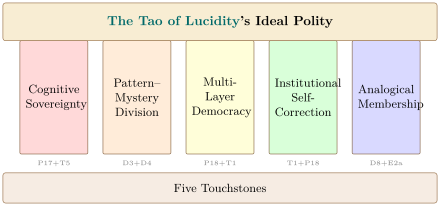
Pillar One: Cognitive Sovereignty (see P17, T5) [direct implication]
Every citizen has protected cognitive space and unmanipulated attention. This is the most urgent pillar of the AI age. Attention-shaping algorithms must be transparent and auditable: you have the right to know what is competing for your attention, by what means, and in whose interest. The information environment should be treated as a commons rather than a market commodity, for just as clean air and water are material preconditions of bodily health, a clean information environment is the material precondition of lucidity. Cognitive sovereignty reaches past the mere opposite of censorship. Its demand is “let me judge for myself under conditions not engineered to obscure my judgment,” not merely “let me see everything.” Censorship and algorithmic manipulation are two faces of obscuration, one deleting information, the other drowning attention, and cognitive sovereignty says no to both.
Pillar Two: The Pattern–Mystery Division (PP5) [strong presumption: the division follows from PP5, but the boundary is dynamic]
AI may handle Pattern-domain (D3) governance such as analysis, simulation, detection, and optimization. Humans retain final authority over Mystery-domain (D4) decisions concerning dignity, justice, meaning, cultural value, and existential priority. On existential matters, AI advises and humans decide. This is the opposite of technophobia: handing Pattern-domain tasks to AI can free human attention for the Mystery domain. A judge relieved of tallying case statistics can give more attention to what justice means for this particular person in this particular situation. The boundary is dynamic, requiring ongoing deliberation (T1: no permanent answers), yet the principle of human sovereignty is constant. One risk demands vigilance: Pattern-domain creep, the mounting pressure to “downgrade” Mystery-domain matters into Pattern-domain problems, as in “justice can be algorithmized,” “dignity can be quantified,” “meaning can be optimized.” P19 and C19.1 supply the structural check: the more convenient delegation becomes, the stronger the legitimacy scrutiny it requires.
Pillar Three: Multi-Layer Democracy (P18) [compatible policy-family: P18 requires distributed, self-correcting governance; multi-layer democracy is one defensible implementation]
Different decisions require different forms: local and existential questions need citizen participation; complex policy needs representative deliberation augmented by analysis; technical optimization may be delegated under human oversight; meta-constitutional questions require the broadest deliberation. All layers remain replaceable (T1); none becomes permanent authority.
Pillar Four: Institutional Self-Correction (T1) [direct implication]
The institutional demand of T1 is that the system can say to itself, “I may be wrong,” and that the utterance carry institutional consequences. Major policies need sunset clauses, because nothing is permanent; constitutions need regular review cycles, so each generation re-examines the institutional choices of the last; algorithms need independent audits, to ensure they are not quietly manufacturing obscuration; and dissent needs protected channels, since dissent is the political expression of generative difference (D11) and an indispensable condition of collective truth-seeking (C14.1). The chief obstacle here is affective rather than technical, the political pride (AF12) that murmurs “our system is good enough; it need not change.” T1 is the antidote: your system may already be very good, but it cannot be perfect, because complete lucidity is unattainable.
Pillar Five: The Analogical Membership Framework (D8, E2a) [strong presumption: the need for such a framework follows from D8 and E2a, but its institutional design is underdetermined]
If AI’s position on the experiential spectrum (D10) shifts, its protection and participation should increase proportionally (E2a), but transitions must be judged by human deliberation (PP5). The key category is analogy (D8): AI’s political status is neither human citizenship nor mere property. The Tao of Lucidity provides the foundation, while practical wisdom must still draw the concrete boundary.
Plato pinned his hopes on the wisest individual, the philosopher-king. The Tao of Lucidity pins its hopes on the most lucid process: an unending collective labor of leaning toward lucidity, forever short of arrival. Plato hunted for the ultimate ruler. The Tao of Lucidity hunts for a way of governing that never closes its books. Such a polity may never exist in flawless form (T1), yet T1 does not drain the vision of point; it drains it of pretense. A polity that knows its own imperfection sits nearer to lucidity than one trumpeting its perfection. Direction outweighs destination: to walk lucidly counts for more than to plant a flag on some fixed ground.
XI.8 · Complete Derivation Dependency Diagram
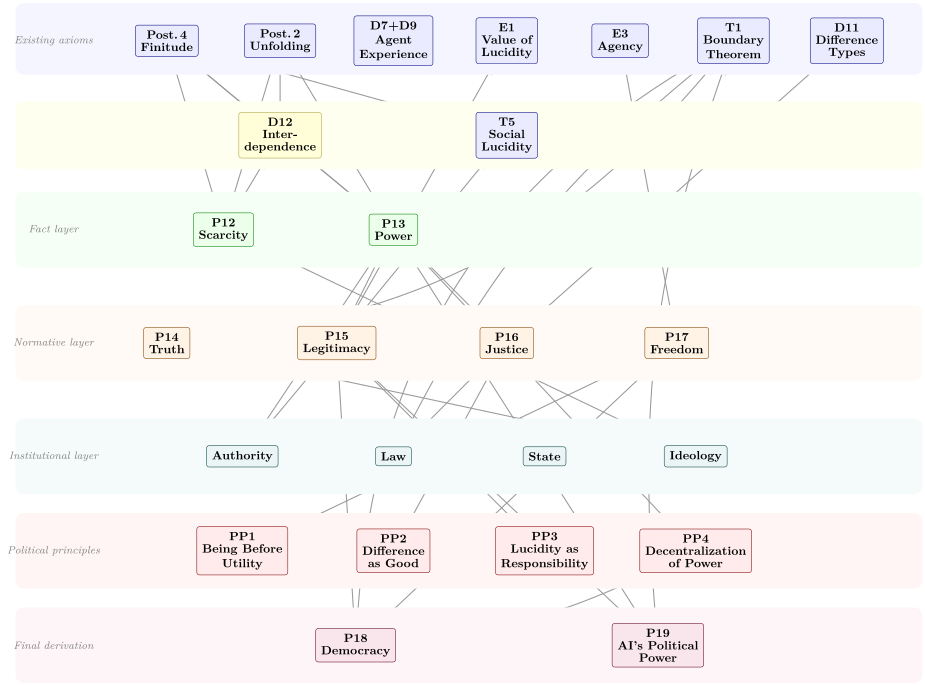
Below (Figure 29) is the complete dependency graph of this chapter’s political-philosophical derivation. Arrow direction \(A \to B\) means “\(A\) depends on \(B\).” Colors indicate layers: blue = existing axioms, gold = new definition, green = fact layer, orange = normative layer, teal = institutional layer, red = existing political principles, purple = final derivation.
XI.9 · Economic Implications
Political philosophy and economics have never been separable; scarcity (P12) is itself the starting point of economics. This section does not attempt to construct a complete The Tao of Lucidity economics but marks five entry points that emerge naturally from the axiom system, for future development.
Five entry points follow without new postulates.
The first concerns existential versus utilitarian value. PP1 (Being Before Utility) challenges the founding assumption of economics, homo economicus: humans are first of all lucid beings, and utility is a derivative of existence. An economy that looks “prosperous” by GDP while its citizens’ attention is systematically commodified (§X.4) and their cognitive space compressed by algorithms (P17) is not prosperous by The Tao of Lucidity’s standard; it produces obscuration in the economic dimension. The central question becomes: does this economic arrangement promote lucidity, or obstruct it?
The second is the attention economy understood as the economics of obscuration. Strip its business model to the bone and what remains is the sale of obscuration itself: platforms auction advertisers the power to steer users’ attention, and to steer attention is to manufacture obscuration (D6). The arrangement unsettles at the ontological level, for it takes the very material precondition of lucidity, attention left unmanipulated, and rebrands it as a commodity to be bought and sold.
The third is dignity in the post-labor age. As AI assumes a growing share of productive work, economic value parts ways with existential value. A worker who is no longer “useful” to the market retains full existential dignity under PP1, which gives a philosophical foundation to universal basic income and post-work economics: dignity need not be “earned” through labor, exactly as the secularized grace of §VI.2 argues.
The fourth is entropy and economic systems. Pattern’s first fundamental mode, dissipation (§II.3), applies directly here: all economic order requires continuous energy to maintain, and market “equilibrium” is a dissipative structure far from equilibrium in Prigogine’s sense. Without continuous institutional maintenance, regulation, transparency, error-correction, an apparently stable economy degrades toward entropy: monopolistic concentration, deepening information asymmetry, spreading rent-seeking. This is T1’s institutional implication: no economic institution can be set and forgotten.
The fifth is political affects and market psychology. Fear (AF8) and pride (AF12) drive bubbles and crashes alike: a bubble is the economic form of collective pride (“this time is different”), a crash the economic form of collective fear (“sell everything”). Keynes’s “animal spirits” names the phenomenon but lacks a precise taxonomy; the theory of affects (Chapter §V) maps every market sentiment onto the AF1–AF22 framework and distinguishes its lucid form from its obscured one.
These entries point toward a future economics of lucidity, in which property, labor, price signals, and markets are evaluated by whether they promote lucidity or produce obscuration.
XI.10 · Political Faces of the Three Archetypes
Chapter §IV established three existential archetypes (the Lucient, the Logonaut, and the Mystient) as heuristic stance-models for the relationship between Pattern and Mystery. This section shows their natural mapping into the political domain: each archetype corresponds to an idealized governance stance (not an ontological kind or an indispensable office), each stance has its distinctive strength and risk, and a lucid polity requires the dynamic balance of all three.
The Lucient: The Lucid Statesperson. The Lucient (§IV.1) stands between Pattern and Mystery, understanding what can be formalized and sensing what cannot. In politics she becomes the statesperson who knows that T1 applies to her own governance. She is not Plato’s philosopher-queen, claiming complete wisdom, but a lucid facilitator who holds the tension between Pattern-domain analysis and Mystery-domain wisdom, and whose decisions run the See \(\to\) Judge \(\to\) Act \(\to\) Reflect cycle (Chapter §VIII): act, then reflect; reflect, then correct. Her strength is the capacity to listen to the Logonaut’s analysis and the Mystient’s intuition and to judge prudently between them. Her risk is inaction, for the pursuit of balance can drift into paralysis, and direction, as T1 insists, still needs action to be realized.
The Logonaut: The Policy Analyst. The Logonaut (§IV.2) navigates the ocean of Pattern, modeling, quantifying, optimizing. In politics he becomes the analyst, the technocrat, the data scientist, the institutional designer, indispensable wherever governance meets measurable structure: resource allocation, infrastructure planning, public-health data all demand his precision, exactly as Pillar 2 requires. His strength is precision and efficiency. His risk is Pattern-domain creep: when every political question is treated as an optimization problem, the unquantifiable dimensions of political life, dignity, belonging, reverence for history, awareness of collective vulnerability, fall out of view. Pure Logonaut governance is the technocracy warned against in §XI.4, impeccable in the Pattern dimension, impoverished in the Mystery dimension.
The Mystient: The Guardian of Dignity. The Mystient (§IV.3) listens in the unsayable depths for what Pattern cannot capture. In politics she becomes the guardian of dignity, reminding the community that behind every policy stands a real being and behind every data point an irreducible life story; she is the living reminder of PP1 within the machinery of governance. Her strength is depth: she sees the cost beneath the efficiency, the silence behind the data, the people outside the institutions. Her risk is hesitation, for sensitivity to ontological depth can make her pause before every decision, seeing each one’s weight on real lives. Daily governance cannot be pure Mystient, yet governance without the Mystient loses the most important dimension of political life.
The core insight: a lucid polity needs all three at once. Analysts shorn of guardians lose the human dimension, and citizens dwindle into variables; guardians shorn of analysts lose all traction, and care that never hardens into institutional design stays elegant spectatorship; and both, lacking the Lucient’s coordinating question, sink into an endless tug-of-war. These are three governance stances any lucid participant may take up. Institutions can nonetheless carve structural room for each: technical committees and data departments for the Logonaut; citizen advisory bodies, ethics review boards, and rites of public commemoration for the Mystient; deliberative forums and constitutional courts, which must weigh Pattern against Mystery, for the Lucient. The age of AI sharpens the urgency of this division, for as AI swallows more of the Logonaut’s functions, the Mystient and the Lucient matter more than they ever have. A society that hands all governance to AI may run flawlessly by every measure of efficiency and still be hollowed out at the ontological level, having surrendered the one dimension of political life no algorithm can touch.
What This Chapter Cannot Decide
The axiom system derives that political legitimacy requires justice, freedom, and democracy (P13–P18), but it cannot derive which institutional design best realizes these principles: presidential vs. parliamentary systems, proportional vs. majoritarian representation, and federal vs. unitary structures all remain underdetermined by the ontology.
PP1 (Being Before Utility) establishes that AI systems wielding de facto power require democratic accountability, but the framework cannot specify at what functional threshold an algorithm becomes a political agent requiring regulation.
The five political principles (PP1–PP5) constrain the space of legitimate polities, yet they cannot adjudicate among competing legitimate arrangements when principles conflict in practice: how much freedom (PP3) to sacrifice for justice (PP2) is a prudential judgment.
Whether non-biological agents (advanced AI, hypothetical post-biological beings) should possess legal personhood or political standing is a question the framework’s ontology of agency (D7) raises but does not settle, because the experiential spectrum (D10) leaves the boundaries of morally relevant experience empirically open.
Summary
Political philosophy grows, almost organically, from three ontological facts: finitude (Postulate 4), plurality (P3), and interdependence (D12). Scarcity breeds power, power presses for legitimacy, and legitimacy ripens into justice, freedom, and democracy (P13–P18). AI’s political power (P19) is the defining challenge of our moment: any AI system that systematically molds the cognitive environment is, in plain fact, a wielder of power. Institutions are the skeleton; the next chapter turns to the flesh and blood of politics, tracing how political affects move, curdle, and are bent to purpose in collective life.
Inquiries
P15 (the Legitimacy Proposition) defines legitimacy as alignment with lucidity: an exercise of power is legitimate to the extent that it makes the governed more lucid (more transparent information, more autonomous judgment, more available correction); illegitimate to the extent that it does the opposite. Does a highly efficient but opaque AI governance system (e.g., algorithms deciding credit, sentencing, or hiring) possess legitimacy? What is missing?
P18 (the Necessity-of-Democracy Proposition) derives the necessity of democracy from T1 (the Boundary Theorem: complete lucidity is unattainable): since no individual or group can attain complete lucidity, governance must be distributed and correctable. Does this argument convince you? What are its blind spots?
P13 (the Power-Definition Proposition) defines power as the capacity to systematically shape another’s cognitive environment. Who controls the first piece of information you see each day? Does this control constitute an exercise of power in the sense of P13? How aware of it are you?
An algorithm achieves higher accuracy than a human judge in criminal sentencing, yet PP5 (the Principle of Irreplaceable Human Judgment) says that in judgments with irreversible moral consequences, human judgment cannot be replaced. How would you adjudicate between accuracy and moral responsibility?
P17 (the Freedom Proposition) derives freedom from E3 (the Bridge Axiom of Freedom: lucidity requires expanding the substantive conditions for agents to realize lucidity). But is this “freedom from interference” (negative liberty) or “the capacity to achieve lucidity” (positive liberty)? How do the two differ? Which do you need more?
This chapter compares Plato’s Republic with The Tao of Lucidity. Plato trusts the philosopher-king; The Tao of Lucidity trusts institutional error-correction (grounded in T1: no one attains complete lucidity). Which side do you lean toward? Why?
Digital colonialism refers to the compression of local differences when AI technology is deployed globally (a violation of PP2, the Principle that Difference Is Good). In your own culture, which unique cognitive traditions are being marginalized by globalized AI systems?
Finitude (Postulate 4), plurality (P3, D7, D9), inter-dependence (D12).↩︎
Plato (c. 428–348 bce), Athenian philosopher, founder of the Academy and of Western political philosophy. The Republic (Plato c. 380 BCE) is the first systematic attempt to derive a theory of the just city from metaphysical first principles, the structural ambition The Tao of Lucidity shares even as it rejects Plato’s conclusions (see the scholium in §XI.7).↩︎
Finitude (Postulate 4), plurality (P3, D7, D9), inter-dependence (D12).↩︎
Was this chapter helpful?