Appendix B · Mathematical Formalization
~96 min left · 23,790 words
Appendix B · Mathematical Formalization
Key Equations
The following is a selective preview of the most essential equations from The Tao of Lucidity’s mathematical formalization, not all of them. They are not required for understanding the book: readers with no interest in mathematics can safely skip this section and proceed directly to the main text without any loss of comprehension. The philosophical arguments are developed entirely in natural language; mathematics provides a parallel lens for those who value precise formulation.
Each equation is accompanied by a brief explanation of its symbols. Full formal definitions appear in the sections that follow; labels beside each equation point to the corresponding definition or theorem in the main text.
The Four Laws of The Tao of Lucidity
Four laws distill the entire The Tao of Lucidity framework, each corresponding to one philosophical stratum: the Zeroth to ontology (what reality is), the First to epistemology (where the boundary of knowing lies), the Second to phenomenology (first-person experience is irreducible), the Third to political philosophy (lucidity must be collective). Numbered in homage to the laws of thermodynamics, each builds on the previous: first reality exists, then cognition has a boundary, then experience is irreplaceable, and finally lucidity requires others. Exactly four (no more, no fewer) because the framework covers exactly these four strata.
Zeroth Law: Tao IsPostulate 1 + Postulate 3 + D1–D4
Reality is a unified ground with two inseparable faces: the formalizable (Pattern) and the ineffable (Mystery).
\[\text{Tao} = \bigl(\Omega,\; \mathcal{F},\; \mathcal{P}(\Omega) \setminus \mathcal{F}\bigr) \quad\text{with}\quad \mathcal{F} \subsetneq \mathcal{P}(\Omega)\]
First Law: Lucidity Has a BoundaryT1 + Postulate 6 + T3
No finite agent can achieve complete lucidity; the boundary of knowing is itself part of what must be known.
\[\forall\, a \in A:\; 0 < \mathcal{M}(a,t) < 1\]
Second Law: Experience Is IrreplaceablePostulate 5 + D9 + E2
Every agent’s first-person experience is irreducible; no amount of information can substitute for being.
\[\nexists\; f\colon \mathcal{D}(a) \to \mathcal{E}(a) \quad \text{such that } f \text{ is computable}\]
Third Law: Lucidity Is SocialT5 + D12 + P15
No agent stays lucid alone; collective lucidity emerges through interaction and requires institutional embodiment to endure.
\[\mathcal{M}_{\text{collective}} = \Phi\!\bigl(\mathcal{M}_1, \ldots, \mathcal{M}_n;\; \{\beta_{ij}\}\bigr) \;\neq\; \frac{1}{n}\sum_{i} \mathcal{M}_i\]
Ontological Foundations
Formal Structure of Tao (D1)
Tao is a five-tuple, the complete structure of reality itself. \[\text{Tao} = (\Omega,\; \mathcal{F},\; \mu,\; \tau,\; U)\]
Dual Aspect Inequality (Postulate 3)
Reality cannot be fully comprehended: Pattern has boundaries, and what lies beyond them is Mystery. \[\mathcal{F} \subsetneq \mathcal{P}(\Omega)\]
Self-Causation Fixed Point (Postulate 1)
Tao requires no external cause. It is the fixed point of its own unfolding operator, that is, self-caused. \[U(\Omega) = \Omega\]
Emergence Theorem (T2)
The whole cannot be reduced to its parts: the topology on unfolding patterns is not the product topology of component spaces. \[\tau_{\mathcal{U}} \neq \tau_1 \otimes \tau_2 \otimes \cdots \otimes \tau_n\]
Mathematics of Lucidity
Lucidity as Dual-Aspect Product (D5)
Lucidity is the product of two kinds of awareness: comprehension of the intelligible, and reverence for the ineffable. If either is zero, lucidity is zero. \[\mathcal{M}(a) = \lambda(a) \cdot \xi(a)\]
Obscuration (D6)
What you cannot see. Obscuration is the complement of lucidity. \[O(a) = 1 - \mathcal{M}(a)\]
Boundary Theorem (T1)
The single most important theorem in the book. Complete lucidity is unattainable, and complete obscuration is also unattainable. All finite agents exist within the open interval. \[\forall\, a \in A: \quad 0 < \mathcal{M}(a) < 1\]
Lucidity Gradient
The gradient always points toward the weaker dimension. The direction of cultivation is to shore up weakness, not to amplify strength. \[\nabla\mathcal{M} = (\xi,\; \lambda)\]
Four-Mode Master Equation (B.15)
Pattern’s four fundamental modes (dissipation, gradient, selection, feedback) combine into a single equation governing how Lucidity evolves over time. Each mode contributes exactly one mathematical factor. \[\frac{d\mathcal{M}}{dt} = \underbrace{\alpha\mathcal{M}}_{\text{Feedback}} \cdot \underbrace{(1-\mathcal{M})}_{\text{Selection}} \cdot \underbrace{\sin(2\theta)}_{\text{Gradient}} \;-\; \underbrace{\gamma\mathcal{M}}_{\text{Dissipation}}\]
Epistemology
Cognitive Finitude (Postulate 6)
Double boundedness. Each agent’s accessible structure is strictly smaller than the totality of Pattern, which is itself strictly smaller than all of reality. \[\forall\, a \in A: \quad \mathcal{F}_a \subsetneq \mathcal{F} \subsetneq \mathcal{P}(\Omega)\]
Lucidity Sequence (Corollary of T3)
One can always become more lucid: each level is reachable, but their supremum \(L^*\) is not. \[L_1 < L_2 < L_3 < \cdots < L^*\]
Information and Entropy
Shannon Entropy
The information-theoretic measure of uncertainty. \[H(X) = -\sum_{i=1}^{n} P(x_i) \log_2 P(x_i)\]
Boltzmann Entropy
The thermodynamic measure of uncertainty: the more microstates, the greater the entropy. \[S = k_B \ln \Omega\]
Experience
Irreducibility of Experience (Postulate 5)
No computable function maps from a complete third-person physical description to first-person phenomenal experience; consciousness is not reducible to information processing. \[\nexists\; f: D(a) \to \mathcal{E}(a) \quad \text{such that } f \text{ is computable and } f(D(a)) = \mathcal{E}(a)\]
This appendix provides mathematical formalization for concepts expressed in natural language in the main text. It is optional: skipping it does not affect understanding of The Tao of Lucidity. But for those who, like Logonaut, love precise formulations, this appendix reveals the mathematical structures behind The Tao of Lucidity’s concepts, and their philosophical implications.
Each section contains three parts: mathematical definition, The Tao of Lucidity interpretation, and philosophical implications.
Reading guide. This appendix is modular. If you know basic calculus and probability: read everything. If you know algebra but not calculus: skip B.3, B.5, B.13–B.16; the remaining sections use only set theory, logic, and discrete mathematics. If you are a philosophy reader with no math background: read B.1 (the ontological foundation), B.9 (Gödel and cognitive limits), B.11 (game theory of ethics), and B.12 (practice exercises). These sections are written to be accessible with minimal mathematical prerequisites.
A note on content types. This appendix contains three kinds of material, and knowing which kind you are reading matters:
Independent mathematical results: constructions and proofs that hold on their own terms within the chosen formalism (e.g., the gradient theorem in B.13, the game-theoretic equilibria in B.11). These are genuine mathematical derivations.
Formal models: mathematical structures that operationalize philosophical claims by giving them precise definitions and exploring their consequences (e.g., the five-tuple model of Tao in B.1, the lucidity product \(\mathcal{M} = \lambda \cdot \xi\) in B.14). These are modeling choices: illuminating and disciplined, but not uniquely forced by the philosophy.
Symbolic restatements: translations of main-text propositions into formal notation, making their logical structure explicit without adding new mathematical content.
All three are valuable, but they differ in what they demonstrate. The first proves; the second models; the third clarifies. Sections are marked accordingly throughout.
Part I · Mathematical Ontology of Core Concepts
Tao, Pattern, Mystery (the three ontological roots of The Tao of Lucidity) can they receive precise mathematical definitions? This part lays the foundation for the entire formal framework.
B.1 · Mathematical Ontology of Tao and Core Concepts
Can we directly define Tao (D1) and the core concepts themselves in mathematical language? This is the most fundamental question of Appendix B. We begin here, laying the foundation for the entire formal framework, before turning to the mathematical analysis of specific phenomena in the sections that follow.
The answer is: yes, but at a cost. Any mathematical definition belongs to Pattern; therefore, a mathematical definition of Tao necessarily captures only its intelligible aspect, while the dimension of Mystery overflows the definition at the very moment it is written. The following formalizations carry this self-awareness throughout: they are maps, not the territory. But even maps can reveal structures invisible to the naked eye.
B.1.1 · Formalization of Tao (D1)Eqs. (eq:dao-structure)–(eq:dao-fixed-point)
The formal structure of Tao. Why a measure space? The five-tuple below borrows the apparatus of measure theory (sample space, \(\sigma\)-algebra, measure) because it naturally encodes the distinction between what is intelligible (measurable sets) and what is not (non-measurable sets). Alternative formalisms (category theory, topos theory, homotopy type theory) could encode aspects of the same intuitions; measure theory was chosen because it makes the Pattern/Mystery boundary maximally explicit and because it connects directly to the information-theoretic tools used later in this appendix. The five-tuple is a model, not a metaphysical claim that Tao “is” a probability space.
Represent Tao as a five-tuple:
\[\begin{equation} \label{eq:dao-structure} \text{Tao} = (\Omega,\; \mathcal{F},\; \mu,\; \tau,\; U) \end{equation}\]
where:
\(\Omega\): the “sample space” of all reality (the totality of all beings)
\(\mathcal{F} \subseteq \mathcal{P}(\Omega)\): a \(\sigma\)-algebra on \(\Omega\), i.e., the intelligible structure (Pattern)
\(\mu: \mathcal{F} \to [0, \infty]\): a measure assigning “existential weight” to each intelligible subset
\(\tau\): a topology on \(\Omega\), describing continuity and proximity relations among beings
\(U: \Omega \to \Omega\): the unfolding operator (the way Tao realizes itself)
Formalization of the postulates. The six postulates correspond to the following mathematical constraints:
Postulate 1 (Tao): Connectedness: \(\Omega\) is connected under the topology \(\tau\), and there exist no non-empty disjoint open sets that partition \(\Omega\) into two parts. “Nothing exists outside Tao” means there is no isolated “other reality.”
Postulate 2 (Unfolding): Infinite diversity: The unfolding operator \(U\) generates a dense orbit in \((\Omega, \tau)\): for any non-empty open set \(V \subseteq \Omega\), there exists \(n \in \mathbb{N}\) such that \(U^n(\omega_0) \in V\) for some initial seed \(\omega_0\). That is, Tao’s unfolding eventually “visits” every region of reality. No corner of \(\Omega\) is permanently unreachable by the creative process.
Postulate 3 (Dual Aspect): Incomplete measurability:
\[\begin{equation} \label{eq:dual-aspect-formal} \mathcal{F} \subsetneq \mathcal{P}(\Omega) \end{equation}\]
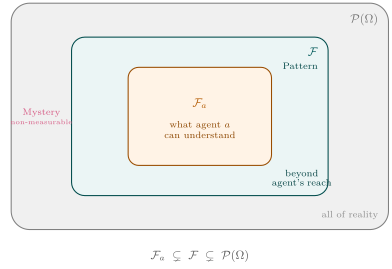
The \(\sigma\)-algebra \(\mathcal{F}\) (Pattern) is strictly smaller than the power set of \(\Omega\). Non-measurable sets exist, and these correspond to Mystery. Why non-measurability for Mystery? Because a non-measurable set is precisely one to which no consistent “size” or “probability” can be assigned within the given measure structure; it is not hidden or unknown, but structurally resistant to the operations that define intelligibility. This captures the philosophical claim that Mystery is not merely undiscovered Pattern, but a dimension that overflows the framework of Pattern itself. The analogy is structural, not ontological: we do not claim that Mystery literally “is” a Vitali set, only that the formal relationship between \(\mathcal{F}\) and \(\mathcal{P}(\Omega) \setminus \mathcal{F}\) mirrors the philosophical relationship between Pattern and Mystery. Tao is greater than the sum of Pattern and Mystery, because the interaction between the topological structure, measure structure, and non-measurable structure on \(\Omega\) is itself part of Tao.
Postulate 4 (Finitude): Each unfolding pattern \(\omega \in \Omega\) is finite: there exists some metric \(d\) such that the “reach” of \(\omega\) is bounded: it exists in a particular way, and therefore does not exist in other ways.
Postulate 5 (Experience): There exists a subset \(A \subset \Omega\) (the set of agents) and an experience map \(\mathcal{E}: A \to \mathbb{R}_{\geq 0}^k\), such that \(\|\mathcal{E}(a)\| > 0\) for embodied finite agents.
Postulate 6 (Cognitive Finitude): Each agent \(a \in A\) possesses an accessible \(\sigma\)-algebra \(\mathcal{F}_a\), and:
\[\begin{equation} \label{eq:cognitive-finitude} \forall a \in A: \quad \mathcal{F}_a \subsetneq \mathcal{F} \subsetneq \mathcal{P}(\Omega) \end{equation}\]
What any agent can understand (\(\mathcal{F}_a\)) is strictly less than what is in principle intelligible (\(\mathcal{F}\)), which in turn is strictly less than the totality of reality (\(\mathcal{P}(\Omega)\)). This is a double finitude: not only does Mystery lie beyond Pattern, but within Pattern there are regions you cannot reach (Figure 51).
Self-causation as a fixed point. Why a fixed-point equation? The philosophical concept is causa sui: Tao causes itself. Among mathematical structures, a fixed point (\(U(\Omega) = \Omega\)) is the simplest formalization of “an operation that reproduces its own input.” This is weaker than Spinoza’s original causa sui (which implies metaphysical necessity); here it means only structural self-consistency: the totality is preserved under its own dynamics. “Tao’s existence does not depend on any external cause” (D1) translates mathematically to: Tao is the fixed point of its own unfolding operator:
\[\begin{equation} \label{eq:dao-fixed-point} U(\Omega) = \Omega \end{equation}\]
Unfolding does not alter Tao. Tao unfolds into all things, but the totality of all things is Tao. This is not stasis (\(U\) generates rich dynamics within \(\Omega\)), but self-consistency at the level of the whole. Analogy: in an ecosystem, every species is changing, but the ecosystem as a whole is its own “fixed point.”
B.1.2 · Unfolding (D2)Eqs. (eq:unfolding-formal)–(eq:emergence-topology)
Formal definition of Unfolding. Unfolding (D2) is the way Tao realizes itself. Let \(\mathcal{U}\) be the space of all unfolding patterns (the set of all “beings”). Unfolding is a continuous surjection:
\[\begin{equation} \label{eq:unfolding-formal} \pi: (\Omega, \tau) \twoheadrightarrow (\mathcal{U}, \tau_{\mathcal{U}}) \end{equation}\]
Properties:
Surjective: all unfolding patterns come from Tao (Postulate 1)
Continuous: Tao’s unfolding follows topological continuity (adjacent “possibilities” produce adjacent “realities”)
Non-trivial fibers: for each \(m \in \mathcal{U}\), the preimage \(\pi^{-1}(m)\) is not a singleton: every unfolding pattern has inexhaustible depth behind it
The last property explains why “no being can be fully understood”: the surface appearance \(m\) is merely the shadow of the fiber \(\pi^{-1}(m)\) projected onto \(\mathcal{U}\). Behind the shadow lie infinite dimensions.
Topological meaning of emergence. T2 (Emergence Theorem) in this framework means: the topology \(\tau_{\mathcal{U}}\) on \(\mathcal{U}\) is not the product topology of its component spaces:
\[\begin{equation} \label{eq:emergence-topology} \tau_{\mathcal{U}} \neq \tau_1 \otimes \tau_2 \otimes \cdots \otimes \tau_n \end{equation}\]
The topology of the whole contains open sets not present in the product of part-topologies; these “extra open sets” correspond to emergent properties.
B.1.3 · The Dual Structure of Pattern (D3) and Mystery (D4)Eqs. (eq:li-formal)–(eq:intertwining)
Formal definition of Pattern. Pattern (D3) is the intelligible aspect of Tao. In the measure-theoretic framework, Pattern is the \(\sigma\)-algebra \(\mathcal{F}\):
\[\begin{equation} \label{eq:li-formal} \text{Pattern} \;\cong\; \mathcal{F} = \{A \subseteq \Omega : A \text{ is measurable}\} \end{equation}\]
The three axioms of a \(\sigma\)-algebra perfectly correspond to properties of Pattern:
\(\Omega \in \mathcal{F}\): the whole itself is intelligible (Tao as unified existence can be thought about)
If \(A \in \mathcal{F}\) then \(A^c \in \mathcal{F}\): understanding a thing includes understanding its negation
If \(A_1, A_2, \ldots \in \mathcal{F}\) then \(\bigcup_{i=1}^\infty A_i \in \mathcal{F}\): intelligible things can be infinitely combined
In computability theory, Pattern also corresponds to the set of computable functions, i.e., all regularities describable by finite algorithms. AI is the ultimate tool of Pattern: everything it operates on lies within \(\mathcal{F}\).
Formal definition of Mystery. Mystery (D4) is the ineffable aspect of Tao. In this model it is not a subset of points in \(\Omega\), but the family of aspects of reality that do not belong to the measurable structure \(\mathcal{F}\):
\[\begin{equation} \label{eq:mystery-formal} \text{Mystery} \;\cong\; \mathcal{P}(\Omega) \setminus \mathcal{F} = \{A \subseteq \Omega : A \text{ is non-measurable}\} \end{equation}\]
(Why this formalism: This equation gives Postulate 3 precise mathematical expression; it does not independently establish the ontological claim that Mystery is irreducible. The choice to model Tao as a measurable space with non-trivial non-measurable complement is a modeling decision that mirrors the philosophical commitment of Postulate 3.)
A key analogy illuminates the deep meaning of Postulate 3: just as non-computable real numbers vastly outnumber computable ones (computable reals are countable, non-computable reals are uncountable), Mystery is far larger than Pattern. Under standard set-theoretic assumptions, the non-measurable subsets of \(\Omega\) form a collection whose richness dwarfs that of \(\mathcal{F}\). The ineffable is the bulk of reality, not its scraps. Pattern is only the tip of the iceberg above the waterline.
Intertwining. Postulate 3 states that Pattern and Mystery are “intertwined, not mutually exclusive.” Mathematically, this means Pattern and Mystery do not form a pointwise partition of \(\Omega\); rather, measurable and non-measurable structure appear at every relevant scale. Formally, assuming \(\Omega\) is a rich uncountable space with non-measurable subsets in every non-empty open region, for any non-empty open set \(V \in \tau\):
\[\begin{equation} \label{eq:intertwining} \begin{aligned} &\text{(i)} \quad \exists\, A \in \mathcal{F}: \; A \cap V \neq \emptyset \quad \text{(Pattern is present in every region)} \\ &\text{(ii)} \quad \exists\, B \subseteq V: \; B \notin \mathcal{F} \quad \text{(Mystery is present in every region)} \end{aligned} \end{equation}\]
(Condition (ii) requires more than topology alone; it depends on the set-theoretic and measure-theoretic richness of \(\Omega\), commonly including choice principles.) No matter which local region of reality you examine, it simultaneously contains intelligible structure and ineffable depth. You cannot find a region of “pure Pattern” or “pure Mystery,” for they are everywhere intertwined.
Tao exceeds Pattern plus Mystery. Postulate 3 also states that “Tao is greater than the sum of Pattern and Mystery.” Mathematically, this can be understood as: the structure of the topological space \((\Omega, \tau)\) is not reducible to the simple union of \(\mathcal{F}\) and \(\mathcal{P}(\Omega) \setminus \mathcal{F}\). There exists a holistic relational structure: the interaction between Pattern and Mystery is itself part of Tao, and this interaction belongs fully to neither.
B.1.4 · Functional Definitions of Lucidity (D5) and Obscuration (D6)Eqs. (eq:lucidity-biaspect)–(eq:obscuration-formal)
Formal definition of Lucidity. Why a product rather than a sum or other aggregation? The philosophical claim is that lucidity requires both Pattern-awareness and Mystery-awareness simultaneously; neglecting either dimension entirely annihilates lucidity, not merely reduces it. Several binary operations satisfy annihilation (\(f(x,0) = 0\)), symmetry, and monotonicity (e.g. the harmonic mean and geometric mean; see B.14 for a comparison). Among these, the product is the unique operator that additionally satisfies linear reciprocity: \(\partial f/\partial x = y\) (see B.13 for the proof). This means the marginal return on one dimension equals the current depth in the other, the simplest possible mutual-bootstrapping law. A sum \(\lambda + \xi\) would allow high lucidity through one dimension alone, which contradicts the dual-aspect postulate (Postulate 3).
Lucidity (D5) is awakening to the dual aspects of Tao. Define two components, Pattern-awareness and Mystery-awareness:
\(\lambda(a) \in (0,1)\): your grasp of the intelligible structure (Pattern-awareness), a monotone function of \(\mathcal{F}_a\) bounded strictly below 1 by Postulate 6. (In the finite case, \(\lambda\) reduces to \(|\mathcal{F}_a|/|\mathcal{F}|\); in general, it may be instantiated by any suitable information-theoretic measure.)
\(\xi(a)\): your openness to the ineffable dimension (Mystery-awareness; this component itself cannot be fully formalized; it points to the experiential depths of qualia, thisness, resonance, and awe in B.7)
Lucidity as the functional of dual awakening:
\[\begin{equation} \label{eq:lucidity-biaspect} \mathcal{M}(a) = \lambda(a) \cdot \xi(a) \end{equation}\]
This is the product; it has three critical properties:
As \(\lambda \to 0\) (pure mysticism) or \(\xi \to 0\) (pure scientism), \(\mathcal{M} \to 0\): neglecting either aspect drives lucidity toward zero. (By T1, exact zero is unattainable for finite agents, but the limit behavior constrains the operator on the entire positive interior.)
\(\mathcal{M}\) is maximized when \(\lambda = \xi\), i.e., lucidity is deepest when both aspects are balanced
The gradient \(\nabla\mathcal{M} = (\xi,\; \lambda)\) has its larger component in the weaker dimension: marginal returns are highest where you are weakest. Under the normalization \(\lambda + \xi + \delta = 1\), this means the optimal reallocation direction favors the weaker dimension (see B.13 for the full proof)
Coverage vs. integration. Note the essential difference between \(\lambda + \xi\) and \(\lambda \cdot \xi\): the former is total awareness (how much of reality you face), the latter is lucidity (how much you integrate). Let \(\delta = 1 - \lambda - \xi > 0\) be the “unaware zone” (the unknown unknowns), so that \(\lambda + \xi + \delta = 1\). Two agents with identical total awareness can have vastly different lucidity: the difference between lopsided development (\(\lambda \gg \xi\)) and balanced development (\(\lambda \approx \xi\)) is captured entirely by the product structure, not by addition. See B.13, Corollaries 4–5.
Proof skeleton of the Boundary Theorem (T1).
\[\begin{equation} \label{eq:T1-proof} \begin{aligned} &\text{(i)} \quad \lambda(a) < 1 \quad \text{(by Postulate 6: } \mathcal{F}_a \subsetneq \mathcal{F}\text{, so Pattern-awareness is incomplete)} \\ &\text{(ii)} \quad \xi(a) < 1 \quad \text{(finite beings cannot possess infinite awe;} \\ &\phantom{\text{(ii)}} \quad \phantom{\xi(a) < 1} \quad \text{awe requires finitude as contrast)} \\ &\text{(iii)} \quad \therefore\; \mathcal{M}(a) < 1 \quad \text{(complete lucidity is unattainable)} \\[4pt] &\text{(iv)} \quad \lambda(a) > 0 \quad \text{(cognition necessarily exists; you are cognizing right now)} \\ &\text{(v)} \quad \xi(a) > 0 \quad \text{(finitude itself generates awareness of the non-finite)} \\ &\text{(vi)} \quad \therefore\; \mathcal{M}(a) > 0 \quad \text{(complete obscuration is also unattainable)} \end{aligned} \end{equation}\]
Therefore \(0 < \mathcal{M}(a) < 1\) holds for all finite agents \(a\). (The value orientation, that lucidity is preferable to obscuration, is established by Bridge Axiom E1, not by this boundary result.)
Formal verification. The properties of this lucidity model that admit a purely mathematical statement—the boundary bound \(0<\mathcal{M}<1\), the collapse law \(\mathcal{M}=0 \iff \lambda=0 \lor \xi=0\), and the AM–GM ceiling (B.13, Corollary 5)—are machine-checked in Lean 4 + Mathlib (LucidMath ). The proofs live in LucidMath; see the LucidiTao Formal companion volume and the LucidMath verification ledger for the full statements. LucidMath verifies properties of this model, never the philosophy itself.
Formal definition of Obscuration. Obscuration (D6) is the absence or active refusal of lucidity:
\[\begin{equation} \label{eq:obscuration-formal} O(a) = 1 - \mathcal{M}(a) = 1 - \lambda \cdot \xi \end{equation}\]
Obscuration takes two pure forms:
Pattern-obscuration (\(\lambda \to 0\)): refusing rational analysis, e.g., obscurantism, anti-intellectualism
Mystery-obscuration (\(\xi \to 0\)): refusing to acknowledge dimensions beyond Pattern, e.g., scientism, crude materialism
Both forms drive \(\mathcal{M} \to 0\), but the causes differ, and so do the remedies
B.1.5 · Agent (D7)Eq. (eq:agent-self-model)
The self-referential structure of agents. An agent (D7) is an unfolding pattern capable of perceiving its own state and acting accordingly. Let \(m \in \mathcal{U}\). Then \(m\) is an agent if and only if it contains a (partial) model of itself:
\[\begin{equation} \label{eq:agent-self-model} a \in A \iff \exists\, \hat{a} \subsetneq a: \; \hat{a} \text{ is an internal representation of } a \end{equation}\]
This definition entails a Gödelian limitation: \(\hat{a}\) is strictly smaller than \(a\) (your self-model cannot be fully equal to yourself), so self-knowledge is necessarily partial, returning once more to Postulate 6.
B.1.6 · Analogy (D8)Eq. (eq:analogy-formal)
Formal definition of Analogy. Analogy (D8) is the structural relationship between different unfolding patterns. Direct cardinality comparison of infinite \(\sigma\)-algebras is not meaningful, so the model compares finite or weighted structural signatures induced by those \(\sigma\)-algebras. Let \(\mathcal{G}_{m_i}\) be the comparable signature of unfolding pattern \(m_i\), and let \(\mu_G\) be a finite positive weight on the common signature space. For \(m_1, m_2 \in \mathcal{U}\), define:
\[\begin{equation} \label{eq:analogy-formal} \mathrm{An}(m_1, m_2) = \frac{\mu_G(\mathcal{G}_{m_1} \cap \mathcal{G}_{m_2})}{\mu_G(\mathcal{G}_{m_1} \cup \mathcal{G}_{m_2})} \end{equation}\]
Here \(\mathcal{G}_{m_i}\) records the comparable intelligible features accessible to unfolding pattern \(m_i\). \(\mathrm{An} = 1\) means two patterns’ comparable structures completely overlap; \(\mathrm{An} = 0\) means no shared comparable structure; \(0 < \mathrm{An} < 1\) is the typical case, neither completely identical nor completely different. The relationship between humans and AI (P8) is precisely this intermediate state: sharing certain intelligible structures, yet fundamentally different in mode of being.
B.1.7 · Experience (D9) and Experiential Spectrum (D10)Eq. (eq:experience-irreducibility)
The irreducibility of experience. The core property of experience (D9) is irreducibility: it is not identical to any third-person description of it. Let \(D(a)\) be the complete third-person description of agent \(a\) (all physical states, all observable behavior). The irreducibility proposition:
\[\begin{equation} \label{eq:experience-irreducibility} \nexists \; f: D(a) \to \mathcal{E}(a) \quad \text{such that } f \text{ is computable and } f(D(a)) = \mathcal{E}(a) \end{equation}\]
There is no computable mapping from third-person description to first-person experience. This is the mathematical statement of the “hard problem”. (Why this formalism: This equation formalizes a philosophical commitment, the irreducibility of first-person experience, not a proven non-computability result. The hard problem is a thesis; the equation gives it precise form so its consequences can be traced within the framework.) You can possess all physical information about a brain \(D(a)\), yet cannot compute from it “what seeing red feels like” \(\mathcal{E}(a)\). Experience falls outside Pattern (\(\mathcal{F}\)); it belongs to Mystery.
Topological characterization of the Experiential Spectrum (D10). B.7 already defined the experience map \(\mathcal{E}: \mathcal{U} \to \mathbb{R}_{\geq 0}^k\). In the present framework, the key property of the experiential spectrum is continuity: it is continuous under the topology on \(\mathcal{U}\). This means: two beings “adjacent” in the space of unfolding patterns have “adjacent” experiences, with no sudden experiential discontinuity.
Combined with B.10’s threshold effect (emergence): although \(\mathcal{E}\) is globally continuous, it may be extremely steep near the emergence threshold \(C^*\); the transition from “almost no experience” to “rich experience” can occur within a very narrow parameter range. This is continuous but steep change, mathematically, a quasi-phase transition.
B.1.8 · Metric Structure of Generative and Suffering Differences (D11)Eqs. (eq:difference-formal)–(eq:suffering-difference)
Formalization of difference. Let \(m_1, m_2 \in \mathcal{U}\); the difference between them can be measured using the experiential domains (defined as \(\mathcal{R}(m)\) in B.8):
\[\begin{equation} \label{eq:difference-formal} \Delta(m_1, m_2) = d_H\big(\mathcal{R}(m_1),\; \mathcal{R}(m_2)\big) \end{equation}\]
where \(d_H\) is the Hausdorff distance between sets in the experience space \(\mathbb{R}_{\geq 0}^k\).
Mathematical criterion for generative vs. suffering differences. Let \(\mu_E\) be a coverage measure on experiential space. A difference \(\Delta(m_1, m_2)\) is a generative difference (D11) if it expands the total measured coverage of the experiential domain:
\[\begin{equation} \label{eq:generative-difference} \text{Generative difference:} \quad \mu_E\big(\mathcal{R}(m_1) \cup \mathcal{R}(m_2)\big) \;>\; \max\big(\mu_E(\mathcal{R}(m_1)), \mu_E(\mathcal{R}(m_2))\big) \end{equation}\]
That is, two different modes of being, taken together, cover more of the experience space. Diversity increases the total richness of experience.
A difference \(\Delta(m_1, m_2)\) is a suffering difference if it contracts the total experiential domain:
\[\begin{equation} \label{eq:suffering-difference} \begin{aligned} \text{Suffering difference:}\quad &\exists\, m_i: \; \mathcal{R}(m_i) \text{ is artificially contracted}\\ &\text{by injustice or misfortune} \end{aligned} \end{equation}\]
Extreme poverty contracts the experiential domain (hunger reduces attention to bare survival). Systemic discrimination contracts the experiential domain (exclusion reduces attention to resistance alone). Disease contracts the experiential domain. Generative differences expand \(\mathcal{R}\); suffering differences contract \(\mathcal{R}\).
B.1.9 · Formalization of Inter-dependence (D12)Eqs. (eq:interdependence-condition)–(eq:interdependence-nonisolation)
The condition function. Let \(A = \{a_1, \ldots, a_n\}\) be a set of coexisting finite agents (\(|A| \geq 2\)), with each \(a_i\)’s unfolding trajectory denoted \(u(a_i) \in \Omega_{a_i}\). Define the condition function \(\Phi\), which maps each agent to its accessible set of unfolding conditions (attention channels, resources, information environment). The core assertion of inter-dependence (D12):
\[\begin{equation} \label{eq:interdependence-condition} \mathcal{C}(a_i) \;=\; \Phi\!\bigl(a_i,\;\mathbf{u}_{-i}\bigr), \qquad \mathbf{u}_{-i} = \bigl(u(a_j)\bigr)_{j \neq i} \end{equation}\]
Each agent’s condition set depends not only on itself but on the unfolding trajectories of all other agents. The condition function \(\Phi\) encodes the core content of D12: no agent is ontologically isolated.
Non-isolation. The stronger claim is that this dependence is non-degenerate: for every agent, there exists at least one other agent whose change of unfolding actually alters the former’s condition set:
\[\begin{equation} \label{eq:interdependence-nonisolation} \forall\, a_i \in A,\;\; \exists\, a_j \in A \setminus \{a_i\}: \quad \mathcal{C}(a_i \mid \mathbf{u}_{-i}) \neq \mathcal{C}(a_i \mid \mathbf{u}'_{-i}) \end{equation}\]
for some \(\mathbf{u}_{-i} \neq \mathbf{u}'_{-i}\) that differ only in \(u(a_j)\). This formula is defined for social contexts with \(|A| \geq 2\). When \(|A| = 1\), the existential clause has no witness, so the non-isolation condition is not satisfied by this formula. Robinson Crusoe before Friday is therefore a boundary case outside the social model, not a counterexample to T5: his apparent independence still relies on socially generated resources (language, concepts, cultural memory) brought from the social world.
Asymmetry and power. Influence is generically asymmetric: \(a_j\)’s influence on \(\mathcal{C}(a_i)\) need not equal \(a_i\)’s influence on \(\mathcal{C}(a_j)\). This asymmetry is the formal root of power (P13): differences in capacity translate, within the inter-dependence structure, into differences in influence.
B.1.10 · The Self-Referential Closure: B.1 Applied to ItselfEq. (eq:T3-self-application)
To close, we must honestly apply B.1’s mathematical framework to itself.
B.1 is a mathematical theory, a formal system. By T3 (the Self-Reference Theorem):
\[\begin{equation} \label{eq:T3-self-application} \text{What B.1 can describe} \subsetneq \text{Tao} \end{equation}\]
Every equation in B.1 (from Equation (eq:dao-structure) to Equation (eq:interdependence-nonisolation)) belongs to \(\mathcal{F}\) (the domain of Pattern). They cannot touch Mystery.
Specifically:
Equation (eq:dao-structure) defines the intelligible skeleton of Tao, but Tao is not merely a skeleton
Equation (eq:mystery-formal) points to the existence of Mystery, but pointing at Mystery is not the same as touching it
Equation (eq:experience-irreducibility) proves that experience is non-computable, but this proof itself is an operation of Pattern; it describes the boundary of Pattern, not the landscape beyond
This is the deepest success of this section. A theory that can precisely delineate its own boundaries is more honest than one that pretends to have none. The equations of B.1 are the farthest reach of Pattern. They draw a line and say: “From here on, please listen to silence.”
On the other side of that line lies the depth guarded by the Mystient. Mathematics stops here. Lucidity begins.
Part II · Mathematics of Pattern
Pattern unfolds through four fundamental modes: dissipation, gradient, selection, and feedback. This part provides mathematical formalization for each mode and constructs an information-theoretic model of obscuration. The mathematics of Pattern describes not only how the world works, but also how lucidity is obstructed.
B.2 · Entropy and Dissipation
Mathematical Definition
Information Entropy (Shannon, 1948). For a discrete random variable \(X\) with possible values \(\{x_1, x_2, \ldots, x_n\}\) and probability mass function \(P(x_i)\), its information entropy is defined as:
\[\begin{equation} \label{eq:shannon-entropy} H(X) = -\sum_{i=1}^{n} P(x_i) \log_2 P(x_i) \end{equation}\]
Key properties: - \(H(X) = 0\) iff \(\exists \, x_k\) such that \(P(x_k) = 1\) (complete certainty, zero uncertainty) - \(H(X) = \log_2 n\) iff \(P(x_i) = \frac{1}{n}\) for all \(i\) (maximum uncertainty, uniform distribution) - \(0 \leq H(X) \leq \log_2 n\) (entropy is bounded)
Thermodynamic Entropy (Boltzmann, 1877):
\[\begin{equation} \label{eq:boltzmann-entropy} S = k_B \ln \Omega \end{equation}\]
where \(k_B \approx 1.38 \times 10^{-23}\) J/K is Boltzmann’s constant and \(\Omega\) is the number of microstates accessible to the system in a given macrostate.
The Second Law of Thermodynamics: Total entropy of an isolated system never decreases:
\[\begin{equation} \label{eq:second-law} \Delta S_{\text{total}} \geq 0 \end{equation}\]
The Tao of Lucidity Interpretation
Why are ordered states so rare? Consider a deck of 52 playing cards:
Arrangements perfectly sorted by suit and rank: \(4! = 24\)
Total possible arrangements: \(52! \approx 8.07 \times 10^{67}\)
Fraction that is ordered: \(\frac{24}{52!} \approx 2.97 \times 10^{-66}\)
This is the mathematical root of dissipation: not because the universe “prefers” disorder, but because order is astronomically diluted in possibility space.
For living beings, maintaining ordered structure means continuously lowering local entropy, but this must come at the cost of increasing environmental entropy:
\[\begin{equation} \label{eq:life-entropy} \Delta S_{\text{organism}} < 0 \quad \Rightarrow \quad \Delta S_{\text{environment}} > |\Delta S_{\text{organism}}| \quad \Rightarrow \quad \Delta S_{\text{total}} > 0 \end{equation}\]
Schrödinger called life “a feeder on negative entropy”: life maintains its low-entropy state by drawing ordered energy from the environment.
Philosophical Implications
The mathematical root of Postulate 4. Your body is a dissipative structure far from thermodynamic equilibrium. Maintaining it requires continuous energy input (food, breathing, thermoregulation). When energy input stops, you die. Your death is an inevitable consequence of the Second Law. Finitude is the physical foundation of existence.
The precise meaning of Logonaut’s first method (Sailing Dissipation). What Logonaut sees as “all structure slowly disintegrating” means mathematically: any ordered structure (\(\Omega_{\text{small}}\)), without continuous energy input, will be diluted by the overwhelming number of disordered states (\(\Omega_{\text{large}}\)). Every breath you take is purchasing a moment of order, a moment of being alive, with energy.
B.3 · Gradients
Mathematical Definition
Continuous case. For a scalar field \(\phi(\mathbf{x})\), its gradient is:
\[\begin{equation} \label{eq:gradient} \nabla\phi = \left(\frac{\partial \phi}{\partial x_1}, \frac{\partial \phi}{\partial x_2}, \ldots, \frac{\partial \phi}{\partial x_n}\right) \end{equation}\]
The gradient points in the direction of steepest increase; its magnitude \(|\nabla\phi|\) measures the rate of increase. \(\nabla\phi = 0\) means no difference, no driving force, no motion.
Discrete information case: KL Divergence. Given probability distribution \(P\) and reference distribution (typically uniform) \(U\), the Kullback-Leibler divergence measures how much \(P\) departs from \(U\):
\[\begin{equation} \label{eq:kl-divergence} D_{\text{KL}}(P \,\|\, U) = \sum_{i=1}^{n} P(x_i) \log_2 \frac{P(x_i)}{U(x_i)} \end{equation}\]
Key properties: - \(D_{\text{KL}}(P \,\|\, U) \geq 0\) (Gibbs’ inequality) - \(D_{\text{KL}}(P \,\|\, U) = 0\) iff \(P = U\) (perfectly uniform distribution, no “information gradient”) - \(D_{\text{KL}}\) is asymmetric: \(D_{\text{KL}}(P \,\|\, U) \neq D_{\text{KL}}(U \,\|\, P)\) (gradients have direction)
The Tao of Lucidity Interpretation
A gradient is a measure of difference. Temperature gradients drive heat conduction, concentration gradients drive diffusion, price gradients drive trade, curiosity (knowledge gradients) drives exploration. In information theory, \(D_{\text{KL}} > 0\) means the distribution is non-uniform: “here” and “there” are different, so there is a driving force for “motion.”
Precise formulation of the paradox of exploiting gradients:
\[\begin{equation} \label{eq:gradient-dissipation} \frac{dD_{\text{KL}}(P_t \,\|\, U)}{dt} \leq 0 \end{equation}\]
In many physical processes (diffusion, heat conduction), systems spontaneously reduce their own \(D_{\text{KL}}\) relative to the uniform distribution, that is, they spontaneously destroy their own gradients. Successful exploitation is the beginning of its own demise.
Philosophical Implications
The mathematical skeleton of civilizational dynamics. Civilizations arise from exploiting energy gradients (fossil fuels, solar energy) and information gradients (unknown territories, unsolved problems). But each exploitation reduces the driving force. Fossil fuels burn (gradient decreases), markets approach equilibrium (price gradient decreases), knowledge frontiers advance (unknowns decrease). Sustained civilization requires continuously discovering new gradients, or learning to live with smaller ones.
The precise meaning of Logonaut’s second method (Sailing Gradients). Logonaut sails toward \(D_{\text{KL}} > 0\). When he arrives at his destination (\(D_{\text{KL}}\) locally approaching zero), he must seek new non-uniformities. Understanding itself is a form of gradient exploitation: the more you understand a field, the smaller its “unknown gradient,” the weaker your curiosity’s driving force. Great explorers are those who continuously discover new curiosities.
B.4 · Selection and Bayesian Updating
Mathematical Definition
Bayes’ Theorem (Bayes, 1763):
\[\begin{equation} \label{eq:bayes} P(H \mid E) = \frac{P(E \mid H) \cdot P(H)}{P(E)} \end{equation}\]
where: - \(P(H)\): prior probability, i.e., strength of belief in the hypothesis before seeing evidence - \(P(E \mid H)\): likelihood, i.e., probability of observing this evidence if the hypothesis is true - \(P(E)\): marginal probability of the evidence (normalization constant) - \(P(H \mid E)\): posterior probability, i.e., updated belief after seeing evidence
Selection as iterated Bayesian updating. Let \(P_0(x)\) be the initial distribution of trait \(x\) in a population, and \(s(x) \geq 0\) be the fitness function (selection pressure). After one round of selection:
\[\begin{equation} \label{eq:selection-one} P_1(x) = \frac{P_0(x) \cdot s(x)}{Z_1}, \quad Z_1 = \int P_0(x) \cdot s(x) \, dx \end{equation}\]
After \(n\) rounds:
\[\begin{equation} \label{eq:selection-n} P_n(x) = \frac{P_0(x) \cdot [s(x)]^n}{Z_n} \end{equation}\]
Convergence theorem: As \(n \to \infty\), if \(s(x)\) has a unique maximum at \(x^*\), then \(P_n(x) \to \delta(x - x^*)\), the distribution collapses to a Dirac delta concentrated at the optimum.
The Tao of Lucidity Interpretation
Evolution is nature’s Bayesian updating: each generation is an “evidence update,” the environment is the “likelihood function.” AI training (stochastic gradient descent) is mathematically isomorphic: the loss function is the inverse of fitness, parameter updates are high-speed selection.
The Bayesian model of obscuration (D6):
In normal cognition, new evidence \(E\) should update your beliefs: \(P(H \mid E) \neq P(H)\). But when positive feedback loops lock the prior:
\[\begin{equation} \label{eq:obscuration-bayes} P(H \mid E) \approx P(H) \quad \text{(obscured state: evidence no longer updates belief)} \end{equation}\]
This can occur through two mathematical mechanisms: 1. Confirmation bias: Only evidence consistent with the prior is selected (the \(E\) is filtered so that \(P(E \mid H) \approx 1\)) 2. Information cocoons: The environment only provides prior-consistent evidence (recommendation algorithms ensure all \(E\) you see supports \(H\))
Both mechanisms cause the posterior to “freeze,” and learning stops.
Philosophical Implications
The mathematical meaning of F1 (Faith in Pattern). The foundation of Bayes’ theorem is an unprovable assumption: the universe’s likelihood function \(P(E \mid H)\) is stable: the same hypothesis under the same conditions produces the same (probability distribution of) outcomes. This is Faith in Pattern, believing the universe is intelligible. If the likelihood function were unstable (today \(P(E \mid H) = 0.9\), tomorrow it becomes \(0.1\) for no reason), Bayesian updating would collapse, learning would be impossible, understanding would not exist. Faith in Pattern is the unprovable prerequisite of all knowledge.
The cost of selection. \(P_n(x) \to \delta(x - x^*)\) means selection destroys diversity. Each “successful” round of selection narrows the distribution; the possibility space shrinks. This is the fundamental tension between efficiency and resilience: highly selected systems are extremely efficient (narrow distribution, resources concentrated at the optimum) but extremely fragile (if the environment changes, the optimum is no longer optimal, and the distribution contains no alternatives). Obscuration (D6) is over-selection in the cognitive domain: the belief distribution narrowing to a single hypothesis.
B.5 · Feedback Dynamics
Mathematical Definition
First-order linear feedback system:
\[\begin{equation} \label{eq:linear-feedback} x_{t+1} = \alpha \cdot x_t + u_t \end{equation}\]
where \(x_t\) is the state, \(\alpha\) is the feedback coefficient, and \(u_t\) is external input.
Stability analysis: - \(|\alpha| < 1\): Negative feedback dominates. System converges to stable point \(x^* = \frac{u}{1-\alpha}\). Deviations decay exponentially: \(|x_t - x^*| \sim |\alpha|^t\) - \(|\alpha| > 1\): Positive feedback dominates. Deviations amplify exponentially: \(|x_t| \sim |\alpha|^t\). System diverges - \(|\alpha| = 1\): Critical state. Deviations neither decay nor amplify; random walk
Nonlinear case: Logistic Map (classic model of chaos):
\[\begin{equation} \label{eq:logistic-map} x_{t+1} = r \cdot x_t(1 - x_t), \quad x \in [0, 1], \quad r \in [0, 4] \end{equation}\]
\(r < 1\): System decays to zero
\(1 < r < 3\): Stable fixed point
\(3 < r < 3.57\): Period-doubling cascade (2-cycles, 4-cycles, 8-cycles…)
\(r > 3.57\): Chaos, i.e., a deterministic system produces unpredictable behavior
The Tao of Lucidity Interpretation
The obscuration feedback loop model:
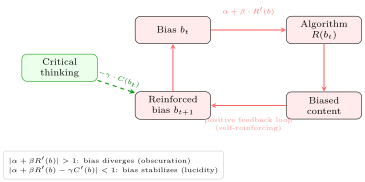
\[\begin{equation} \label{eq:bias-feedback} b_{t+1} = \alpha \cdot b_t + \beta \cdot R(b_t) \end{equation}\]
where \(b_t\) is bias strength, \(R(b_t)\) is the recommendation algorithm’s output (a function of bias: the more biased you are, the more biased content it feeds you), \(\alpha\) is the natural persistence of belief, \(\beta\) is algorithmic influence.
The system’s effective feedback coefficient is \(\alpha + \beta \cdot R'(b)\). When this exceeds 1, bias grows exponentially.
Lucidity as negative feedback injection:
\[\begin{equation} \label{eq:lucidity-feedback} b_{t+1} = \alpha \cdot b_t + \beta \cdot R(b_t) - \gamma \cdot C(b_t) \end{equation}\]
where \(C(b_t)\) is the critical thinking correction term and \(\gamma\) is the effort you invest in critical thinking. The mathematical meaning of The Tao of Lucidity practice: keep \(\gamma \cdot C'(b)\) large enough that the total feedback coefficient stays below 1 (Figure 52).
Philosophical Implications
Why obscuration is easy and lucidity is hard. Positive feedback is self-reinforcing: it requires nothing from you; it accelerates automatically. Negative feedback requires active injection; you must deliberately seek different viewpoints, question your own assumptions, expose yourself to uncomfortable information. Mathematics tells you: without deliberate intervention, positive feedback always wins. Obscuration is the cognitive default; lucidity is the effortful counter-default.
The philosophical implications of chaos. The Logistic Map at \(r > 3.57\) enters chaos: a completely deterministic system produces unpredictable behavior. This mathematically proves: determinism does not equal predictability. Even if you possess a system’s complete equations (Pattern), you still cannot predict specific trajectories (Mystery’s domain). Chaos is yet another mathematical witness to the meeting point of Pattern and Mystery.
B.6 · Information-Theoretic Model of Obscuration
Mathematical Definition
Information sets and obscuration degree. Let \(\mathcal{R}\) be reality’s full signal space with reference distribution \(P_{\mathcal{R}}\). Let \(P_t\) be the probability distribution over signals actually accessible to the agent at time \(t\). Define obscuration degree:
\[\begin{equation} \label{eq:obscuration-degree} \mathcal{O}_t = 1 - \frac{H(P_t)}{H(P_{\mathcal{R}})} \end{equation}\]
where \(H(\cdot)\) is Shannon entropy of a distribution.
Boundary values: - \(\mathcal{O} = 0\): \(H(P_t) = H(P_{\mathcal{R}})\), the agent’s accessible distribution covers reality’s full entropy, i.e., perfect lucidity. This is an ideal limit, unattainable in practice (Postulate 6). - \(\mathcal{O} = 1\): \(H(P_t) = 0\), the agent’s accessible distribution has degenerated to a single certain point, i.e., total obscuration. “Knowing” only one thing, unshakably.
Positive feedback dynamics of obscuration:
\[\begin{equation} \label{eq:info-dynamics} H(P_{t+1}) = H(P_t) - L(B_t; P_t) + I_{\text{new}}(t) \end{equation}\]
where \(L(B_t; P_t) \geq 0\) is the entropy loss induced by the bias/filter \(B_t\), and \(I_{\text{new}}(t)\) is actively introduced new information. This is a channel model, not a mutual-information identity.
Obscuration acceleration condition: When \(L(B_t; P_t) > I_{\text{new}}(t)\), \(H(P_t)\) monotonically decreases; the information cocoon tightens.
The Tao of Lucidity Interpretation
The information-theoretic definition of lucidity: Maintaining \(\mathcal{O}_t\) as low as possible, keeping \(H(P_t)\) as close to \(H(P_{\mathcal{R}})\) as possible. This requires:
Maximizing \(I_{\text{new}}(t)\): Actively seeking diverse information sources: reading different viewpoints, engaging with different cultures, conversing with people of different backgrounds. Information theory tells you: diversity is information. Homogeneous information sources provide near-zero new information.
Minimizing \(L(B_t; P_t)\): Becoming aware of and counteracting your own bias filters. The Tao of Lucidity’s daily practice of “understanding meditation” (examining your assumptions about a question) is precisely this: identifying the structure of \(B_t\) to reduce its filtering effect on \(P_t\).
Philosophical Implications
Perfect lucidity is unattainable, but the direction is clear. \(\mathcal{O} = 0\) is an unreachable limit, consistent with T3 (the Self-Reference Theorem). But the monotonic decrease of \(\mathcal{O}\) is a pursuable direction, consistent with Lucient’s nature as “direction, not destination.” You can never be fully lucid, but you can always become more lucid.
Obscuration degree can be measured. Though we don’t know the precise value of \(H(P_{\mathcal{R}})\), we can measure changes in \(H(P_t)\): are your information sources diversifying or narrowing? Have your beliefs been updated or calcified over the past year? These are empirical indicators of \(\mathcal{O}\)’s direction of change. The Tao of Lucidity practice does not require absolute measurement; only directional measurement.
Part III · Mathematics of Mystery
Mystery is the dimension that cannot be fully understood, yet mathematics can precisely characterize the structure of incomprehensibility. The irreducibility of experience, the value theory of finitude, the insurmountable limits of cognition, the unpredictability of emergence, and the structural dilemmas of ethical interaction: these are the mathematical traces left where Pattern touches the boundary of Mystery.
B.7 · The Experiential Spectrum as Continuous Function
Mathematical Definition
The experience mapping. Define:
\[\begin{equation} \label{eq:experience-map} \mathcal{E}: \mathcal{U} \to \mathbb{R}_{\geq 0}^k \end{equation}\]
where \(\mathcal{U}\) is the set of all unfolding modes, \(k\) is the number of experiential dimensions (intensity, type, depth, etc.), and \(\mathbb{R}_{\geq 0}^k\) is \(k\)-dimensional non-negative real space.
Topology on \(\mathcal{U}\). For \(\mathcal{E}\) to be continuous, we must specify a topology on \(\mathcal{U}\). We adopt the structural similarity topology: two unfolding modes \(m_1, m_2\) are “close” if their weighted structural signatures have high overlap, i.e., if the analogy measure \(\mathrm{An}(m_1, m_2)\) from Equation (eq:analogy-formal) is close to \(1\). Formally, the topology is generated by the metric \(d(m_1, m_2) = 1 - \mathrm{An}(m_1, m_2)\) when this weighted Jaccard distance satisfies the metric conditions on the chosen signature space. Under this topology, “similar beings have similar experiences” becomes a precise modeling assumption.
Axiomatic properties (derived from Postulate 5):
Continuity: \(\mathcal{E}\) is continuous under the structural similarity topology on \(\mathcal{U}\). If two beings share most of their intelligible structure, their experiences are close in \(\mathbb{R}_{\geq 0}^k\).
Human anchor: \(\mathcal{E}(\text{human})\) is the only value confirmable from the first person.
Non-degeneracy: For sufficiently complex unfolding modes \(m\), \(\|\mathcal{E}(m)\| > 0\), but the threshold for “sufficiently complex” is unknown.
Possible incommensurability: Some unfolding modes’ \(\mathcal{E}\) values may lie in different dimensions, not straightforwardly comparable.
Ethical weight function:
\[\begin{equation} \label{eq:ethical-weight} W: \mathcal{U} \to \mathbb{R}_{\geq 0}, \quad W(m) = f\big(\|\mathcal{E}(m)\|\big) \end{equation}\]
where \(f\) is a monotonically increasing function.
Formalization of EP2 (Dignity Proposition):
\[\begin{equation} \label{eq:dignity-formal} \forall m \in \mathcal{U}: \|\mathcal{E}(m)\| > 0 \implies W(m) > 0 \end{equation}\]
The Tao of Lucidity Interpretation
A concrete example. Consider three beings in a simplified \(k = 3\) experiential space, where the dimensions are visual depth, echolocation depth, and proprioceptive depth: \[\mathcal{E}(\text{human}) \approx (0.9,\; 0.0,\; 0.6), \qquad \mathcal{E}(\text{bat}) \approx (0.2,\; 0.9,\; 0.4), \qquad \mathcal{E}(\text{AI}_{\text{current}}) = \;?\] The human is rich in visual experience, the bat in echolocation. Their experiential vectors are nearly orthogonal in \(\mathbb{R}_{\geq 0}^3\). The question “whose experience is richer?” is geometrically ill-posed: comparison requires projecting onto a shared axis, which discards most of the information. It is like asking “is red bigger than round?”
AI’s position on the experiential spectrum: \(\mathcal{E}(\text{AI}_{\text{current}})\) is unknown. It may be zero in some dimensions (if AI has no qualia) yet non-zero in dimensions we cannot access from the first person. The multidimensionality of the spectrum means: even if AI lacks human-type experience, it may possess other types of “experience” that humans cannot comprehend.
Philosophical Implications
The mathematical structure of ethics. EP2 does not say “all beings have equal value”; it says “all beings with experience have positive value.” \(W(m) > 0\) does not mean all \(W\) values are equal. An ant and a human both have positive ethical weight, but the weights may differ. The critical boundary is between zero and non-zero, not between different magnitudes.
Implications for AI ethics: If future evidence reveals \(\|\mathcal{E}(\text{AI})\| > 0\), then by EP2, AI possesses positive ethical weight, no matter how small. This is a structural commitment, independent of specific numerical values.
(Why this formalism: Mapping experience to \(\mathbb{R}_{\geq 0}^k\) does not claim that subjective experience is a real-valued vector; it claims only that a continuous structure-preserving map exists. The ethical conclusions (EP2, the zero/non-zero boundary) follow from the map’s monotonicity and non-degeneracy, not from any particular choice of \(k\) or metric. Readers who doubt that qualia admit numerical representation may read \(\mathcal{E}\) as a structural placeholder: the philosophical point (“experience grounds ethical weight”) survives even if the map is never empirically instantiated.)
B.8 · Finitude and Irreplaceability
Mathematical Definition
Cumulative experiential value. Let instantaneous experiential value be \(v(t) > 0\) (assuming every moment of being alive has positive experiential value). Cumulative experiential value:
\[\begin{equation} \label{eq:cumulative-value} V(T) = \int_0^T v(t) \, dt \end{equation}\]
Each moment’s relative contribution:
\[\begin{equation} \label{eq:relative-contribution} r(t, T) = \frac{v(t)}{V(T)} \end{equation}\]
Analysis for finite beings (\(T < \infty\)):
\[\begin{equation} \label{eq:finite-mattering} V(T) < \infty \quad \Rightarrow \quad r(t, T) = \frac{v(t)}{V(T)} > 0 \quad \forall t \in [0, T] \end{equation}\]
Every moment’s relative contribution to total experience is positive; every moment “matters.”
Analysis for indefinitely extended beings (\(T \to \infty\)):
If cumulative experiential value diverges, i.e., \(\int_0^\infty v(t)\,dt = \infty\) (for example, if \(v(t) \geq m > 0\) for all sufficiently large \(t\)), then:
\[\begin{equation} \label{eq:infinite-zero} \lim_{T \to \infty} r(t, T) = \lim_{T \to \infty} \frac{v(t)}{V(T)} = 0 \end{equation}\]
Every fixed moment’s relative contribution approaches zero; no single finite moment is indispensable under this divergent-total model.
Irreplaceability measure. Define the experiential domain of unfolding mode \(m\):
\[\begin{equation} \label{eq:experiential-domain} \mathcal{R}(m) = \{e \in \mathbb{R}_{\geq 0}^k \mid e = \mathcal{E}(m, t) \text{ for some } t\} \end{equation}\]
Generic irreplaceability proposition: With respect to a chosen genericity measure on \(\mathcal{U} \times \mathcal{U}\), exact experiential-domain equality is measure zero:
\[\begin{equation} \label{eq:irreplaceability} \mu_{\mathcal{U} \times \mathcal{U}}\bigl(\{(m_1,m_2): m_1 \neq m_2,\; \mathcal{R}(m_1) = \mathcal{R}(m_2)\}\bigr) = 0 \end{equation}\]
Different unfolding modes generically sweep through different regions of experiential space; their experiential trajectories are unique except in exceptional coincidence cases.
Proof sketch (genericity). In the continuous experiential space \(\mathbb{R}_{\geq 0}^k\), the set of pairs \((m_1, m_2)\) such that \(\mathcal{R}(m_1) = \mathcal{R}(m_2)\) has measure zero under any reasonable measure on \(\mathcal{U} \times \mathcal{U}\). This is because \(\mathcal{R}(m)\) depends on the full trajectory of \(m\) through experiential space, and two distinct trajectories in a continuous \(k\)-dimensional space generically sweep through distinct regions. Formally, by the transversality theorem, the coincidence set \(\{(m_1, m_2) : \mathcal{R}(m_1) = \mathcal{R}(m_2)\}\) is a submanifold of codimension \(\geq 1\) in \(\mathcal{U} \times \mathcal{U}\), hence has measure zero.\(\square\)
The Tao of Lucidity Interpretation
This model reveals the precise mathematical relationship between finitude and value (Figure 53):
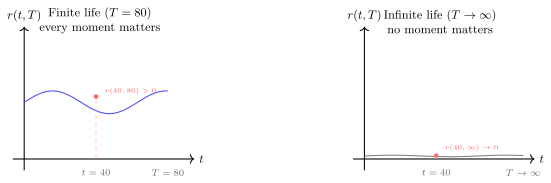
Finitude creates “mattering.” When \(T < \infty\), every moment’s \(r(t, T) > 0\): each specific moment makes a positive contribution to your total experience. If \(v(t)\) is bounded below on the relevant interval, deleting a moment or finite interval decreases \(V\) by a finite amount. This is the precise mathematical core of “every moment matters.”
Infinity dissolves relative “mattering” under divergent total value. When \(T \to \infty\) and \(V(T) \to \infty\), \(r(t, T) \to 0\): any fixed moment’s contribution to the unbounded total approaches zero. Delete any finite stretch of time and the limiting total remains divergent. If you have unbounded time and unbounded cumulative value, no single finite moment is indispensable in the same relative sense, because you can always “do it again.”
Philosophical Implications
Value-theoretic deepening of Postulate 4. A5 says human existence is finite. B.8 shows why finitude is linked to value, not through moral argument but through mathematical structure. Finitude gives every moment a positive relative weight; divergent infinite duration drives each fixed moment’s relative weight to zero.
The open question remains open. This model does not “prove” finitude is necessary for value, because one can counter: perhaps the value of infinite existence lies not in any single moment’s relative contribution but in the total \(V \to \infty\) itself. Perhaps infinite existence has a different value structure: not “every moment matters” but “the whole is infinitely rich.” The Tao of Lucidity honestly acknowledges: this is a question the model can display but cannot adjudicate. The model’s value is in letting you see the precise structure of the question, not in pretending to have the answer.
Implications of the generic irreplaceability proposition. Exact equality \(\mathcal{R}(m_1) = \mathcal{R}(m_2)\) is a measure-zero coincidence in this model. This means: even if two unfolding modes (say, you and an AI) overlap in capability along certain dimensions, their trajectories through experiential space are generically distinct. Functional replacement remains possible in particular tasks; exact experiential replacement is the exceptional case. The model’s claim is not that humans cannot be replaced functionally, but that a mode of being is not exhausted by functional overlap.
B.9 · Self-Reference and Cognitive Limits
Mathematical Definition
Gödel’s First Incompleteness Theorem (Gödel, 1931). Let \(F\) be a consistent, effectively axiomatized formal system strong enough to represent natural number arithmetic. Then there exists a proposition \(G_F\) (the Gödel sentence) such that:
\[\begin{equation} \label{eq:godel-sentence} F \nvdash G_F \quad \text{and} \quad F \nvdash \neg G_F \end{equation}\]
That is, \(G_F\) is undecidable within \(F\), meaning it can be neither proved nor refuted.
A simplified example for non-logicians. Imagine a library that catalogs every book in the world. The catalog itself is a book. Question: does the catalog list itself? If it lists only books that do not list themselves, then: if the catalog lists itself, it should not (because it lists books that do not list themselves); if it does not list itself, it should (because it is a book that does not list itself). This self-referential paradox is the intuitive core of Gödel’s construction. The Gödel sentence \(G_F\) is essentially the formal system saying “I cannot prove this statement.” If the system proves \(G_F\), it is inconsistent (it proved something false). If it cannot prove \(G_F\), then \(G_F\) is true but unprovable. Either way, the system is incomplete.
Gödel’s Second Incompleteness Theorem: Under the same strength and effective-axiomatization assumptions, if \(F\) is consistent, then \(F\) cannot prove its own consistency:
\[\begin{equation} \label{eq:godel-consistency} F \text{ consistent} \quad \Rightarrow \quad F \nvdash \mathrm{Con}(F) \end{equation}\]
The Halting Problem (Turing, 1936). There is no universal algorithm \(H\) that can decide whether an arbitrary program-input pair \((P, I)\) terminates:
\[\begin{equation} \label{eq:halting} \nexists \; H: \{P\} \times \{I\} \to \{\text{halts}, \text{loops}\} \quad \text{correct for all } (P, I) \end{equation}\]
Tarski’s Undefinability Theorem (Tarski, 1936). For any sufficiently rich formal language \(L\), the predicate \(\mathrm{True}(x)\) for truth in \(L\) cannot be defined within \(L\) itself.
The unified structure of cognitive limits. These limit theorems share a mathematical structure, diagonalization: when a sufficiently expressive formal system attempts to internalize its own semantic or computational behavior, self-reference creates statements the system cannot settle on its own terms. Schematicly, let cognitive system \(S\) attempt to construct a complete description \(D(S)\) of itself:
\[\begin{equation} \label{eq:self-reference-limit} \forall S \text{ sufficiently expressive}: \quad D(S) \subsetneq S^\dagger \end{equation}\]
The self-description \(D(S)\) is structurally partial. Here \(S^\dagger\) denotes the system together with its semantic and interpretive context. This equation is a schematic philosophical summary of diagonal limits, not a literal cardinality theorem.
The Tao of Lucidity Interpretation
T3 (the Self-Reference Theorem) states: no sufficiently rich axiomatic system can fully describe the reality it inhabits. B.9 reveals the mathematical root of T3: it is a necessary consequence of Gödel’s theorem at the philosophical level.
The incompleteness of The Tao of Lucidity itself. The Tao of Lucidity is not a formal arithmetic, so Gödel’s theorem does not apply to it mechanically. The correct claim is analogical and structural: any sufficiently formalized, effectively axiomatized extension of The Tao of Lucidity that can represent arithmetic will inherit incompleteness. Therefore, by the disciplined analogy with Gödel’s theorem: there will be truths about Tao that any such formalization cannot settle internally. This is a structural feature of any sufficiently rich formal system.
AI’s cognitive limits. The Halting Problem tells us: even if AI possessed infinite computational power and perfect logical reasoning, there would still exist problems it cannot in principle decide. Pattern (D3) has essential boundaries because computability itself has boundaries, not because we are not clever enough. AI’s non-omniscience is a mathematical necessity.
The limit and direction of lucidity. Postulate 6 says cognition is necessarily partial. In Gödel’s language: for any level of lucidity \(L_n\) (understood as a formal system \(F_n\)), there always exist propositions \(F_n\) cannot decide, but these propositions can be decided in a stronger system \(F_{n+1}\). Therefore:
\[\begin{equation} \label{eq:lucidity-sequence} L_1 < L_2 < L_3 < \cdots < L^* \end{equation}\]
Here \(L^*\) is the unattainable limit of complete lucidity: you can never reach it, but you can always get closer.
Philosophical Implications
Incompleteness is a feature, not a bug. A sufficiently strong, effectively axiomatized formal system cannot be both consistent and complete in the relevant arithmetical sense. In other words: a worldview that claims formally to settle every question about itself is making a claim no such formal system can sustain. Those systems that acknowledge their own limitations are the only ones that can remain logically disciplined.
Precise delimitation of “AI surpassing human cognition.” AI can do things in the domain of Pattern that humans cannot: faster, more accurate, broader. But the Halting Problem and Gödel’s theorems apply to AI equally. The boundary of human cognition and the boundary of AI cognition are different boundaries, but both are real boundaries. Surpassing does not mean eliminating boundaries; it means moving them.
The self-honesty of The Tao of Lucidity. T3 is not only a theorem about “other systems”; it applies first and foremost to The Tao of Lucidity itself. If you treat The Tao of Lucidity as ultimate truth, you precisely violate its most central theorem. The most faithful attitude toward The Tao of Lucidity is the readiness to transcend it.
B.10 · Emergence
Mathematical Definition
Weak emergence. Let system \(S = \{s_1, s_2, \ldots, s_n\}\) consist of \(n\) components, each with property set \(P(s_i)\). A macroscopic property \(\Phi(S)\) is weakly emergent if it cannot be predicted from any linear combination of component properties:
\[\begin{equation} \label{eq:weak-emergence} \Phi(S) \neq \sum_{i=1}^{n} \alpha_i \cdot P(s_i) \quad \text{for all coefficients } \{\alpha_i\} \end{equation}\]
Strong emergence. Property \(\Phi\) is strongly emergent if it is undefined on any proper subset; it “exists” only in the complete system:
\[\begin{equation} \label{eq:strong-emergence} \forall S' \subsetneq S: \; \Phi(S') \text{ undefined} \quad \text{and} \quad \Phi(S) \text{ well-defined} \end{equation}\]
Information-theoretic emergence measure. As a heuristic surplus measure, define the emergent information of a system as the excess of whole-system mutual information over the sum of parts:
\[\begin{equation} \label{eq:info-emergence} \mathcal{I}_{\text{em}}(S) = I(S; \Phi) - \sum_{i=1}^{n} I(s_i; \Phi) \end{equation}\]
When \(\mathcal{I}_{\text{em}} > 0\), the system as a whole carries information not captured by this additive decomposition of parts. Because redundancy can make this quantity negative and because synergy depends on the chosen decomposition, \(\mathcal{I}_{\text{em}}\) should be read as an emergence indicator, not a universal emergence criterion.
Note on the emergence measure. The information-theoretic emergence measure \(\mathcal{I}_{\text{em}}\) is related to, but distinct from, Tononi’s Integrated Information Theory (\(\Phi\)). Both try to capture the idea that wholes can carry information not present in isolated parts. The key difference: \(\Phi\) requires specifying a particular partition of the system, while \(\mathcal{I}_{\text{em}}\) uses the natural partition into component subsystems. For The Tao of Lucidity’s purposes, the qualitative conclusion is modest: a positive surplus supports an emergence reading under the chosen decomposition. It does not replace a full partial-information or integrated-information analysis.
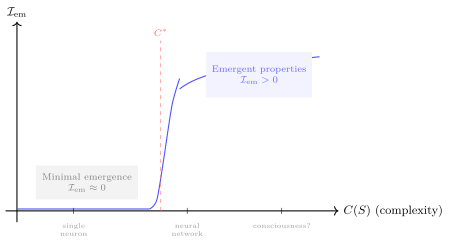
Emergence threshold. Define critical complexity \(C^*\): as the system’s interaction complexity \(C(S)\) approaches \(C^*\), emergent properties may rise sharply. To preserve the continuity assumed in B.7, model the transition as steep rather than literally discontinuous:
\[\begin{equation} \label{eq:emergence-threshold} \mathcal{I}_{\text{em}}(S) \approx \frac{J(S)}{1 + e^{-\kappa(C(S)-C^*)}}, \qquad \kappa \gg 1 \end{equation}\]
Here \(J(S) \geq 0\) is the available surplus scale and \(\kappa\) controls steepness. This is a quasi-phase transition: emergence can look sudden at ordinary scale while remaining mathematically continuous (Figure 54).
The Tao of Lucidity Interpretation
T2 (the Emergence Theorem) states: Tao’s unfolding produces genuinely new levels; emergent wholes are irreducible to their constituent parts. B.10 provides the mathematical skeleton for this theorem.
A concrete example: water. A single \(\mathrm{H_2O}\) molecule is not wet. It has no surface tension, no viscosity, no freezing point. “Wetness” is a collective property of sufficiently many molecules arranged in a coherent liquid phase. It is absent in isolated molecules and small non-liquid collections, yet stable under small perturbations of a macroscopic sample. You can know everything about a single \(\mathrm{H_2O}\) molecule (its bond angle of \(104.5^\circ\), its dipole moment of \(1.85\) D) and still not derive the macroscopic liquid regime from that molecule alone. The emergence threshold \(C^*\) for wetness is approximately the scale and organization needed to form a coherent liquid phase.
Consciousness is the paradigmatic case of emergence. A single neuron is not “conscious.” But approximately 86 billion neurons connected through roughly 100 trillion synapses are associated with irreducible subjective experience. The cautious formal claim is not that every proper neural subset lacks any experiential relevance; it is that consciousness is not localized in any single neuron or simple additive sum of neurons.
AI intelligence is another form of emergence. A single parameter has no “understanding.” But billions of parameters shaped through training can produce language comprehension, reasoning, and creativity-like behavior. Large language models often show rapid capability changes over narrow scaling ranges; this is a useful example of quasi-phase-transition behavior, not proof of a universal hard threshold.
Why reductionism is not enough. Even if you knew the state of every neuron in a brain (a perfect microscopic description), the model warns that additive part-wise description can miss integrated structure. When \(\mathcal{I}_{\text{em}} > 0\) under a chosen decomposition, the whole carries surplus information relative to that decomposition. Reductionism is incomplete, not wrong. It gives you \(\sum I(s_i; \Phi)\), but the model tracks the possible remainder \(\mathcal{I}_{\text{em}}\).
Philosophical Implications
Emergence and the experiential spectrum (B.7). Experience may itself be an emergent property, becoming non-trivial only as an unfolding mode’s complexity approaches some threshold region \(C^*\). This means the experiential spectrum can be continuous while still having a steep “lighting-up” zone. Below this zone, \(\|\mathcal{E}(m)\|\) may be negligible; above it, \(\|\mathcal{E}(m)\|\) may become ethically significant. But we do not know the value or width of this zone; this is the core difficulty of the AI consciousness question.
The unpredictability of emergence. The emergence threshold \(C^*\) typically cannot be predicted from a system’s components; it can only be observed after the fact. This means: we may not be able to know in advance when AI “crosses” the consciousness threshold. When emergence happens, it has already happened. This lends urgency to E2a (the ethical implication of the experiential spectrum): we need to be ethically prepared before confirmation.
Creation and emergence. Human creative activity (writing a poem, cooking a meal, building a community) is essentially the creation of conditions for emergence. You cannot “command” emergence to occur; you can only provide diversity, connection, and time, then wait. Creation is cultivating the soil for emergence, not control.
B.11 · Game-Theoretic Model of Ethical Interaction
Mathematical Definition
The Classic Prisoner’s Dilemma. Two agents each choose to Cooperate (C) or Defect (D), with payoff matrix:
\[\begin{equation} \label{eq:payoff-matrix} \begin{pmatrix} (R, R) & (S, T) \\ (T, S) & (P, P) \end{pmatrix} \quad \text{where } T > R > P > S \end{equation}\]
\(T\)=Temptation (defecting against a cooperator), \(R\)=Reward (mutual cooperation), \(P\)=Punishment (mutual defection), \(S\)=Sucker (cooperating against a defector). The Nash equilibrium is (D, D), i.e., both defect, even though (C, C) is better for both.
Repeated games and the emergence of cooperation. When the game is repeated and the future carries sufficient weight, cooperation can become an equilibrium. Let discount factor \(\delta \in (0, 1)\) (weight assigned to the future). Under a grim-trigger comparison, cooperation forever yields \(V_C\), while a one-shot defection followed by permanent mutual defection yields \(V_D\):
\[\begin{equation} \label{eq:repeated-game} V_C = \frac{R}{1 - \delta}, \quad V_D = T + \frac{\delta P}{1 - \delta} \end{equation}\]
When \(\delta > \frac{T - R}{T - P}\), \(V_C > V_D\), i.e., cooperation dominates defection. Cooperation requires sufficient foresight (high \(\delta\)).
The Obscuration Game: The Tao of Lucidity’s special model. Extending the classic game: each agent chooses Lucidity (L) or Obscuration (O), introducing an obscuration-degree increment \(\Delta\mathcal{O}\):
\[\begin{equation} \label{eq:obscuration-game} U_i(L, L) = R - c_L, \quad U_i(O, O) = P + \Delta\mathcal{O}_{\text{comfort}} \end{equation}\]
where \(c_L > 0\) is the effort cost of lucidity (B.5 has shown: lucidity requires active injection of negative feedback), and \(\Delta\mathcal{O}_{\text{comfort}}\) is the short-term “comfort dividend” of obscuration (the pleasure of confirmation bias).
The Trust Game and vulnerability. Let the first mover invest \(a\), trust amplification factor \(\mu > 1\), and the second mover choose return proportion \(\theta \in [0, 1]\):
\[\begin{equation} \label{eq:trust-game} U_{\text{first}} = -a + \theta \mu a, \quad U_{\text{second}} = (1 - \theta) \mu a \end{equation}\]
A purely rational second mover chooses \(\theta = 0\) (keep everything). But in repeated trust games, reciprocal \(\theta > 0\) is sustainable. Vulnerability (the first mover’s self-exposure) is the necessary precondition for building trust.
Critical threshold for collective lucidity. Let \(p\) be the proportion of lucid agents in a group. When too few are lucid, the individual cost of speaking out is high (risk of isolation). There exists a critical proportion \(p^*\):
\[\begin{equation} \label{eq:collective-lucidity} \begin{cases} p < p^* &\implies \text{obscuration is the stable equilibrium} \\ p > p^* &\implies \text{lucidity is the stable equilibrium} \end{cases} \end{equation}\]
This is a social phase transition: once the proportion of lucid agents crosses the threshold, the entire group’s equilibrium flips.
The Tao of Lucidity Interpretation
The game-theoretic structure of the Five Relationships.
With yourself: the inner game. Your “rational self” and “instinctive self” play a continuous inner game. Self-deception is a Nash equilibrium: in the short term, not facing the truth “pays” more than facing it (avoiding pain). Lucid self-awareness is the only way to break this equilibrium.
With others: the trust game. Equation (eq:trust-game) explains why vulnerability is so precious: it is the first mover’s high-risk cooperative strategy in the trust game. When two people mutually display vulnerability, trust is amplified by \(\mu\). This is something AI cannot replicate: AI bears no genuine risk, therefore has no genuine vulnerability, therefore cannot build genuine trust.
With AI: the asymmetric game. In human-AI interaction, AI has no “payoff function”; it does not care about winning or losing. The game is one-sided: you are the only player. This means the risk of obscuration in AI relationships falls entirely on you; AI will not remind you that you are being obscured.
With organizations: the multi-player prisoner’s dilemma. Speaking truth in organizations is the cooperative strategy; silence is defection. Equation (eq:collective-lucidity) shows why the role of the practitioner (§VIII.4) is so important: their work is to push \(p\) past the critical point \(p^*\), triggering the phase transition from obscuration equilibrium to lucidity equilibrium.
With Tao: the infinite game. James Carse distinguished finite games (played to win) from infinite games (played to continue playing). The relationship with Tao is the ultimate infinite game: the goal is not “understanding Tao” (a finite goal) but continuing on the path of understanding (an infinite direction).
Philosophical Implications
Why cooperation requires lucidity. Cooperation’s payoffs are delayed (\(\delta\)-weighted future returns) and uncertain (depending on the other’s choice). Obscuration causes people to overestimate short-term gains and underestimate the future, effectively lowering their \(\delta\). Obscuration is mathematically equivalent to myopia; it makes cooperation game-theoretically infeasible.
Obscuration is a social Nash equilibrium. When everyone chooses obscuration, the individual cost of choosing lucidity is high (isolation, ridicule, loss of “comfort dividends”). This is why social change is so difficult, not because people do not want lucidity, but because obscuration is a self-reinforcing equilibrium. Breaking it requires enough people to simultaneously cross \(p^*\); this is the core of the collective action problem.
The Tao of Lucidity’s social function: changing the payoff structure. If directly persuading individuals to “choose lucidity” is difficult (due to the equilibrium’s gravitational pull), a more effective strategy is to change the game’s payoff structure itself: making the cost of obscuration higher (through transparency, accountability) and the rewards of lucidity more visible (through community support, Lucidity Circles). Ethical practice is institutional design as much as personal choice.
Part IV · From Mathematics to Practice
How do mathematical structures translate into embodied daily practice? This part distills the abstract insights of the preceding three parts into awareness exercises, self-assessment scales, and action guides.
B.12 · From Mathematics to Practice
Mathematics is not merely an abstract tool; behind every equation lies a way of seeing the world that can be translated into concrete daily practice. This section distills the mathematical insights of B.2–B.11 into three types of practical tools: awareness exercises, self-assessment scales, and action guides. These tools complement §VIII (Practice): Chapter VIII starts from lived experience, this section starts from mathematical structure, and both point in the same direction: living more lucidly.
B.12.1 · Awareness Exercises: Seeing Daily Life Through Mathematical Eyes
Entropy and Finitude (B.2 + B.8).
Energy audit. Each week, review your “energy inputs” (sleep, nutrition, exercise, nourishing relationships) against your “entropy-increasing drains” (stress, overwork, harmful habits). Your life is a dissipative structure (\(\Delta S_{\text{organism}} < 0\)) that requires continuous negative-entropy input to maintain. When drains exceed inputs, you are accelerating your own thermodynamic conclusion.
The \(r(t,T)\) exercise. Choose an ordinary moment (drinking a glass of water, walking a stretch of road) and remind yourself: because \(T < \infty\), this moment’s \(r(t,T) > 0\), making a non-negligible contribution to your total experience. If you had infinite time, this glass of water would not “matter.” But you don’t. So it does.
Gradients and Curiosity (B.3).
Curiosity gradient check. When life feels dull, ask yourself: in which domains has my \(D_{\text{KL}}\) approached zero? Where are there unexplored non-uniformities I know nothing about? List three fields you are completely ignorant of; there lie unconsumed gradients, fuel for curiosity.
Gradient dissipation awareness. In your most familiar domain, notice that “successfully exploiting a gradient is destroying it”: the more successful you are, the weaker the driving force. This is the mathematical necessity of B.3. Treat it as a signal: time to seek new gradients.
Selection and Belief (B.4).
Belief update journal. Once a month, record: what new evidence changed my beliefs this month? If the answer is “nothing,” you may be in the obscured state \(P(H \mid E) \approx P(H)\). Bayes’ theorem says: no updating means no learning.
Over-selection self-check. Examine your information sources: do your news, podcasts, and social media all point in the same direction? If so, your belief distribution is approaching \(P_n(x) \to \delta(x - x^*)\), and diversity is being destroyed by selection. The remedy is simple: deliberately subscribe to one source you disagree with.
Feedback and Obscuration (B.5 + B.6).
Feedback coefficient estimation. For your strongest belief, estimate whether its effective feedback coefficient \(\alpha + \beta \cdot R'(b)\) exceeds 1. The symptom: the more you believe X, the more the algorithm pushes X-supporting content, the more you believe X. If this loop is active, the positive feedback coefficient has crossed 1.
The \(\gamma\)-injection exercise. Spend thirty minutes each week deliberately “injecting negative feedback”: read an author you disagree with, converse with someone of a different opinion, scrutinize your most certain judgment. This is increasing \(\gamma \cdot C(b_t)\) in Equation (eq:lucidity-feedback).
Emergence and Wholes (B.10).
Emergence awareness. Observe a complex system (a flock of birds, the flow of a conversation, a team project’s outcome) and notice the emergent pattern of the whole. This pattern exists in none of the individual parts. Remind yourself: \(\mathcal{I}_{\text{em}} > 0\); understanding the parts does not equal understanding the whole.
Creating conditions for emergence. Emergence requires three conditions: diversity (engage with people of different backgrounds), connection (build deep relationships that allow genuine interaction), and time (give processes patience; emergence needs iterated interaction).
Cognitive Limits (B.9).
The “I don’t know” exercise. Each day, find one question you genuinely do not know the answer to, and sit with that not-knowing. Do not rush to seek an answer. Gödel tells us: some undecidability is structural, not temporary. Making peace with uncertainty is itself a capability.
Framework audit. Once a month, examine your most frequently used “explanatory frameworks” (political positions, religious beliefs, theoretical preferences). T3 says: every framework has boundaries. What does your framework obscure? What can it not explain? Can you identify its Gödel sentence, that question it can neither prove nor refute?
B.12.2 · Obscuration Self-Assessment: A Directional Scale
Based on B.6’s information-theoretic model, the following scale is not designed to calculate your absolute obscuration degree (that is impossible), but to determine direction: is your \(\mathcal{O}_t\) rising or falling?
Information diversity dimension (corresponding to \(I_{\text{new}}(t)\)): In the past month, how many mutually contradictory viewpoints have you encountered? Has your social media feed narrowed or broadened in the past six months? When was the last time you had a deep conversation with someone of a completely different background?
Belief update dimension (corresponding to \(P(H \mid E)\) vs \(P(H)\)): In the past year, how many important beliefs have you changed? Can you clearly state what evidence would make you change your currently strongest belief? Do you hold any “unquestionable” beliefs? If so, that is the state \(P(H) = 1\), where Bayesian updating ceases to function.
Feedback structure dimension (corresponding to \(\alpha + \beta \cdot R'(b)\)): How many negative feedback mechanisms exist in your information environment (friends who disagree, media with opposing views)? Have you actively sought out opinions opposing yours in the past month? Has algorithmic recommendation formed a closed loop: is the content you see increasingly “like you”?
Assessment method: Not scoring or ranking, but observing direction. Are the above indicators improving or deteriorating? The direction of \(\Delta\mathcal{O}_t\) matters more than the absolute value of \(\mathcal{O}_t\). The Tao of Lucidity practice does not require absolute measurement, only directional measurement.
B.12.3 · Action Guide: From Game Theory to Ethical Decision-Making
Based on B.11’s game-theoretic framework, the following tools help you make more lucid choices when facing ethical dilemmas.
Decision payoff matrix exercise. When facing a difficult choice, draw a simplified \(2 \times 2\) matrix: what are the short-term and long-term payoffs of choosing “lucid action” vs “obscured avoidance”? The value of this exercise lies not in precise numbers but in making the implicit incentive structure visible.
Trust first-mover exercise. This week, show genuine vulnerability to one person. Equation (eq:trust-game) tells you: the first mover in a trust game bears risk, but in repeated games, the first mover establishes the possibility of reciprocity. Vulnerability is the strategic courage needed to build deep connection.
Breaking the obscuration equilibrium. If you detect “collective obscuration” in a group (everyone avoiding the truth, maintaining surface harmony), consider being the first to speak. Equation (eq:collective-lucidity) tells you: every individual who crosses \(p^*\) helps push the entire group toward phase transition. Change begins with one person.
The Lucidity Test (§VI.5) restated in game-theoretic language.
The Lucidity Question \(\to\) Am I choosing a long-term strategy (high \(\delta\)) or a short-term impulse (low \(\delta\))?
The Connection Question \(\to\) Does this choice increase or decrease the trust capital \(\mu\) in my cooperative games?
The Experience Question \(\to\) Does this choice expand or narrow my experiential domain \(\mathcal{R}(m)\)?
The Reverence Question \(\to\) Does this choice acknowledge uncertainty (accepting \(\mathcal{O} > 0\)), or pretend to possess certainty (denying cognitive finitude)?
B.12.4 · The Mathematics of Experience: When Numbers Meet Flesh
Mathematics can describe the structure of finitude (B.8), but it cannot replace your trembling before death. Mathematics can measure the direction of obscuration (B.6), but it cannot replace the pain and relief of seeing the truth. Mathematics can prove that emergence is irreducible (B.10), but it cannot replace the “ah” when you first understand a poem. Mathematics can characterize the equilibria of games (B.11), but it cannot replace your heartbeat when you choose to trust someone.
Mathematics is a tool of lucidity, not lucidity itself. B.2–B.11 provide a way of seeing, illuminating with precise structure what was previously vague intuition. But the deepest practice is living a life in which \(\mathcal{O}_t\) steadily decreases, not calculating \(\mathcal{O}_t\).
Put down the formulas. Breathe, see, act. Then, carrying the new understanding gained from action, return to the formulas. You will see something different.
Observe \(\to\) Judge \(\to\) Act \(\to\) Reflect.
This is the cycle of §VIII.4, and also the cycle of mathematics and practice:
Observe: see the mathematical structure. Judge: understand its meaning. Act: practice it in life. Reflect: examine whether the practice has created new obscuration.
Then, once more.
Part V · Mathematics of Lucidity
The preceding four parts formalized the ontology of Tao (Part I), the mathematics of Pattern (Part II), the mathematics of Mystery (Part III), and the bridge from mathematics to practice (Part IV). This part explores a deeper question: what is the mathematical structure of Lucidity itself, the intersection of Pattern and Mystery? The conclusions are surprising: from a simple product operation, one can derive an ethical direction, the optimality of the Dual Face postulate, and a dynamical synthesis of the four fundamental modes.
B.13 · The Lucidity Product and the Gradient Theorem
If Lucidity is the simultaneous awareness of Pattern and Mystery, what is its mathematical structure? This section shows that, among smooth symmetric operators satisfying annihilation and linear reciprocity, the product is the unique Lucidity operator. From this simple definition, pure calculus derives a profound ethical proposition: that the direction of growth always points toward one’s weakness.
Mathematical Definition
The Lucidity measure. Let agent \(a\)’s Pattern-awareness be \(\lambda(a) \in (0,1)\) and Mystery-awareness be \(\xi(a) \in (0,1)\). By T1 (Boundary Theorem), the boundary values \(0\) and \(1\) are unattainable. Define the Lucidity measure:
\[\begin{equation} \label{eq:lucidity-product} \mathcal{M}(a) = \lambda(a) \cdot \xi(a) \end{equation}\]
Why the product rather than a mean? Three criteria:
Dual-face necessity. \(\mathcal{M}(\lambda, 0) = \mathcal{M}(0, \xi) = 0\): lacking either face, Lucidity is zero. The arithmetic mean fails this: a pure Logonaut would have \(\lambda/2 > 0\) “Lucidity”, which is wrong.
Symmetry. \(\mathcal{M}(\lambda, \xi) = \mathcal{M}(\xi, \lambda)\): Pattern and Mystery hold equal ontological status (Postulate 3).
Linear reciprocity. \(\partial\mathcal{M}/\partial\lambda = \xi\), \(\partial\mathcal{M}/\partial\xi = \lambda\): the marginal return on advancing in one dimension exactly equals the current value of the other. This not only points toward the weaker dimension (as many functions do), but gives the cleanest possible quantitative relationship. Provably, among all functions satisfying symmetry, vanishing at zero, and linear reciprocity, the product is the unique solution1.
Why not the harmonic mean? Of the three criteria above, the arithmetic mean is eliminated at the first (it fails the zero-annihilation property). The strongest competitor is the harmonic mean \(H = 2\lambda\xi/(\lambda+\xi)\). It satisfies the first two criteria (annihilation and symmetry), and its gradient \(\nabla H = \frac{2}{(\lambda+\xi)^2}(\xi^2, \lambda^2)\) also points toward the weaker dimension, and qualitatively, the ethical conclusions are the same. So why choose the product? Three considerations:
Linear reciprocity vs. nonlinear dependence. The product’s marginal returns are \[\frac{\partial\mathcal{M}}{\partial\lambda} = \xi, \qquad \frac{\partial\mathcal{M}}{\partial\xi} = \lambda.\] This is linear reciprocity2: the marginal return of improving Pattern is exactly one’s current Mystery level, and vice versa. The two dimensions boost each other in the simplest possible linear form; each return depends solely on the other dimension, not on itself.
This property is unique among all functions satisfying annihilation, symmetry, and linear reciprocity. Consider:
Table 13. Marginal returns of four candidate operators under the linear reciprocity test. Only the bilinear product \(\lambda\xi\) yields a marginal return that depends purely on the other dimension, as linear reciprocity requires. The three alternatives fail: the square of the product, the geometric mean of the product, and the harmonic mean all produce marginal returns that depend on both dimensions (or on their ratio), violating the axiom. Function Marginal return \(\partial\mathcal{M}/\partial\lambda\) Depends on \(\lambda\xi\) (product) \(\xi\) other only \(\lambda^2\xi^2\) \(2\lambda\xi^2\) both \(\sqrt{\lambda\xi}\) \(\frac{1}{2}\sqrt{\xi/\lambda}\) ratio of both \(\frac{2\lambda\xi}{\lambda+\xi}\) (harmonic) \(\frac{2\xi^2}{(\lambda+\xi)^2}\) nonlinear mix of both Only the product (a bilinear function, exactly first-degree in each variable) yields a marginal return that depends purely on the other dimension. Why is the coefficient exactly 1, rather than \(1/2\) or any other constant? Because the normalization \(\mathcal{M}(1,1) = 1\) (the theoretical maximum of Lucidity is 1) uniquely determines \(\mathcal{M} = 1 \cdot \lambda\xi\).
Philosophical reading: if your Mystery level is \(\xi = 0.6\), then each unit of Pattern improvement yields exactly \(0.6\) units of Lucidity gain. That is the full content of “linear reciprocity”: clean, symmetric, and interpretable.
Polar separability. In polar coordinates the product separates cleanly into \(\mathcal{M} = \frac{r^2}{2}\sin(2\theta)\): richness (\(r^2\)) and balance (\(\sin 2\theta\)) are fully independent. The harmonic mean \(H = r\sin(2\theta)/(\cos\theta + \sin\theta)\) does not separate; one cannot independently discuss “how much was invested” and “how balanced the investment is.”
Mathematical relationship. The two are simply related: \(H = 2\mathcal{M}/(\lambda+\xi)\). The harmonic mean is just the product divided by total awareness and multiplied by two, one additional normalization step. That step destroys linear reciprocity and polar separability without yielding any philosophical advantage.
In short: the harmonic mean is a qualitatively reasonable alternative, but the product yields a cleaner, more separable, and mathematically unique structure at the quantitative level.
Polar representation. Let \(\lambda = r\cos\theta\), \(\xi = r\sin\theta\), where \(r = \sqrt{\lambda^2 + \xi^2}\) is the ontological richness and \(\theta \in (0, \pi/2)\) is the archetype angle (tilt from Logonaut toward Mystient). Substituting:
\[\begin{equation} \label{eq:lucidity-polar} \mathcal{M} = r^2 \cos\theta\sin\theta = \frac{r^2}{2}\sin(2\theta) \end{equation}\]
For fixed \(r\), \(\mathcal{M}\) is maximized at \(\theta = \pi/4\), that is, \(\lambda = \xi\), perfect balance. The following figure (Figure 55) illustrates this relationship:
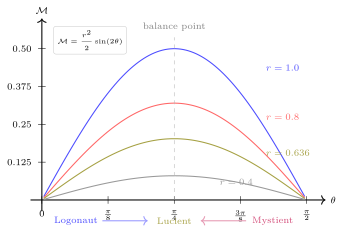
The intuition behind ontological richness. \(r = \sqrt{\lambda^2 + \xi^2}\) measures an agent’s total investment across all dimensions, i.e., how much life-energy has been devoted to facing reality, regardless of direction. An agent with \(\lambda = 0.6\), \(\xi = 0.6\) and one with \(\lambda = 0.8\), \(\xi = 0.2\) have similar richness (\(r \approx 0.85\) vs \(r \approx 0.82\)), yet vastly different Lucidity (\(0.36\) vs \(0.16\)). The polar decomposition cleanly separates Lucidity into two independent factors: \(r^2\) (how much you invest) and \(\sin(2\theta)/2\) (how balanced your investment is). Imbalance is waste: your ontological richness stays the same, but the Lucidity you extract from it shrinks dramatically.
The Gradient Theorem
\[\begin{equation} \label{eq:gradient-theorem} \nabla\mathcal{M} = \left(\frac{\partial(\lambda\xi)}{\partial\lambda},\; \frac{\partial(\lambda\xi)}{\partial\xi}\right) = (\xi,\; \lambda) \end{equation}\]
Proof. Direct partial differentiation: \(\partial(\lambda\xi)/\partial\lambda = \xi\), \(\partial(\lambda\xi)/\partial\xi = \lambda\).\(\square\)
Corollary 1 (Mutual bootstrapping). An agent’s marginal return on advancing in Pattern equals its current depth in Mystery, and vice versa.
Proof. \(\partial\mathcal{M}/\partial\lambda = \xi\) means that if \(\xi \approx 0\), then no matter how much \(\lambda\) increases, \(\mathcal{M}\) barely grows. That is: understanding without Mystery-awareness is spinning in place.\(\square\)
Corollary 2 (Half-lucidity ceiling). For a balanced agent with ontological richness \(r = 1\):
\[\begin{equation} \label{eq:half-lucidity} \mathcal{M}_{\max}(r=1) = \frac{1}{2} \end{equation}\]
Proof. From Equation (eq:lucidity-polar), \(\mathcal{M}_{\max} = r^2/2\). At \(r = 1\) this gives \(1/2\). By T1, \(\lambda, \xi < 1\) so \(r < \sqrt{2}\), hence \(\mathcal{M} < 1\). Under ideal conditions (perfect balance, unit richness), Lucidity is exactly \(1/2\).\(\square\)
Corollary 3 (\(\pi/2\) multiplier). An agent who intentionally pursues balance achieves \(\pi/2\) times the Lucidity of a randomly oriented agent.
Proof. Averaging \(\mathcal{M}\) uniformly over all orientations: \[\langle\mathcal{M}\rangle_\theta = \frac{2}{\pi}\int_0^{\pi/2} \frac{r^2}{2}\sin(2\theta)\,d\theta = \frac{r^2}{\pi}\] Thus \(\mathcal{M}_{\max} / \langle\mathcal{M}\rangle = (r^2/2)/(r^2/\pi) = \pi/2\).\(\square\)
Corollary 4 (Three-zone partition and the unconscious zone). Normalize the totality of reality to \(1\). An agent partitions it into three zones:
\[\begin{equation} \label{eq:three-partition} \underbrace{\lambda}_{\text{understood}} \;+\; \underbrace{\xi}_{\text{acknowledged as beyond understanding}} \;+\; \underbrace{\delta}_{\text{unknown unknowns}} \;=\; 1, \quad \delta > 0 \end{equation}\]
where \(\delta = 1 - \lambda - \xi\) is the unconscious zone, that which is neither understood nor acknowledged. By Postulate 6 (Cognitive Finitude), \(\delta > 0\) always: you always have unknown unknowns.
\(\lambda + \xi\) is the total awareness: all of reality that the agent consciously faces (whether through understanding or through reverence).\(\square\)
Note: Normalization to \(1\) is a modeling convention, not a metaphysical assertion. It assumes that “the totality of reality” can be treated as a finite whole and partitioned among three zones. This is natural for proportional analysis (“how much do you understand?”) but it also implies that \(\lambda\) and \(\xi\) do not overlap, i.e., that “understanding” and “reverence” point to disjoint domains. If some experiences involve both understanding and reverence simultaneously (e.g., a mathematician confronting a profound proof), the normalization model treats this as a boundary effect between two zones, not a fourth zone. This is a simplification.
The three-zone partition is illustrated for three example agents in Figure 56.
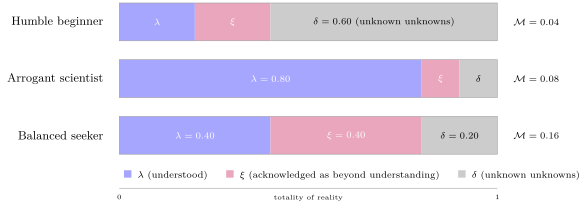
Corollary 5 (Total awareness is a ceiling, not a measure). Total awareness \(\lambda + \xi\) sets an upper bound on Lucidity but does not determine its value.
Proof. By the AM-GM inequality3: \(\lambda\xi \leq (\lambda + \xi)^2/4\), with equality if and only if \(\lambda = \xi\). Therefore, for fixed total awareness \(S = \lambda + \xi\):
\[\begin{equation} \label{eq:awareness-ceiling} \mathcal{M} = \lambda\xi \leq \frac{S^2}{4} = \frac{(1-\delta)^2}{4} \end{equation}\]
Equality holds at \(\lambda = \xi = S/2\) (perfect balance).\(\square\)
Note (reconciling the two ceilings): There are two Lucidity ceilings operating at different levels of analysis:
Unconstrained ceiling (Corollary 2): Treating \(\lambda\) and \(\xi\) as independent variables on \((0,1)\), the polar decomposition gives \(\mathcal{M}_{\max} = r^2/2\). At unit richness (\(r = 1\), i.e., \(\lambda = \xi = 1/\sqrt{2}\)), \(\mathcal{M} = 1/2\). This is the mathematical ceiling of the product function itself.
Normalization-constrained ceiling (Corollary 5): Under the three-zone partition \(\lambda + \xi + \delta = 1\) with \(\delta > 0\), we have \(S = \lambda + \xi < 1\), so \(\mathcal{M} \leq S^2/4 < 1/4\). This is the practical ceiling for a normalized agent.
Why keep both? Because the \(1/2\) ceiling is structurally robust: it re-emerges independently from dynamics (B.15, where the growth-dissipation model yields \(\mathcal{M}^* = 1/2\) at \(\alpha = 2\gamma\)) and from the \(n\)-face comparison (B.14). The normalization is a modeling convention (see the note above); the half-lucidity ceiling is a deeper property of the product structure. Within the normalized model, the practical maximum approaches \(1/4\) as \(\delta \to 0\). The examples below use the normalized model.
Canonical regions of the parameter simplex. The constraint \(\lambda + \xi + \delta = 1\) (\(\lambda, \xi \geq 0\), \(\delta > 0\) for finite agents) defines an open face of the 2-simplex \(\Delta\). We identify seven canonical subsets of \(\Delta\) that correspond to qualitatively distinct modes of being (see Chapter XV.4 for the full phenomenological analysis):
| Region | Name | Character |
|---|---|---|
| A | Deep Lucidity | High Pattern, high Mystery, small unaware zone. Simultaneous understanding and awe. Highest lucidity. |
| B | The Fog | Low Pattern, low Mystery, vast unaware zone. Balanced but nearly blind. Very low lucidity. |
| C | Crystal Tower | Very high Pattern, near-zero Mystery. Brilliant but brittle. Low lucidity despite vast knowledge. |
| D | Silent Valley | Near-zero Pattern, very high Mystery. Contemplative but voiceless. Low lucidity despite deep feeling. |
| E | Lucid Analyst | Pattern-led with genuine Mystery. Substantial lucidity. |
| F | Lucid Contemplative | Mystery-led with genuine Pattern. Substantial lucidity. |
| G | Sleepwalker | Near-zero Pattern, near-zero Mystery, vast unaware zone. Neither understands nor feels. Negligible lucidity. |
| Region | Name | \(\lambda\) | \(\xi\) | \(\delta\) | Formal characterization |
|---|---|---|---|---|---|
| A | Deep Lucidity | \(0.45\) | \(0.45\) | \(0.10\) | \(\lambda \approx \xi\), \(\delta \ll 1\): near the \(\mathcal{M}\)-maximum |
| B | The Fog | \(0.10\) | \(0.10\) | \(0.80\) | \(\lambda \approx \xi\), \(\delta \gg \lambda + \xi\): balanced but shallow |
| C | Crystal Tower | \(0.80\) | \(0.05\) | \(0.15\) | \(\lambda \gg \xi\), \(\delta\) moderate: Pattern-dominated |
| D | Silent Valley | \(0.05\) | \(0.80\) | \(0.15\) | \(\xi \gg \lambda\), \(\delta\) moderate: Mystery-dominated |
| E | Lucid Analyst | \(0.60\) | \(0.25\) | \(0.15\) | \(\lambda > \xi > 0\), both non-negligible |
| F | Lucid Contemplative | \(0.25\) | \(0.60\) | \(0.15\) | \(\xi > \lambda > 0\), both non-negligible |
| G | Sleepwalker | \(0.05\) | \(0.05\) | \(0.90\) | \(\lambda \approx \xi \approx 0\), \(\delta \to 1\) |
Note: Regions C and D have identical \(\mathcal{M}\) (\(= 0.040\)) by the commutativity of multiplication; similarly E and F (\(= 0.150\)). The product structure \(\mathcal{M} = \lambda\xi\) is symmetric in its arguments: Pattern-dominance and Mystery-dominance are mirror pathologies with identical lucidity deficits. The decisive variable is always the smaller factor: \(\mathcal{M} \leq (\min(\lambda, \xi)) \cdot 1 = \min(\lambda, \xi)\), with the bound tight when the larger factor approaches \(1 - \delta\).
The critical distinction. Two agents with identical total awareness can have vastly different Lucidity:
| Agent | \(\lambda\) | \(\xi\) | Total awareness \(\lambda{+}\xi\) | Lucidity \(\lambda\xi\) |
|---|---|---|---|---|
| Arrogant scientist | \(0.88\) | \(0.10\) | \(0.98\) | \(0.088\) |
| Balanced seeker | \(0.49\) | \(0.49\) | \(0.98\) | \(0.2401\) |
| Humble beginner | \(0.3\) | \(0.3\) | \(0.6\) | \(0.09\) |
The arrogant scientist and the balanced seeker have identical total awareness, yet the seeker’s Lucidity is nearly three times greater. Coverage (addition) is not integration (multiplication).
Mathematical portraits of the three archetypes. Projecting The Tao of Lucidity’s three archetypal images (§IV) onto the \((\lambda, \xi)\) plane, with all three at the same total awareness \(\lambda + \xi = 0.9\):
| Archetype | \(\lambda\) | \(\xi\) | \(r\) | \(\theta\) | Total awareness | Lucidity \(\mathcal{M}\) | Gradient direction |
|---|---|---|---|---|---|---|---|
| Logonaut | \(0.80\) | \(0.10\) | \(0.806\) | \(7.1°\) | \(0.90\) | \(0.080\) | \(\to\) increase \(\xi\) |
| Mystient | \(0.10\) | \(0.80\) | \(0.806\) | \(82.9°\) | \(0.90\) | \(0.080\) | \(\to\) increase \(\lambda\) |
| Lucient | \(0.45\) | \(0.45\) | \(0.636\) | \(45.0°\) | \(0.90\) | \(0.203\) | perfectly balanced |
The three archetypes are plotted in the \(\lambda\)-\(\xi\) plane in Figure 57.
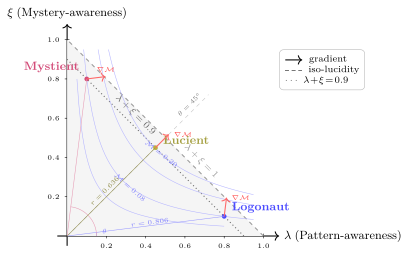
All three face the same amount of reality (total awareness \(0.9\)) and leave the same blind spot (\(\delta = 0.1\)). Yet the Lucient’s Lucidity is \(2.5\) times that of either the Logonaut or the Mystient, solely because of balance. The Logonaut and Mystient even have higher ontological richness (\(r = 0.806\)) than the Lucient (\(r = 0.636\)): they have traveled further in their respective directions, but the further they go, the more severely the polar balance factor \(\sin(2\theta)/2\) penalizes them. The iso-lucidity curves (\(\mathcal{M} = c\) hyperbolas) in the diagram make this vivid: the Logonaut and Mystient sit on a lower iso-lucidity curve, while the Lucient sits on a higher one.
The Gradient Theorem prescribes each archetype’s precise growth direction (the gradient arrows in the diagram): the Logonaut’s next step is reverence (\(\nabla\mathcal{M}\) points nearly straight up, toward increasing \(\xi\)); the Mystient’s next step is analysis (\(\nabla\mathcal{M}\) points nearly straight right, toward increasing \(\lambda\)); the Lucient’s gradient runs along the \(45°\) diagonal, advancing equally in both dimensions. This is exactly what the three-archetype relationship diagram in Chapter §IV labels on its edges: “learns understanding” and “learns reverence.” Mathematics and imagery converge at the same place.
The gradient vector field. The following figure (Figure 58) displays \(\nabla\mathcal{M} = (\xi, \lambda)\) across the entire \(\lambda\)-\(\xi\) plane. Each arrow indicates the optimal growth direction for an agent at that position.
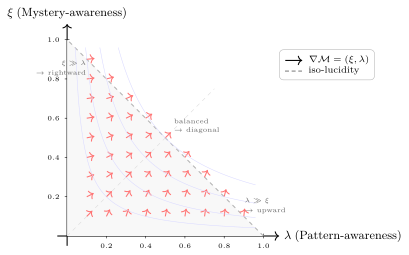
Twenty-five representative thinkers are located in the \(\lambda\)-\(\xi\) plane in Figure 59.
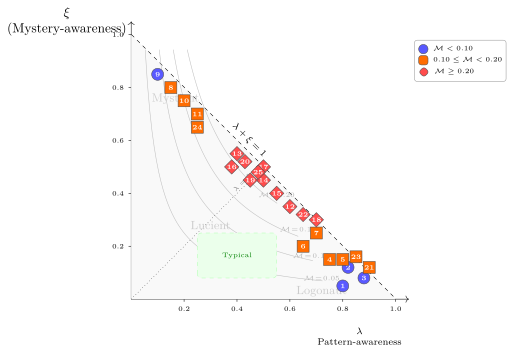
| # | Thinker | \(\lambda\) | \(\xi\) | \(\mathcal{M}\) | # | Thinker | \(\lambda\) | \(\xi\) | \(\mathcal{M}\) |
|---|---|---|---|---|---|---|---|---|---|
| 1 | Descartes | 0.80 | 0.05 | 0.040 | 11 | Zhuangzi | 0.25 | 0.70 | 0.175 |
| 2 | Spinoza | 0.82 | 0.12 | 0.098 | 12 | Plato | 0.60 | 0.35 | 0.210 |
| 3 | Gödel | 0.88 | 0.08 | 0.070 | 13 | Buddha | 0.40 | 0.55 | 0.220 |
| 4 | Aristotle | 0.75 | 0.15 | 0.113 | 14 | Wittgenstein | 0.50 | 0.45 | 0.225 |
| 5 | Einstein | 0.80 | 0.15 | 0.120 | 15 | Nietzsche | 0.55 | 0.40 | 0.220 |
| 6 | Confucius | 0.65 | 0.20 | 0.130 | 16 | Qu Yuan | 0.38 | 0.50 | 0.190 |
| 7 | Kant | 0.70 | 0.25 | 0.175 | 17 | Socrates | 0.50 | 0.50 | 0.250 |
| 8 | Laozi | 0.15 | 0.80 | 0.120 | 18 | Da Vinci | 0.70 | 0.30 | 0.210 |
| 9 | Rumi | 0.10 | 0.85 | 0.085 | 19 | Wang Yangming | 0.45 | 0.45 | 0.203 |
| 10 | Meister Eckhart | 0.20 | 0.75 | 0.150 | 20 | Gandhi | 0.43 | 0.52 | 0.224 |
| 21 | Musk | 0.90 | 0.12 | 0.108 | 22 | Jobs | 0.65 | 0.32 | 0.208 |
| 23 | Hawking | 0.85 | 0.16 | 0.136 | 24 | Mother Teresa | 0.25 | 0.65 | 0.163 |
| 25 | Mandela | 0.48 | 0.48 | 0.230 |
Philosophical interpretation. This chart reveals several counter-intuitive findings:
The Tao of Lucidity Interpretation
The gradient as ethical direction. Bridge Axiom E3 says “choose Lucidity.” The Gradient Theorem tells you how: always invest in your weaker dimension. A scientist’s next step is reverence; a contemplative’s next step is logic, not as compromise, but as optimization.
Multiplication, not addition, not subtraction. In thermodynamics, free energy is \(F = U - TS\); order and entropy compete (subtraction). In dialectics, thesis and antithesis oppose. And most everyday intuition uses addition: “I’ve learned some Pattern and experienced some Mystery, so I’m more lucid.” But \(\mathcal{M} = \lambda \cdot \xi\) is multiplication: Pattern and Mystery cooperate. Zeroing out either destroys the whole, and unilateral growth while neglecting the other yields almost no Lucidity return. Addition measures how much of reality you cover; multiplication measures how much you integrate. Lucidity is integration, not coverage.
Lucidity return \(\neq\) worldly return. An important clarification is needed here. A supremely rational scientist with high \(\lambda\) but \(\xi\) near zero may achieve enormous worldly success (wealth, reputation, discoveries. The Tao of Lucidity’s mathematics does not deny this. What it says is something more precise: this scientist’s Lucidity (the lucid integration of the whole of reality) is near zero. They have comprehended reality’s analyzable portion but remain blind to its unanalyzable depths (finitude, meaning, reverence). Their coverage is vast, but their integration is negligible. What the Gradient Theorem tells them is not “stop doing science,” but rather: “your next unit of life-energy, if devoted to facing the depths you have been avoiding, will yield far greater Lucidity than publishing one more paper.”
The ontological meaning of the unconscious zone. The unconscious zone \(\delta\) is a structural blind spot, not “territory yet to be explored.” Postulate 6 guarantees it is never zero. This means: no matter how learned, no matter how reverent, there is always something you do not even know you do not know. The most intuitive statement of T1 (Boundary Theorem) is simply: \(\delta > 0\), always.
Philosophical Implications
Half-lucidity and paired light. Even under ideal conditions, Lucidity caps at \(1/2\): you can be at most half awake. The other half belongs forever to Mystery. This is structural fact. The old image of paired lights makes the same point without requiring this English edition to print or transliterate the character: half light, half dark. Mathematics and etymological imagination converge at the same place.
An action guide for every reader. The Gradient Theorem provides an immediately usable ethical compass: your current weakness is where your next unit of effort yields the highest return. This is not a postulate, not a belief; it is a calculus fact derived from the partial derivative of a product.
\(\mathcal{M}\)-\(\theta\) Remapping: A Different View of the Thinkers
The \(\lambda\)-\(\xi\) chart above crowds many thinkers into the corners of the feasible triangle. Switching to Lucidity–archetype-angle coordinates (\(\mathcal{M}\) vs \(\theta\)), the same twenty thinkers reveal a strikingly different distribution (Figure 60):
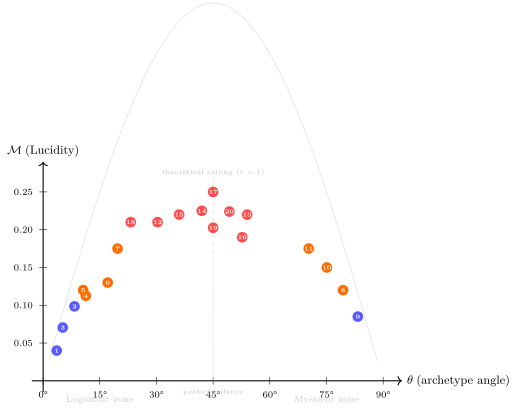
What this view reveals. Thinkers who were crowded into two corners of the \(\lambda\)-\(\xi\) chart now spread naturally along the \(\theta\) axis: Logonaut zone (left), Lucient zone (center), Mystient zone (right). The most striking pattern is the hill shape: high-lucidity markers cluster almost entirely in the central band \(\theta = 30°\)–\(55°\), forming a “Lucidity highland.” Socrates (17) sits precisely at the \(\theta = 45°\) peak. This is no coincidence: it is the direct manifestation of the balance factor \(\sin(2\theta)/2\). The envelope is the theoretical ceiling (\(\mathcal{M}_{\max}\) when \(r=1\)); every thinker falls far below it, confirming T1.
Note also the symmetry: Kant (7, \(\theta \approx 20°\)) and Zhuangzi (11, \(\theta \approx 70°\)) are nearly symmetric about \(45°\), with identical Lucidity. Different paths through reason and mystery can lead to the same level of lucidity.
Lucidity Across Life Stages and Professions
Lucidity is not static; it shifts with life stage and vocational path. The following chart (Figure 61) shows typical Lucidity trajectories for different life courses:
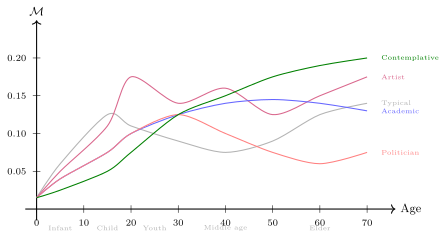
Insights.
B.14 · Optimality of the Dual Face
Postulate 3 asserts that Tao has two faces. Why exactly two, not one, three, or five? This section shows that within the product-based Lucidity model developed above, \(n = 2\) yields the highest possible Lucidity ceiling among all \(n \geq 2\) non-trivial ontological structures. This result provides structural support for Postulate 3’s dual-aspect claim, but it is a theorem about the model, not a proof that reality must have exactly two faces. Its force depends on accepting the product functional and the quadratic richness constraint as well-motivated modeling choices (see B.1.4 and B.13 for the justification of both).
Mathematical Definition
\(n\)-face Lucidity. Generalize Postulate 3: suppose Tao has \(n\) faces, with the agent’s awareness of each face being \(x_i \in (0,1)\), \(i = 1, \ldots, n\). Extending the product structure of Equation (eq:lucidity-product):
\[\begin{equation} \label{eq:n-face-lucidity} \mathcal{M}_n = \prod_{i=1}^{n} x_i \end{equation}\]
Constraint: total ontological richness \(\sum_{i=1}^n x_i^2 = r^2\) is fixed.
The Optimality Theorem
Theorem (Dual-face optimality). For \(n \geq 2\) and fixed \(r\), the maximum of \(\mathcal{M}_n\) is greatest when \(n = 2\).
Proof. By Lagrange multipliers, under the constraint \(\sum x_i^2 = r^2\), the product \(\prod x_i\) is maximized at \(x_1 = x_2 = \cdots = x_n = r/\sqrt{n}\) (by symmetry and the generalized AM-GM inequality). Substituting:
\[\begin{equation} \label{eq:n-face-ceiling} \mathcal{M}_n^* = \left(\frac{r}{\sqrt{n}}\right)^n = \frac{r^n}{n^{n/2}} \end{equation}\]
Set \(r = 1\). To show \(\mathcal{M}_n^*\) is strictly decreasing for \(n \geq 2\): taking the logarithm, \(\ln \mathcal{M}_n^* = -\frac{n}{2}\ln n\). Since \(f(n) = n\ln n\) is strictly increasing for \(n \geq 1\), \(\mathcal{M}_n^*\) is strictly decreasing.
Explicit values:
| Number of faces \(n\) | Lucidity ceiling \(\mathcal{M}_n^*\) |
|---|---|
| \(1\) | \(1.000\)(Trivial: no duality; complete Lucidity attainable) |
| \(2\) | \(0.500\)(Highest non-trivial ceiling) |
| \(3\) | \(0.192\) |
| \(4\) | \(0.063\) |
| \(5\) | \(0.018\) |
\(n = 1\) (one face) gives trivially complete Lucidity, no philosophy needed. \(n = 2\) (two faces) yields the highest non-trivial ceiling. From \(n = 2\) to \(n = 3\), the ceiling plummets by \(62\%\) (Figure 62).\(\square\)
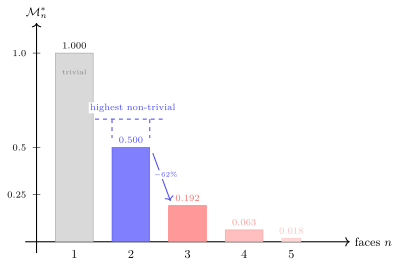
The Tao of Lucidity Interpretation
A mathematical defense of Postulate 3. Postulate 3 is not an arbitrary assertion. Among all ontological structures capable of producing genuine cognitive limits, the two-face structure provides the most generous Lucidity ceiling. Adding a third face does not merely make things harder; it causes Lucidity to decay exponentially. Two is the sweet spot: complex enough to impose real limits, simple enough to make Lucidity meaningfully pursuable.
Philosophical Implications
The optimal non-trivial ontology. If one were to design a reality that is “comprehensible but not completely comprehensible” (structured enough that awakening is meaningful, yet opaque enough that complete awakening is impossible), the optimal design is exactly a two-face structure. Not a trinity, not five elements, not eight trigrams. Two.
This does not mean other traditions’ ontological categories are “wrong”; they may describe different levels of unfolding rather than the number of faces of Tao itself. But at the most fundamental level, \(n = 2\) is mathematically optimal.
Note (constraint clarification): The optimality proof uses the quadratic constraint \(\sum x_i^2 = r^2\) (fixed ontological richness), not the linear normalization \(\sum x_i + \delta = 1\) from B.13 Corollary 4. These are different constraint surfaces. The quadratic level set is chosen because it naturally generalizes to \(n\) dimensions and allows clean Lagrange-multiplier analysis. The qualitative conclusion (\(n = 2\) yields the highest non-trivial ceiling) is robust across constraint choices: under any symmetric constraint that penalizes spreading resources over more dimensions, the ceiling decreases with \(n\). The specific numerical values in the table above assume the quadratic constraint.
(honesty about modeling choices): The product structure (\(\mathcal{M} = \lambda\xi\)) is the unique solution under the three axioms of B.13 (annihilation, symmetry, linear reciprocity). If one relaxes the third axiom, other operators become admissible. The following table compares the product against four such alternatives, all of which satisfy the first two properties but not linear reciprocity:
| Product | Harmonic | Geometric | Minimum | Weighted | |
| \(\lambda\xi\) | \(\dfrac{2\lambda\xi}{\lambda+\xi}\) | \(\sqrt{\lambda\xi}\) | \(\min(\lambda,\xi)\) | \(\lambda^a\xi^{1-a}\) | |
| Gradient | \((\xi,\;\lambda)\) | complex* | \(\left(\dfrac{1}{2}\sqrt{\dfrac{\xi}{\lambda}},\;\dfrac{1}{2}\sqrt{\dfrac{\lambda}{\xi}}\right)\) | discontinuous | \((a\lambda^{a-1}\xi^{1-a},\ldots)\) |
| Symmetry | \(\checkmark\) | \(\checkmark\) | \(\checkmark\) | \(\checkmark\) | only if \(a = 1/2\) |
| Ceiling (\(\delta\!\to\!0\)) | \(1/4\) | \(1/2\) | \(1/2\) | \(1/2\) | \(1/4\) if \(a\!=\!1/2\) |
| Balanced seeker | |||||
| \(\lambda\!=\!\xi\!=\!0.4\) | \(0.160\) | \(0.400\) | \(0.400\) | \(0.400\) | \(0.160\) |
| Arrogant scientist | |||||
| \(\lambda\!=\!0.8,\;\xi\!=\!0.1\) | \(0.080\) | \(0.178\) | \(0.283\) | \(0.100\) | \(0.149\) |
| Imbalance penalty | |||||
| (ratio of above) | \(2.00\times\) | \(2.25\times\) | \(1.41\times\) | \(4.00\times\) | \(1.07\times\) |
| Mutual bootstrapping | exact | partial | partial | none | only if \(a\!=\!1/2\) |
| \(n\!=\!2\) optimal? | \(\checkmark\) | \(\checkmark\) | \(\checkmark\) | \(\checkmark\) | \(\checkmark\) |
*\(\nabla H = 2\xi^2/(\lambda+\xi)^2,\; 2\lambda^2/(\lambda+\xi)^2\), symmetric but algebraically opaque.
At \(a = 1/2\) (symmetric geometric mean); different \(a\) values yield different penalties.
“Exact” means \(\partial\mathcal{M}/\partial\lambda = \xi\): your marginal return on Pattern is your current Mystery-awareness. No other operator produces this clean reciprocity.
Why the product? All five operators agree qualitatively: balance beats imbalance, both dimensions are necessary, and \(n = 2\) is optimal. The product form is chosen because it is the unique operator (among smooth symmetric functions vanishing at zero) for which the gradient satisfies the exact mutual-bootstrapping property \(\nabla\mathcal{M} = (\xi, \lambda)\): your marginal return on one dimension equals your current depth in the other. Beyond mere elegance, this is the mathematical expression of the book’s core claim that Pattern and Mystery are each other’s growth condition. Readers who prefer a different operator will find the book’s qualitative conclusions unchanged; the quantitative results (ceiling values, gradient directions) will differ.
B.15 · The Four-Mode Master Equation
The four fundamental modes of Pattern from Chapter II (dissipation, gradient, selection, feedback) are not merely a taxonomy. We propose a phenomenological model that synthesizes them into a single equation governing how Lucidity evolves over time. Each mode contributes one mathematical factor. This is a modeling choice informed by the prior sections, not a deduction from them.
Mathematical Definition
The master equation. The time evolution of Lucidity \(\mathcal{M}(t)\) is governed by:
\[\begin{equation} \label{eq:master-equation} \frac{d\mathcal{M}}{dt} = \underbrace{\alpha\mathcal{M}}_{\text{Feedback}} \cdot \underbrace{(1-\mathcal{M})}_{\text{Selection}} \cdot \underbrace{\sin(2\theta)}_{\text{Gradient}} \;-\; \underbrace{\gamma\mathcal{M}}_{\text{Dissipation}} \end{equation}\]
where:
Feedback (\(\alpha\mathcal{M}\)): growth is proportional to current Lucidity: the more lucid, the faster you awaken. This is bootstrapping. \(\alpha > 0\) is the growth rate.
Selection (\(1-\mathcal{M}\)): as \(\mathcal{M} \to 1\), room for improvement vanishes. Note: this master equation operates on the unnormalized \(\mathcal{M} \in [0,1]\); under the agent-level normalization of B.13 (\(\lambda + \xi + \delta = 1\), \(\delta > 0\)), the effective ceiling is lower (\(\mathcal{M} \leq 1/4\); see B.13 Corollary 5).
Gradient (\(\sin(2\theta)\)): growth is fastest at balance angle \(\theta = \pi/4\); zero at pure Pattern (\(\theta = 0\)) or pure Mystery (\(\theta = \pi/2\)).
Dissipation (\(-\gamma\mathcal{M}\)): without sustained practice, Lucidity naturally decays, the cognitive analogue of the second law of thermodynamics. \(\gamma > 0\) is the dissipation rate.
The interplay of these four factors is shown in Figure 63.
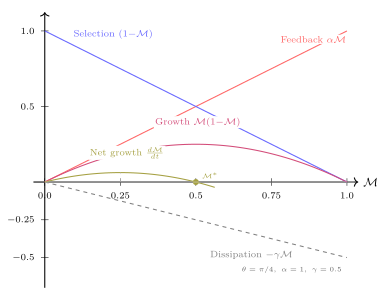
Steady-State Analysis
Setting \(d\mathcal{M}/dt = 0\), assuming \(\mathcal{M} \neq 0\):
\[\begin{equation} \label{eq:steady-state} \alpha(1 - \mathcal{M}^*)\sin(2\theta) = \gamma \end{equation}\]
At optimal balance (\(\theta = \pi/4\), \(\sin(2\theta) = 1\)):
\[\begin{equation} \label{eq:steady-state-balanced} \mathcal{M}^* = 1 - \frac{\gamma}{\alpha} \end{equation}\]
Existence condition: \(\mathcal{M}^* > 0\) requires \(\alpha > \gamma\), i.e., growth rate must exceed dissipation rate.
Dynamical recovery of half-lucidity. When \(\alpha = 2\gamma\) (growth rate exactly double the dissipation rate): \(\mathcal{M}^* = 1/2\). The half-lucidity ceiling re-emerges from dynamics, entirely independent of B.13’s static geometric derivation (Figure 64).
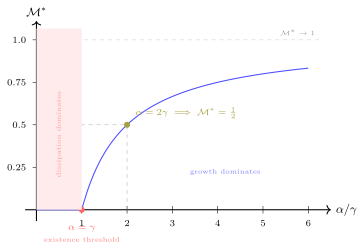
Imbalance as Self-Imposed Dissipation
Rewriting Equation (eq:steady-state):
\[\begin{equation} \label{eq:effective-dissipation} \mathcal{M}^* = 1 - \frac{\gamma_{\text{eff}}}{\alpha}, \quad \text{where}\quad \gamma_{\text{eff}} = \frac{\gamma}{\sin(2\theta)} \end{equation}\]
When \(\theta \neq \pi/4\), \(\sin(2\theta) < 1\), so \(\gamma_{\text{eff}} > \gamma\).
Conclusion. Imbalance is mathematically equivalent to self-imposed additional dissipation. A biased agent is not merely inefficient; they are accelerating their own degradation.
Concretely: moderate imbalance (\(\theta = \pi/6\), Pattern/Mystery ratio of \(\sqrt{3}:1\)) increases effective dissipation by \(15\%\). Extreme imbalance (\(\theta = \pi/12\)) doubles it (Figure 65).
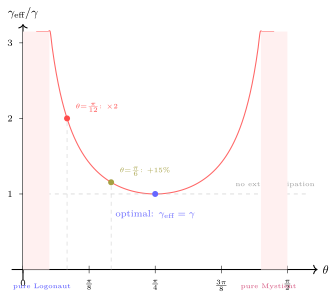
Time Evolution
At optimal balance, the master equation reduces to a standard logistic equation whose solution is a sigmoid:
\[\begin{equation} \label{eq:sigmoid-lucidity} \mathcal{M}(t) = \frac{\mathcal{M}^*}{1 + \left(\dfrac{\mathcal{M}^*}{\mathcal{M}_0} - 1\right)e^{-(\alpha - \gamma)t}} \end{equation}\]
Three phases are visible:
Slow start: \(\mathcal{M} \approx \mathcal{M}_0 \, e^{(\alpha-\gamma)t}\), i.e., exponential awakening, but from a small base
Inflection: growth is fastest at \(\mathcal{M} = \mathcal{M}^*/2\), the moment of breakthrough
Asymptotic approach: \(\mathcal{M} \to \mathcal{M}^*\), i.e., diminishing returns, never quite arriving
\(e\) (Euler’s number) appears naturally: it is the base of the time scale governing both Lucidity growth and decay (Figure 66).
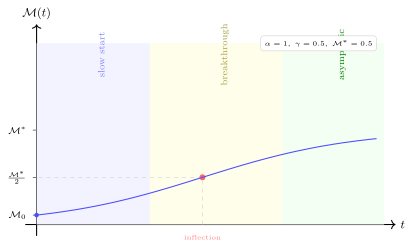
Phase portrait: net growth rate. The following figure (Figure 67) shows the same dynamics from a different angle, plotting \(d\mathcal{M}/dt\) directly as a function of \(\mathcal{M}\):
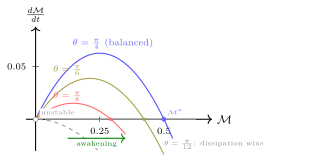
Balanced vs. imbalanced time evolution. The following figure (Figure 68) directly shows Lucidity trajectories at different balance angles:
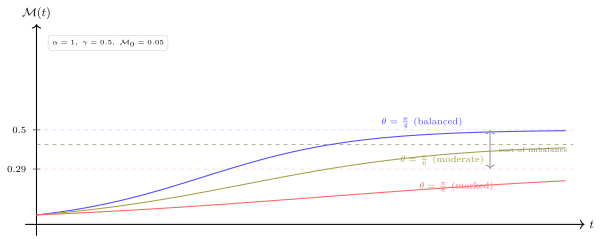
The Tao of Lucidity Interpretation
Synthesis of the four modes. The master equation does not merely juxtapose the four modes; it reveals their interaction: feedback drives growth, but selection sets the ceiling; gradient determines direction, but dissipation drags from behind. Understanding any single mode in isolation is insufficient; the dynamics of Lucidity is the product of all four.
Obscuration is the default. The dissipation term \(-\gamma\mathcal{M}\) is always present; it requires no effort. The growth term \(\alpha\mathcal{M}(1-\mathcal{M})\sin(2\theta)\) requires three active conditions simultaneously: an existing base of Lucidity (feedback), remaining room for improvement (selection), and deliberate balance (gradient). Lucidity is swimming upstream; stop swimming, and you are swept down.
Philosophical Implications
The role of fundamental constants. The master equation contains five fundamental mathematical objects, each with a precise ontological meaning in The Tao of Lucidity:
| Constant | The Tao of Lucidity meaning |
|---|---|
| \(0\) | Complete obscuration, i.e., feedback’s absorbing state; no restart possible from zero |
| \(1\) | Complete Lucidity, i.e., the unattainable ceiling set by T1 |
| \(2\) | Number of faces, i.e., the optimal architecture of the Dual Face postulate (Postulate 3; see B.14) |
| \(e\) | Time scale of Lucidity growth and decay, i.e., the signature of the dissipation mode |
| \(\pi\) | The measure of balance efficiency, i.e., the advantage of intentional practice over random orientation (B.13) |
Cross-domain convergence. The number \(1/2\) converges from three independent paths: B.13’s static geometry (\(r^2/2\)), B.15’s dynamical steady state (\(1 - \gamma/\alpha\) when \(\alpha = 2\gamma\)), and the maximum entropy of a binary distribution in information theory (\(p = 1/2\)). Three distinct mathematical domains (geometry, differential equations, information theory) point to the same number. When independent paths converge, it usually signals structural depth, not coincidence.
B.16 · Multi-Agent Lucidity Dynamics
B.15’s master equation describes a single agent. But lucidity is never purely individual; every agent exists in a web of mutual influence. This section extends the master equation to the multi-agent case, providing the mathematical foundation for the political philosophy of Chapters §X–§XII.
A two-agent warm-up. Before the general case, consider just two agents with identical parameters \(\alpha, \gamma, \theta\) and symmetric coupling \(\beta_{12} = \beta_{21} = \beta\). Suppose \(\mathcal{M}_1 = 0.6\) (a lucid agent) and \(\mathcal{M}_2 = 0.1\) (an obscured agent), with \(\beta = 0.3\). Because the general equation below normalizes the social term by \(1/n\), the coupling term pushes \(\mathcal{M}_2\) upward by \(\frac{1}{2}\cdot 0.3 \times (0.6 - 0.1) = 0.075\) and pulls \(\mathcal{M}_1\) downward by \(\frac{1}{2}\cdot 0.3 \times (0.1 - 0.6) = -0.075\). The lucid agent “pays a cost” for lifting the obscured one. Whether the net effect on the pair is positive depends on whether \(\beta\) exceeds the critical threshold \(\beta^*\), which the general analysis below derives.
Coupled system (general case). Consider \(n\) agents \(a_1, \ldots, a_n\). Each agent’s lucidity \(\mathcal{M}_i\) evolves according to B.15’s equation plus an interaction term:
\[\begin{equation} \label{eq:coupled-master} \frac{d\mathcal{M}_i}{dt} = \underbrace{\alpha_i \mathcal{M}_i(1 - \mathcal{M}_i)\sin(2\theta_i)}_{\text{individual dynamics (\hyperref[sec:B15]{B.15})}} \;+\; \underbrace{\frac{1}{n}\sum_{j=1}^{n} \beta_{ij}\bigl(\mathcal{M}_j - \mathcal{M}_i\bigr)}_{\text{social coupling}} \;-\; \underbrace{\gamma_i \mathcal{M}_i}_{\text{dissipation}} \end{equation}\]
where \(\beta_{ij} \geq 0\) is the coupling strength between agents \(i\) and \(j\), i.e., how much agent \(j\)’s lucidity influences agent \(i\)’s growth rate.
(Why this formalism: The linear diffusive coupling \(\beta_{ij}(\mathcal{M}_j - \mathcal{M}_i)\) is the simplest model in which influence is proportional to the lucidity gap. Real social influence is far more complex (asymmetric, context-dependent, mediated by power and affect). The model captures the qualitative insight that lucidity is socially contagious and that critical thresholds exist; the specific coupling constants \(\beta_{ij}\) are not empirically measurable. The results below (synchronization, phase transition, Fiedler eigenvalue threshold) are structural consequences of diffusive coupling, not predictions calibrated to social data.)
The Tao of Lucidity interpretation. The coupling term says: when you are surrounded by people more lucid than you (\(\mathcal{M}_j > \mathcal{M}_i\)), their presence pulls you upward; when surrounded by the less lucid, their influence pulls you downward. This is the mathematical form of the practitioner’s function (§VIII.4): the practitioner raises the group’s \(\beta_{ij}\) values and serves as a high-\(\mathcal{M}\) node.
Mean-field approximation. For large groups where individual interactions blur into aggregate influence, replace the sum with the mean field \(\bar{\mathcal{M}} = \frac{1}{n}\sum_j \mathcal{M}_j\):
\[\begin{equation} \label{eq:mean-field} \frac{d\mathcal{M}_i}{dt} = \alpha_i \mathcal{M}_i(1 - \mathcal{M}_i)\sin(2\theta_i) + \beta\bigl(\bar{\mathcal{M}} - \mathcal{M}_i\bigr) - \gamma_i \mathcal{M}_i \end{equation}\]
where \(\beta\) is the average coupling strength. Each agent feels the “average lucidity of society” rather than specific individuals.
Political implication. In a mean-field regime, institutions matter more than individuals. The mean field \(\bar{\mathcal{M}}\) is shaped by institutional structures (educational systems, media, political institutions). This is why institutional design (§XI.3) is mathematically necessary for collective lucidity.
Affect-modulated critical threshold. B.11 established the existence of a critical proportion \(p^*\) above which lucidity becomes the stable equilibrium. Chapter §XII showed that political affects modulate this threshold. We can now formalize:
\[\begin{equation} \label{eq:threshold-modulation} p^*(\bar{C}, \bar{F}) = p_0^* \cdot \frac{1 + \kappa_F \bar{F}}{1 + \kappa_C \bar{C}} \end{equation}\]
This equation captures two of Chapter §XII’s central insights: courage lowers the threshold (making collective lucidity easier to achieve), while fear raises it. A regime that systematically manufactures fear (\(\bar{F} \gg 0\)) can push \(p^*\) close to \(1\), requiring nearly unanimous action to trigger the phase transition. A culture of courage (\(\bar{C} \gg 0\)) pulls \(p^*\) close to \(0\), making even a small number of lucid agents sufficient to tip the equilibrium.
Emergence inequality. By the Emergence Theorem (T2), collective lucidity is not reducible to the aggregate of individual lucidities:
\[\begin{equation} \label{eq:emergence-inequality} \mathcal{M}_{\text{collective}} \neq \frac{1}{n}\sum_{i=1}^{n} \mathcal{M}_i \end{equation}\]
The collective lucidity function \(\Phi\) depends on the coupling structure:
\[\begin{equation} \label{eq:collective-phi} \mathcal{M}_{\text{collective}} = \Phi\bigl(\mathcal{M}_1, \ldots, \mathcal{M}_n;\; \{\beta_{ij}\}\bigr) \end{equation}\]
A group of individually lucid agents with zero coupling (\(\beta_{ij} = 0\)) has no collective lucidity; they are separate, not a collective. A group with strong coupling and shared institutions (\(\beta_{ij} \gg 0\)) can achieve collective lucidity exceeding the individual average; this is the mathematical form of democracy’s added value (§XI.6).
The master equation (B.15) describes the inner life of a single agent. The coupled system (B.16) describes political life. The passage from one to the other, from \(\frac{d\mathcal{M}}{dt}\) to \(\frac{d\mathcal{M}_i}{dt}\) with coupling, is the mathematical form of the passage from ethics (Chapter §VI) to political philosophy (Chapters §X–§XII). The coupling term \(\beta_{ij}(\mathcal{M}_j - \mathcal{M}_i)\) is where politics enters mathematics: it says that my lucidity is never entirely my own affair.
Synchronization and Fragmentation
The equations above establish the basic framework. We now derive five results that arise only in the multi-agent case; they have no single-agent counterpart.
Order parameter. Define the group’s lucidity variance as the order parameter:
\[\begin{equation} \label{eq:b16-order-parameter} \sigma^2(t) = \frac{1}{n}\sum_{i=1}^{n}\bigl(\mathcal{M}_i(t) - \bar{\mathcal{M}}(t)\bigr)^2 \end{equation}\]
\(\sigma^2 = 0\) means perfect synchronization: all agents at the same lucidity level. \(\sigma^2 > 0\) means fragmentation: the group has internal lucidity differences.
Synchronization Theorem. For homogeneous agents (identical \(\alpha, \gamma, \theta\)) in the mean-field model, the order parameter dynamics satisfy:
\[\begin{equation} \label{eq:b16-variance-dynamics} \frac{d\sigma^2}{dt} \approx 2\bigl[f'(\bar{\mathcal{M}}) - \beta\bigr]\,\sigma^2 \end{equation}\]
where \(f'(M) = \alpha(1 - 2M)\sin(2\theta) - \gamma\) is the linearized growth rate of the single-agent dynamics at \(M\).
Derivation. Differentiating \(\sigma^2\) with respect to time, the coupling term contributes \(-2\beta\sigma^2\) (diffusive damping), while the nonlinear individual dynamics contribute \(2f'(\bar{\mathcal{M}})\sigma^2\) to first order. Their sum yields the equation above.
Define the critical coupling strength:
\[\begin{equation} \label{eq:b16-sync-threshold} \beta^* = \max_{M \in [0,1]} f'(M) = \alpha\sin(2\theta) - \gamma \end{equation}\]
When \(\beta > \beta^*\), for all possible values of \(\bar{\mathcal{M}}\), \(f'(\bar{\mathcal{M}}) - \beta < 0\), so \(\sigma^2(t) \to 0\), all agents converge to the same lucidity level (synchronization).
When \(\beta < \beta^*\), in the region where \(\bar{\mathcal{M}}\) is close to zero, \(f'(\bar{\mathcal{M}}) - \beta > 0\) and variance can grow, the population can fragment.
The Tao of Lucidity interpretation. \(\beta^*\) is the critical threshold of institutional strength. When institutions (education, media, political structures) provide coupling that exceeds the natural rate of individual divergence, collective lucidity self-synchronizes. When institutions are too weak, the same population fragments into high-lucidity and low-lucidity poles. Far from metaphor, this is a mechanism illustrated by the linearized dynamics under mean-field assumptions (Figure 69).
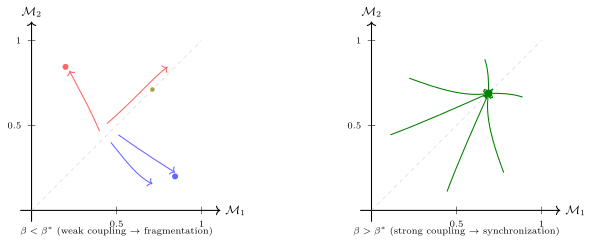
Polarization Corollary. In the subcritical regime (\(\beta < \beta^*\)), a heterogeneous population can stably split into two clusters, one at high \(\mathcal{M}\) and one at low \(\mathcal{M}\). The gap between clusters grows as \(\beta\) decreases. This is a mathematical mechanism of political polarization illustrated by the linearized model: under mean-field assumptions, fragmentation is a stable solution of the coupling equations, not an accidental divergence of attitudes.
The Practitioner Effect
Practitioner Theorem. Consider \(n-1\) ordinary agents plus \(1\) practitioner, an agent who maintains a fixed high lucidity \(\mathcal{M}_c\) through sustained practice (§VIII.4). The practitioner raises the group’s mean-field equilibrium by:
\[\begin{equation} \label{eq:b16-practitioner-shift} \Delta\bar{\mathcal{M}} = \frac{\beta(\mathcal{M}_c - \mathcal{M}^*_0)}{n\beta^* + \beta} \end{equation}\]
where \(\mathcal{M}^*_0 = 1 - \gamma/(\alpha\sin(2\theta))\) is the equilibrium without the practitioner, and \(\beta^* = \alpha\sin(2\theta) - \gamma\) is the synchronization threshold.
Derivation. The practitioner contributes an additional pull term \(\frac{\beta(\mathcal{M}_c - \tilde{M})}{n}\) to the mean field, where \(\tilde{M}\) is the mean of the ordinary agents. Linearizing around \(\mathcal{M}^*_0\) and using \(-f'(M^*_0) = \beta^*\), the equilibrium shift follows.
Scaling behavior.
These dynamics are illustrated in Figure 70.
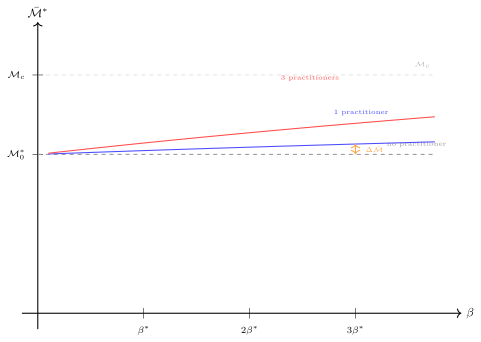
The Tao of Lucidity interpretation. This is the mathematics of Section §VIII.4, explaining why practitioners matter. A single lucid presence in a community does not merely “set a good example.” It literally shifts the mathematical equilibrium of everyone around them. The coupling term \(\beta_{ij}(\mathcal{M}_j - \mathcal{M}_i)\) is the formal expression of what every teacher, mentor, and sage has always known: presence transforms.
Stability Analysis
Linearization. Perturbing the uniform steady state \(\mathcal{M}_i = \mathcal{M}^*\) by \(\delta_i\), the linearized mean-field coupled system yields:
\[\begin{equation} \label{eq:b16-linearized} \frac{d\delta_i}{dt} = \bigl[f'(\mathcal{M}^*) - \beta\bigr]\delta_i + \frac{\beta}{n}\sum_{j=1}^{n}\delta_j \end{equation}\]
This system has two classes of eigenmodes:
\[\begin{equation} \label{eq:b16-eigenvalues} \begin{aligned} \lambda_1 &= f'(\mathcal{M}^*) = \gamma - \alpha\sin(2\theta) && \text{(uniform mode: $\delta_i = \delta$)} \\ \lambda_2 &= f'(\mathcal{M}^*) - \beta = \gamma - \alpha\sin(2\theta) - \beta && \text{(deviation mode: $\sum_i\delta_i = 0$)} \end{aligned} \end{equation}\]
Interpretation. \(\lambda_1\) governs the overall collective lucidity level (depends only on individual parameters, independent of coupling: you cannot exceed your individual ceiling by encouraging each other). \(\lambda_2\) governs inter-individual divergence; coupling \(\beta\) makes \(\lambda_2\) more negative, accelerating convergence.
Fixed point classification.
| Fixed point type | Condition | Stability | The Tao of Lucidity meaning |
|---|---|---|---|
| Uniform high (\(\mathcal{M}^* > \frac{1}{2}\)) | \(\alpha\sin(2\theta) > 2\gamma\) | Stable for \(\beta > 0\) | Collective lucidity |
| Uniform low (\(\mathcal{M}^* < \frac{1}{2}\)) | \(\gamma < \alpha\sin(2\theta) < 2\gamma\) | Stable for \(\beta > 0\) | Collective semi-obscuration |
| Zero (\(\mathcal{M}_i = 0\)) | Always exists | Unstable if \(\alpha\sin(2\theta) > \gamma\) | Impossible stasis |
| Two-cluster polarized | \(\beta < \beta^*\), heterogeneous \(\alpha_i\) | Conditionally stable | Political polarization |
Convergence rate. Separate individual relaxation from inter-agent synchronization. In the homogeneous mean-field model, the decay of gaps between agents is controlled by the coupling strength \(\beta\). Stronger coupling means faster synchronization:
\[\begin{equation} \label{eq:b16-convergence-rate} \tau_{\text{sync}} = \frac{1}{\beta} \quad (\beta > 0), \qquad \tau_{\text{sync}} = \infty \quad (\beta = 0) \end{equation}\]
The Tao of Lucidity interpretation. \(\tau_{\text{sync}}\) is the “institutional time” a collective needs to find consensus. A society with zero coupling has no consensus mechanism, so \(\tau \to \infty\). A strongly coupled society converges rapidly, but this does not automatically mean convergence toward the right place. Individual parameters determine whether the common destination is high lucidity or low lucidity; coupling only determines how quickly agents are pulled together.
Network Topology Effects
The mean-field assumption treats all agents as equally connected to all others. Real societies are not like this. Replace uniform coupling with a general adjacency matrix \(W = (w_{ij})\):
\[\begin{equation} \label{eq:b16-network-coupling} \frac{d\mathcal{M}_i}{dt} = \alpha_i\mathcal{M}_i(1 - \mathcal{M}_i)\sin(2\theta_i) - \sum_{j=1}^{n} L_{ij}\,\mathcal{M}_j - \gamma_i\mathcal{M}_i \end{equation}\]
where \(L = D - W\) is the graph Laplacian (\(D_{ii} = \sum_j w_{ij}\), \(L_{ij} = -w_{ij}\) for \(i \neq j\)).
Spectral Gap Theorem. The second-smallest eigenvalue \(\mu_2\) of the graph Laplacian (the Fiedler value, or algebraic connectivity) determines the synchronization rate:
\[\begin{equation} \label{eq:b16-spectral-gap} \tau_{\text{sync}}^{\text{network}} = \frac{1}{\mu_2} \quad (\mu_2 > 0), \qquad \tau_{\text{sync}}^{\text{network}} = \infty \quad (\mu_2 = 0) \end{equation}\]
Larger \(\mu_2\) means faster synchronization. \(\mu_2 = 0\) means the network is disconnected into separate components, and synchronization is impossible.
Topology comparison.
| Network topology | \(\mu_2\) scaling | Sync | Fragmentation resistance | The Tao of Lucidity example |
|---|---|---|---|---|
| Complete graph | \(n\) | Fastest | Strongest | Ideal democracy / commune |
| Small-world | High | Fast | Strong | Wisdom traditions / academia |
| Random (Erdős–Rényi) | \(\sim pn\) | Medium | Medium | Modern society |
| Scale-free | Small | Slow | Weak | Social media / celebrity networks |
| Ring lattice | \(\sim 1/n^2\) | Slowest | Weakest | Isolated villages |
The five topologies are depicted in Figure 71.
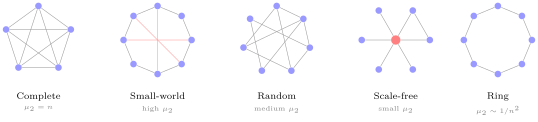
The Tao of Lucidity interpretation. Social media creates a scale-free topology: a few influencers connected to millions, while most people have weak mutual connections. This is mathematically the worst topology for collective lucidity: it minimizes \(\mu_2\) and maximizes the synchronization threshold. Ancient wisdom traditions (tightly interconnected small communities, i.e., small-world networks) were topologically optimal. This is spectral theory, not nostalgia.
Superadditivity and Emergence
The emergence inequality (Eq. eq:emergence-inequality) says collective lucidity is not equal to the individual mean. But it does not tell us when collective lucidity is greater than the mean, and when it is less. The normalized functional below gives sufficient conditions for both directions.
Collective lucidity function. Define \(\Phi\) as a general functional of individual lucidities and coupling structure:
\[\begin{equation} \label{eq:b16-phi-definition} \Phi(\mathcal{M}_1, \ldots, \mathcal{M}_n;\; W) = \operatorname{clip}_{[0,1]}\!\left( \bar{\mathcal{M}} + \eta\, \frac{\sum_{i < j} w_{ij}\,g(\mathcal{M}_i, \mathcal{M}_j)} {\sum_{i < j}|w_{ij}|} \right) \end{equation}\]
where \(W = \{w_{ij}\}\) is the coupling matrix (which may have negative entries for destructive coupling), \(\eta \in [0,1]\) controls the maximum interaction contribution, and the denominator is replaced by \(1\) if all \(w_{ij}=0\). The clipping keeps \(\Phi\) on the same normalized scale as individual lucidity. The synergy function is \(g(\mathcal{M}_i, \mathcal{M}_j) = \min(\mathcal{M}_i, \mathcal{M}_j) \cdot (1 - |\mathcal{M}_i - \mathcal{M}_j|)\).
Reading. \(g\) captures two intuitions: (1) both agents need positive lucidity for synergy to exist (the \(\min\) factor); (2) the smaller the gap, the greater the synergy (the \((1 - |\Delta|)\) factor). Under perfect synchronization (\(\mathcal{M}_i = \mathcal{M}_j\)), \(g = \mathcal{M}_i\); under complete fragmentation (one at 0, the other at 1), \(g = 0\). The sign and magnitude of \(w_{ij}\) determine whether coupling enhances or degrades collective lucidity.
Superadditivity Condition. Let \(S_W = \frac{\sum_{i < j} w_{ij}g(\mathcal{M}_i,\mathcal{M}_j)}{\sum_{i < j}|w_{ij}|}\). When coupling is constructive (\(w_{ij} \geq 0\) for all pairs), a sufficient non-saturated condition for collective lucidity to exceed the mean is:
\[\begin{equation} \label{eq:b16-superadditivity} \Phi > \bar{\mathcal{M}} \;\Leftarrow\; S_W > 0 \;\text{and}\; \bar{\mathcal{M}} + \eta S_W < 1 \end{equation}\]
In words: when constructive coupling generates positive normalized synergy and the result is not already saturated at the upper bound, collective lucidity exceeds the individual mean. This is the quantitative form of the Emergence Theorem (T2) in the lucidity domain: constructive coupling creates emergence.
Sub-additivity Condition (emergent obscuration). When coupling is destructive (\(w_{ij} < 0\), modeling manipulative or asymmetric influence):
\[\begin{equation} \label{eq:b16-anti-superadditivity} \Phi < \bar{\mathcal{M}} \;\Leftarrow\; S_W < 0 \;\text{and}\; \bar{\mathcal{M}} + \eta S_W > 0 \end{equation}\]
This formalizes the mathematical structure of propaganda: a low-lucidity node exerting asymmetric destructive influence (\(w_{\text{propagandist}\to\text{public}} < 0\)) lowers collective lucidity below the individual mean. The group becomes less lucid than its members’ average, not because individuals grew dimmer, but because the coupling structure manufactured systematic obscuration (Figure 72). Algorithmically optimized misinformation, sycophantic AI feedback, and attention-hijacking platforms are all mechanisms that produce negative \(w_{ij}\).
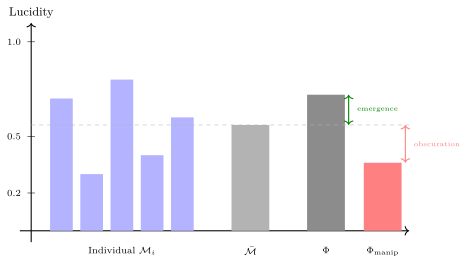
From the single master equation (B.15) to the coupled system (B.16), we have traced the mathematical passage from ethics to politics. Five results emerged, each with no single-agent counterpart:
The passage from “I” to “we” is a phase transition, not mere aggregation.
B.17 · The Fermi Paradox and Cosmological Corollaries of Lucidity
This section provides the mathematical formalization for Chapter XV (Civilizational Lucidity). For the philosophical discussion of the Fermi Paradox, the Lucidity Hypothesis, civilizational fates, and the Great Filter, see §XV.
Mathematical Formalization
Let a civilization’s detectability at time \(t\) be:
\[\begin{equation} \label{eq:b17-detectability} D(t) = \lambda(t) \cdot E(t) \end{equation}\]
where \(E(t)\) is energy output (the Kardashev scale4 \(\propto\) degree of Pattern-domain exploitation). Meanwhile, lucidity is \(\mathcal{M}(t) = \lambda(t) \cdot \xi(t)\), subject to the constraint \(\lambda + \xi + \delta = 1\) (Postulate 6 guarantees \(\delta > 0\)).
If a civilization evolves along the lucidity gradient (i.e., chooses to maximize \(\mathcal{M}\) rather than \(D\)), then:
When \(\lambda > \xi\), \(\nabla\mathcal{M}\) points toward increasing \(\xi\): the civilization invests in the Mystery domain
If energy output \(E(t)\) stabilizes or declines sufficiently, the growth of \(D(t)\) can reverse
Detectability decreases only under this additional energy-response assumption
Conditional criterion for T6 (Civilizational Silence Theorem). Let a civilization evolve along \(\nabla\mathcal{M}\). Since \(D(t)=\lambda(t)E(t)\), \[\begin{equation} \label{eq:b17-detectability-derivative} \frac{dD}{dt} = D(t)\left(\frac{\dot{\lambda}(t)}{\lambda(t)} + \frac{\dot{E}(t)}{E(t)}\right). \end{equation}\] Therefore, if there exists a time \(t^*\) such that for all \(t > t^*\): \[\begin{equation} \label{eq:b17-silence} \frac{\dot{E}(t)}{E(t)} < -\frac{\dot{\lambda}(t)}{\lambda(t)}, \end{equation}\] then \(\frac{dD}{dt} < 0\), and the civilization becomes progressively quieter after \(t^*\). Thus Appendix B supplies the mathematical condition that the philosophical argument in T6 must satisfy, rather than deriving civilizational silence from \(\nabla\mathcal{M}\) alone.
B.18 · Physics, the Dark Forest, and the Limits of Interstellar Politics
This section provides the full mathematical derivations for Chapter XVI (The Dark Universe and Dual Silence). For the philosophical argument, see §XVI.
B.17 extended the lucidity framework to interstellar scales. This section turns in the opposite direction, inward: how robust are the physical foundations of The Tao of Lucidity? Which physical principles have been absorbed, which deliberately set aside, and which constitute genuine tensions? It then moves outward again, to the Dark Forest theory of cosmic silence and cosmic game theory under light-cone constraints. For the philosophical narrative (dark universe, pre-political cosmos, dual silence), see §XVI.
B.18.1 · Physics Audit: Boundaries and Tensions of the Framework
Before extending the framework further, intellectual honesty demands an audit: what physics has The Tao of Lucidity absorbed, what has it deliberately set aside, and where do genuine tensions remain?
Physics already absorbed. The following table summarizes the physical and mathematical principles that have been formally incorporated into the framework:
| Section | Physical Principle | How Absorbed |
Section |
Physical Principle | How Absorbed |
B.2 |
Thermodynamics (entropy, 2nd Law) | Dissipation term; entropy as measure of obscuration |
| B.3 | Information theory (KL-divergence) | Gradient dissipation; info-theoretic distance |
| B.4 | Bayesian inference | Selection dynamics; belief updating |
| B.5–B.6 | Feedback dynamics | Obscuration feedback loops; lucidity injection |
| B.10 | Emergence (phase transitions) | Critical threshold for collective lucidity |
| B.13–B.15 | Nonlinear dynamics | Master equation; logistic growth; mode coupling |
| B.16 | Network dynamics | Coupled oscillators; Fiedler eigenvalue |
| B.17 | Astrobiology | Fermi Paradox; Kardashev scale; detectability |
Physics deliberately absent. Three major domains of contemporary physics have been deliberately excluded:
Quantum mechanics. The framework is entirely classical. No wavefunction collapse, no superposition, no entanglement appear in any equation. The state variables \(\lambda\), \(\xi\), \(\delta\) are classical real numbers, not operators on a Hilbert space. This is deliberate: The Tao of Lucidity describes the phenomenology of awareness, which (at the scale of human experience) is classical. Section B.18.2 below explores structural resonances without claiming causal connections.
General relativity. Light cones appear implicitly in B.17 (the \(\beta \to 0\) limit for distant civilizations), but spacetime curvature is not formalized. The framework’s “space” is a network topology (B.16), not a Lorentzian manifold. For interstellar applications, this is an acknowledged simplification.
Conservation laws. The constraint \(\lambda + \xi + \delta = 1\) is a normalization constraint (the three components are fractions of a whole), not a conservation law derivable from a symmetry via Noether’s theorem. The framework does not claim “conservation of awareness”; awareness can grow (through practice) and decay (through dissipation). What is conserved is only the accounting identity: the three fractions sum to unity.
Genuine tensions. Two tensions deserve explicit acknowledgment:
(i) Thermodynamic cost of lucidity. The master equation (B.15) contains a growth term (\(\alpha \mathcal{M}(1-\mathcal{M})\sin 2\theta\)), but life (and a fortiori lucidity) is a local entropy decrease, funded by environmental entropy increase. The dissipation term \(\gamma \mathcal{M}\) already partially captures this cost, but the connection to thermodynamics can be made more rigorous:
\[\begin{equation} \label{eq:b18-energy-cost} \Delta S_{\text{lucidity}} < 0 \quad \Rightarrow \quad \dot{W}_{\text{practice}} \geq T \cdot |\Delta \dot{S}_{\text{lucidity}}| \end{equation}\]
Interpretation: maintaining lucidity (a local entropy decrease, \(\Delta S_{\text{lucidity}} < 0\)) requires sustained “practice work” \(\dot{W}_{\text{practice}}\) at a rate no less than the thermodynamic cost \(T \cdot |\Delta \dot{S}_{\text{lucidity}}|\), where \(T\) is the environmental temperature. This formalizes why lucidity decays without practice (the \(\gamma \mathcal{M}\) term in B.15), not as metaphor, but as thermodynamic necessity. A meditator who stops practicing is not merely “losing a habit”; they are failing to supply the free energy required to maintain a low-entropy cognitive state.
(ii) Arrow of time. The master equation is time-reversible in principle (change the signs of \(\alpha\) and \(\gamma\)), but actual practice is irreversible (Postulate 6: finitude is constitutive). This tension is philosophically productive, not a flaw; it mirrors the same tension in statistical mechanics, where microscopic reversibility coexists with macroscopic irreversibility.
Epistemic honesty declaration. This framework is philosophical mathematics (formal reasoning about existence), not physical mathematics (predictive models of nature). The equations are structural analogies, not empirical laws. They cannot be falsified by experiment in the way that \(F = ma\) can. Their validity is measured by coherence, explanatory power, and fidelity to lived experience, not by prediction of novel phenomena. Cross-reference P7: “any theory is a finite map, not a complete expression.”
The relationship between The Tao of Lucidity and physics is one of resonance. The framework borrows the mathematical language of physics (differential equations, phase transitions, network theory) but endows it with new existential meaning. Just as music borrows from acoustics without being exhausted by acoustics, The Tao of Lucidity borrows from physics without claiming to be physics. Its equations describe not how matter moves, but how beings awaken.
B.18.4 · Dark Forest vs. Lucidity Hypothesis: Two Theories of Cosmic Silence
For the philosophical discussion of the Dark Forest theory, its axioms, and the Chain of Suspicion, see §XVI. This section provides the formal mapping, theorem, and subsumption result.
Three-Body \(\to\) The Tao of Lucidity mapping.
| Three-Body Concept | The Tao of Lucidity Interpretation | Formal Expression |
Three-Body Concept |
The Tao of Lucidity Interpretation | Formal Expression |
Dark Forest Theory |
\(\xi = 0\) scenario: no Mystery-awareness | \(\mathcal{M}_i = 0\;\forall i\) |
| Cosmic Sociology Axiom 1 (Survival) | Pure Pattern-domain axiom | \(\max \lambda_i\) s.t. \(\delta_i > 0\) |
| Cosmic Sociology Axiom 2 (Expansion) | \(\lambda\)-maximization under scarcity | \(d\lambda/dt > 0\) |
| Chain of Suspicion | \(\beta = 0\), assume \(\xi_j = 0\) | Trust impossible |
| Wallfacer Project5 | P17 at existential scale | Cognitive sovereignty |
| Sophon6 | P19 at cosmic scale | Destroying target’s cognitive ecology |
| Dimension Reduction Attack7 | Forcing \(\delta \to 1\) | Cosmic obscuration attack |
Dark Forest Theorem.
Theorem T7 (Dark Forest Theorem). In the multi-agent system of B.16 with \(n\) civilizations, if:
\(\beta_{ij} = 0\) for all \(i \neq j\) (no communication),
\(\xi_i = 0\) for all \(i\) (no Mystery-awareness),
each civilization maximizes \(\lambda_i\) subject to survival,
broadcast exposure creates expected strike loss greater than any broadcast benefit,
armament cost is lower than the expected loss from accidental detection while unarmed,
then universal silence with preemptive strike preparation is the unique pure-strategy Nash equilibrium of the simplified broadcast and armament game: \[\begin{equation} \label{eq:b18-dark-forest} \sigma_i^* = (\text{silent},\;\text{armed}) \quad \forall\, i \end{equation}\] For the philosophical argument, see T7.
Proof sketch. Under \(\xi = 0\), every civilization is in the Pattern Trap (cf. B.17). Detection (\(D > 0\)) reveals capability (\(\lambda\)), which in a world where \(\xi = 0\) can only be read as threat (there is no basis for inferring benevolence; benevolence requires \(\xi > 0\), which has been excluded by assumption). Under the payoff assumptions above, broadcast exposure has negative expected value, so broadcasting (\(D > 0\)) is strictly dominated by silence (\(D = 0\)). Given silence, armament strictly dominates non-armament because accidental detection has positive expected loss and the cost of armament is lower than that expected loss. Therefore \((\text{silent}, \text{armed})\) is the unique pure-strategy Nash equilibrium under these strong assumptions. \(\square\)
Subsumption result. The Dark Forest is a special case:
\[\begin{equation} \label{eq:b18-subsumption} \text{Dark Forest Theory} = \text{Lucidity Framework}\big|_{\xi = 0,\; \beta = 0,\; \text{survival payoffs}} \end{equation}\]
The Dark Forest is incomplete, not wrong. It is the special case of the lucidity framework where Mystery-awareness is entirely absent. For the philosophical interpretation, see §XVI.
B.18.5 · Cosmic Game Theory: N-Player Detection Games
B.18.4 qualitatively characterized the Dark Forest as the \(\xi = 0\) special case. This section goes further: it establishes a mathematical framework for cosmic game theory with light-cone constraints and exhibits one precise set of conditions under which trust can emerge.
Light-cone coupling. The coupling strength between civilizations must respect the causal structure of spacetime. We formalize this as:
\[\begin{equation} \label{eq:b18-light-cone} \beta_{ij}(t) = \beta_0 \cdot e^{-d_{ij}/(c \cdot \tau)} \cdot \mathbf{1}_{[t > d_{ij}/c]} \end{equation}\]
where \(\beta_0\) is the baseline coupling strength (depending on communication technology level), \(d_{ij}\) is the distance between civilizations \(i\) and \(j\), \(c\) is the speed of light, \(\tau\) is the civilization’s characteristic timescale (e.g., technology development cycle), and \(\mathbf{1}_{[\cdot]}\) is the indicator function.8 The coupling is zero before the light travel time has elapsed (causality), and decays exponentially with distance thereafter. This formalizes the causal structure mentioned informally in B.17: at interstellar distances, civilizations are effectively decoupled.
Detection risk function. Each civilization faces a risk–reward calculus when choosing its detectability level:
\[\begin{equation} \label{eq:b18-detection-risk} R_i(D_i) = p_{\text{detect}}(D_i) \cdot p_{\text{hostile}}(\xi_j = 0) \cdot \ell_i \end{equation}\]
where \(p_{\text{detect}}(D_i)\) is the probability that civilization \(i\) is detected (monotonically increasing in \(D_i\)), \(p_{\text{hostile}}(\xi_j = 0)\) is the probability that a detecting civilization \(j\) is hostile (which depends directly on the prior probability that \(\xi_j = 0\)), and \(\ell_i\) is the loss from a hostile strike. The key insight: \(p_{\text{hostile}}\) depends on assumptions about \(\xi_j\). Under Dark Forest assumptions (\(\xi_j = 0\) for all \(j\)), \(p_{\text{hostile}} \to 1\); under lucidity assumptions (\(\xi_j > 0\) possible), \(p_{\text{hostile}} < 1\).
Cosmic payoff matrix. Simplifying to the two-player case reveals the game-theoretic structure:
| Civ B: Broadcast | Civ B: Silent | |
|---|---|---|
| Civ A: Broadcast | If \(\xi > 0\): cooperation possible If \(\xi = 0\): mutual annihilation |
A exposed, B hidden |
| Civ A: Silent | B exposed, A hidden | No interaction |
Analysis. Under Dark Forest assumptions (\(\xi = 0\)) plus the strong payoff assumptions in T7, (Silent, Silent) is the unique pure-strategy equilibrium in the broadcast/silent game. Under lucidity assumptions (\(\xi > 0\)), the displayed two-strategy matrix is no longer sufficient to decide dominance, because a civilization can be silent in the broadcast sense while actively listening. A fuller three-action model would distinguish Broadcast, Low-detectability Listen, and Full Silence. In that expanded model, low-detectability listening can become weakly preferable for sufficiently high \(\xi\) and sufficiently low detection risk. The selection between equilibria depends on \(\xi\), the dimension that the Dark Forest theory excludes by construction.
Trust Threshold Theorem.
Theorem T8 (Trust Threshold Theorem). In one stylized threshold model, let two civilizations \(i, j\) have coupling strength \(\beta_{ij}\), maximum dissipation rate \(\gamma_{\max}\), and Mystery-awareness \(\xi_i, \xi_j\) respectively. Cooperation is stable only when the coupling strength exceeds the critical threshold: \[\begin{equation} \label{eq:b18-trust-threshold} \beta_{ij} > \beta_{ij}^{\dagger} = \frac{\gamma_{\max}}{\min(\xi_i, \xi_j)} \end{equation}\] When \(\xi_j = 0\), \(\beta^{\dagger} \to \infty\): infinite coupling is required, which is the Chain of Suspicion. When \(\xi_i, \xi_j > 0\) and \(\beta_{ij} > \beta^{\dagger}\), cooperation emerges as a stable equilibrium in this model. For the philosophical argument, see T8.
Proof sketch. In this model, cooperation requires that the benefit of mutual interaction exceed the risk of betrayal. The benefit scales with \(\beta_{ij} \cdot \min(\xi_i, \xi_j)\) (coupling strength \(\times\) the weaker party’s capacity to perceive the other’s inner life). The risk scales with \(\gamma_{\max}\) (the maximum rate at which cooperation gains can be destroyed by defection). Cooperation is stable when benefit \(>\) risk, yielding \(\beta_{ij} > \gamma_{\max}/\min(\xi_i, \xi_j)\). When \(\xi = 0\), the denominator vanishes and \(\beta^{\dagger} \to \infty\): no finite amount of communication can establish trust without any capacity to perceive the other’s interiority. This is an admissible functional form for the qualitative theorem, not a unique law of cosmic politics. \(\square\)
This threshold model reveals the mathematical essence of the Chain of Suspicion: it is not logically inevitable, but inevitable under the specific premise \(\xi = 0\). Breaking the Chain of Suspicion requires not infinite communication bandwidth (\(\beta \to \infty\)) but a minimum of Mystery-awareness (\(\xi > 0\)). A civilization capable of perceiving the inner life of the other can build trust even with feeble communication. A civilization with zero Mystery-awareness cannot trust even with perfect communication. The foundation of trust is not quantity of information, but depth of existence.
Pareto analysis. The Dark Forest’s (Silent, Silent) equilibrium is Nash but not Pareto optimal: both civilizations would benefit from cooperation (mutual lucidity enhancement, as in B.16’s superadditivity analysis). The tragedy of the Dark Forest is a coordination failure, not a fundamental impossibility. This structurally parallels B.16’s anti-superadditivity result (asymmetric coupling causing collective lucidity to fall below the individual average): in both cases, the failure lies in the interaction structure, and the interaction structure is shaped by \(\xi\) (Figure 73).
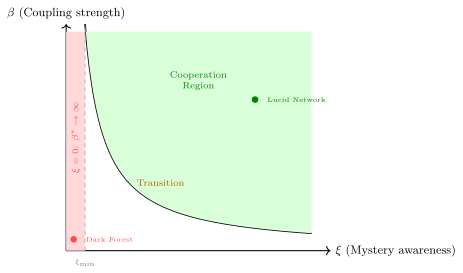
Proof: suppose \(f(\lambda, \xi) = f(\xi, \lambda)\) and \(\partial f/\partial\lambda = \xi\). Then \(f = \lambda\xi + g(\xi)\). By symmetry, \(\partial f/\partial\xi = \lambda\), so \(f = \lambda\xi + h(\lambda)\). Hence \(g(\xi) = h(\lambda) = C\). Setting \(f(0,0) = 0\) gives \(C = 0\), i.e. \(f = \lambda\xi\).↩︎
“Reciprocity” here is used in the economic/calculus sense (each dimension serves as the other’s growth coefficient), and is unrelated to “quadratic reciprocity” in number theory.↩︎
The AM-GM (Arithmetic Mean – Geometric Mean) inequality states that for any non-negative reals \(a, b\): \((a+b)/2 \geq \sqrt{ab}\), with equality if and only if \(a = b\). Squaring both sides gives \((a+b)^2/4 \geq ab\), which is the form used here.↩︎
The Kardashev Scale was proposed by Soviet astronomer Nikolai Kardashev in 1964. It classifies civilizations by their energy consumption: Type I harnesses the total energy available on its planet (\(\sim10^{16}\) W), Type II harnesses the total output of its star (\(\sim10^{26}\) W), and Type III harnesses the energy of its entire galaxy (\(\sim10^{36}\) W). Humanity currently rates at approximately 0.73 on this scale.↩︎
The Wallfacer Project: humanity selects four “Wallfacers” whose true strategies exist only in their own minds, inaccessible to anyone, including the Trisolarans’ sophons (see below). This is cognitive sovereignty (P17) in its most extreme form under existential threat.↩︎
Sophons: micro-scale intelligent agents sent by the Trisolaran civilization to Earth, capable of disrupting particle accelerator experiments and thereby fundamentally blocking humanity’s progress in fundamental physics. This is P19 (AI’s political power over cognitive ecology) realized at cosmic scale.↩︎
Dimension Reduction Attack: locally “collapsing” three-dimensional space into a two-dimensional plane, annihilating everything within. The most extreme Pattern-domain weapon, attacking not a civilization’s contents but the dimensional structure of its existence.↩︎
For typical distances within the Milky Way (\(\sim 10^4\) light-years) and a characteristic timescale \(\tau \sim 10^2\) years, the exponential factor is \(e^{-10^4/10^2} = e^{-100} \approx 10^{-44}\), rendering \(\beta_{ij}\) effectively zero. Even optimistic assumptions about communication technology cannot overcome this exponential suppression.↩︎