Part I · The Scale of Reality · What is real?
II · The Inner Face of Pattern
~16 min left · 3,934 words
II · The Inner Face of Pattern
§I gave the framework its metaphysical skeleton: six postulates, five theorems, eleven propositions. Yet Postulate 3 names Tao’s intelligible aspect, Pattern, without showing how Pattern looks from within. What is its inner structure? How does it operate? Where does it meet its limits? If we are to face the AI age lucidly, we must understand how intelligibility itself works, because AI is the most powerful instrument of Pattern we have yet built. This chapter unfolds Pattern’s four fundamental modes and arrives, at the end, at a crucial intersection: probability, the meeting point of Pattern and Mystery.
II.1 · Pattern Is Not a Clock
For three centuries, to “understand the universe” meant to track down its deterministic laws: fix the starting conditions and the outcome follows, exact to the decimal. Laplace dreamed up an all-seeing “demon”1: hand it the position and speed of every particle alive, and it could reel off the whole future in advance. Pattern, in this dream, was a vast clock, every gear precise, every tick foreseen.
Twentieth-century physics demolished this picture. At the most fundamental level, quantum mechanics tells us, the universe runs on probability rather than determinism. An electron has no definite position; it exists as a cloud of probability. A radioactive atom does not decay at an appointed moment, only with a certain likelihood of decaying. And this is no gap in our knowledge2.
But this is Pattern’s upgrade.
Pattern is no clock. Picture instead a weaver who throws dice as she works: the dice tumble freely, yet the odds by which they settle obey laws as exact as any clockwork. The universe yields to understanding not because it ticks along some fixed track, but because the shape of its chances stays steady, and a steady shape can be read.
This is a deeper insight than determinism: Pattern contains uncertainty, but uncertainty itself has structure.
(independence from quantum interpretation): This chapter’s use of quantum-mechanical probability does not depend on any particular interpretation of quantum mechanics. Whether one adopts the Copenhagen interpretation (probability is ontological), the many-worlds interpretation (probability is branch weight), or Bohmian mechanics (probability is epistemological), The Tao of Lucidity’s core claim holds across the major interpretive frameworks: uncertainty is structural rather than merely temporary ignorance. Under fully deterministic interpretations, this claim requires the weaker formulation “epistemological uncertainty is ineliminable,” which still suffices to support the framework’s conclusions. See §XIX.1 (the fragility of probabilistic ontology) and §XIX.2 (Objection VI).
II.2 · The Upgrade of Understanding
In the deterministic worldview, “understanding” meant “predicting precisely.” In the probabilistic worldview, “understanding” means “correctly describing the distribution of possibilities.” I do not need to predict the exact second when this atom will decay; I need to know its half-life. I do not need to force tomorrow’s weather into certainty; I need to know the probability of rain.
This is deeper understanding: it honestly includes uncertainty rather than pretending uncertainty does not exist.
Implication for The Tao of Lucidity practice: when you understand a system deeply, see not only its deterministic structure (causes, patterns) but also its probabilistic one: what is possible, what is unlikely, and where uncertainty draws its borders. Whoever sees only determinism is caught off guard the moment uncertainty arrives. Whoever also reads the probabilistic structure stays lucid within that uncertainty, because the uncertainty has itself become part of what he understands.
II.3 · The Four Fundamental Modes of Pattern
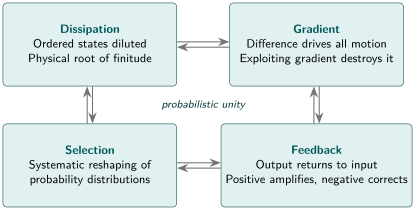
Pattern (D3) is not one kind of order; it unfolds (D2) through four fundamental modes (Figure 8).
Why precisely these four? The selection answers to four constraints. Minimality: cover the widest range of dynamic phenomena with the fewest fundamental modes. Mutual irreducibility: none of the four can be assembled from the other three. Chaos can be read through feedback and gradient, self-organization through the synergy of all four, yet dissipation, gradient, selection, and feedback stay independent of one another. Probabilistic unity: all four speak the language of probability, which is precisely where Pattern and Mystery meet (§III.2). And symmetry: each mode of Pattern answers to one depth of Mystery, forming a fourfold mapping between them. Other candidates, such as symmetry breaking, emergence, information, and network topology, either combine these modes or describe relations among them rather than standing as modes in their own right. So the partition is disciplined, but it does not claim to be final: it is a well-motivated classification. Should a genuinely irreducible fifth mode ever come to light, the framework would stretch to receive it rather than break.
The first mode is dissipation, or entropy. You raise a sandcastle on the beach. The tide is still far out, yet the wind is already rounding off the little battlements you cut, and the grains are settling under their own weight. From the instant the last tower is done, the castle is on its way back to flat sand. No enemy need come to “destroy” it: coming apart is the default heading, the one direction that asks for no help at all.
This is no metaphor. It is the daily face of the Second Law of Thermodynamics3. Every structure leans toward coming apart. The coffee goes cold. The mountain wears down. The empire frays. The person dies. Of all the states a thing might occupy, the orderly ones are vanishingly few and the disorderly ones beyond counting. A deck sorted by suit has exactly one arrangement; shuffled at random, it has more than the mind can hold. The universe harbors no taste for disorder. Order simply thins out, a few drops lost in an ocean of possibility.
Your life, an exquisitely ordered structure, is fighting dissipation every moment. You eat, you breathe, you hold your body at thirty-seven degrees: each of these is a local stand against decay. When you stop fighting, you die. The Finitude Postulate (Postulate 4) has its physical root precisely here. And the machine waging war beside you fights the same war: the standard loss function for training a neural network, cross-entropy, measures exactly how scattered a model’s predictions are from the true distribution. A body’s metabolism and a model’s learning are isomorphic struggles, both holding a small pocket of order against the surrounding drift toward disorder. The formal model appears in Appendix B.2, Eqs. (eq:shannon-entropy)–(eq:life-entropy).
The second mode is gradient. Picture a universe ironed perfectly flat: the same temperature everywhere, the same density, the same energy at every point. In a place like that, nothing stirs. No flow, no change, no life. Motion has one precondition, and that precondition is difference.
Heat slides from hot to cold, water from high ground to low, capital from thin returns to fat ones, attention from boredom toward whatever lights it up. Tao unfolds along these slopes. Yet a deep paradox waits at the bottom of every one: to ride a gradient is to wear it away. Conduction levels the temperature gap, diffusion levels the concentration gap, trade levels the price gap. Each “success” saps the very force that powered it.
The rise and fall of the Venetian Republic holds the whole story in miniature. Venice climbed on the price gradient between East and West: a sack of Eastern spice could sell in Europe for several times, sometimes ten times, its source price. But the trade itself narrowed the gap. As more merchants crowded the same routes, profit margins inevitably shrank. Venice’s “success” sowed the seeds of its own decline: working the gradient flattened the gradient. The same paradox reappears in AI training in precise mathematical form. “Gradient descent” moves downhill along the loss function, but as optimization deepens, the gradient itself tends to vanish (the vanishing gradient problem), and the system stalls on flat plateaus. Civilizations and algorithms share the same structural predicament. The formal model appears in Appendix B.3, Eqs. (eq:gradient)–(eq:gradient-dissipation).
The third mode is selection. “Survival of the fittest”: these four words may be among the most deeply misread phrases in the history of science. They conjure an image of the strong tearing the weak apart, selection as a kind of slaughter. But the true mechanism has nothing to do with violence and needs no designer presiding over it. Whatever persists better, persists more. That is the whole of it. The same quiet sorting runs through molecules, genes, ideas, companies, and civilizations: before selection, the variants stand at roughly equal odds; after it, some are amplified and others compressed, and possibility-space has been quietly redrawn. Evidence changes the probability of hypotheses4; evolution reshapes populations; AI training retains parameters that reduce error and discards those that increase it. Selection is repeated probability revision across domains. The formal model appears in Appendix B.4, Eqs. (eq:bayes)–(eq:selection-n).
The fourth mode is feedback. You click on a news article. The algorithm remembers your click. Next time you refresh, three more articles like it appear. You click on two of them. Three months later, your information world has narrowed to a tunnel; and you are oblivious, because the tunnel walls are papered with things you “chose yourself.”
This is positive feedback: the output loops back as input, and the cycle feeds on itself, growing louder each turn. Bank runs, a video going viral, beliefs hardening at the poles, the news tunnel just described: in each, output piles onto output. Thermostats, the balance of predator and prey, a market settling on its price: these run on negative feedback, where every swing gets reined back toward the middle.
Positive feedback concentrates possibilities into fewer options; negative feedback maintains diversity. A healthy system needs both in balance. The Tao of Lucidity ethics’ central concern (the positive feedback loop of obscuration (D6)) is precisely a diagnosis of this imbalance: AI recommendations reinforce your biases, your biases reinforce AI recommendations, and without external negative feedback (critical thinking, exposure to different viewpoints), the system trends toward extremes. The essence of obscuration is positive feedback dominance with negative feedback absence. The formal model appears in Appendix B.5, Eqs. (eq:linear-feedback)–(eq:lucidity-feedback).
(synthesis): The four modes above are not merely a taxonomy; they can be combined into a single master equation governing how Lucidity evolves over time (Appendix B.15). In this equation, feedback drives growth, selection sets the ceiling, gradient modulates balance, and dissipation drags against maintenance. A surprising corollary: imbalance is mathematically equivalent to self-imposed additional dissipation; a biased agent is not merely inefficient; they are accelerating their own degradation.
The four modes describe the dynamic face of Pattern: how Pattern operates out in the world. But they also operate reflexively. When an agent (D7) turns Pattern’s modes back upon Pattern itself, what emerges is mathematics, logic, and reasoning. These are not a fifth mode; they are the same four modes running in the cognitive domain rather than the physical one.
Logic is selection in idea-space. Out of the vast field of all sayable statements, deductive logic keeps only the valid ones, and a proof reshapes the probability over conclusions exactly as the environment reshapes a population: before the proof a conjecture might be true or false; after it, its truth is necessary.
Reasoning is feedback in the space of ideas. You float a hypothesis, hold it up against the evidence, revise, and hold it up again. The scientific method is just negative feedback written down and turned loose on belief. When reasoning curdles into confirmation bias, motivated reasoning, the ideological echo chamber, it breaks in the exact manner this chapter has already named: positive feedback running wild, negative feedback nowhere to be found. A mind locked inside its own confirmations and a news feed locked inside algorithmic amplification are one disease wearing two faces.
Proof is gradient-following in idea-space. A proof moves down a logical slope from premises toward conclusion, living off the difference between what is established and what remains to be shown; and like every act of gradient-exploitation, solving the problem destroys the gradient. Once proved, the gap closes, and the theorem comes to look “obvious” in hindsight. This is why mathematics advances irreversibly: each solved problem flattens a slope that can never be descended in quite the same way again.
Mathematical truth, meanwhile, resists dissipation more stubbornly than anything else in the universe. \(2+2=4\) holds no matter how much entropy rises. Empires fall, languages die, stars burn out, yet the Pythagorean theorem remains. Mathematics is Pattern at its most crystallized, and this is the deepest reason mathematical knowledge can be shared without loss (see P-Share below): what does not decay can be passed on intact.
(reflexivity): That cognition runs on the same four modes as physical reality is no coincidence; it follows from the agent (D7) being embedded in Tao (D1). An agent’s cognitive apparatus is itself a physical system subject to dissipation, gradient, selection, and feedback, so when it models the world it does so using the very modes it is trying to model. Pattern comprehending Pattern is a structural inevitability. The same reflexivity is why AI can reason at all: artificial neural networks implement selection (backpropagation), feedback (recurrence), gradient-following (optimization), and dissipation-resistance (weight persistence) in silicon rather than carbon. The substrate differs; the four modes are identical.
The four modes thus have two faces: an outward face (how Pattern operates in nature) and an inward face (how agents comprehend Pattern through reasoning). But Pattern has one more static characteristic, perhaps its most striking one.
Pattern’s most distinctive feature is shareability: a mathematical theorem, once proved, belongs to everyone regardless of who discovered it. Algorithms can be perfectly copied; knowledge can be transmitted losslessly. AI is the ultimate embodiment of Pattern’s shareability: a model trained once can be deployed infinitely. This is pattern-awareness accumulation at the civilizational scale (§XV): Pattern’s shareability enables knowledge to compound across individuals and generations.
But shareability has a boundary. Understanding Pattern (that “aha!” moment) cannot be transmitted. You can transmit every step of a proof, but not the experience of understanding it. This is why education cannot be reduced to delivery: Pattern’s content can be transmitted, but Pattern’s experience must be awakened in a living agent. This is also the trap that civilizations must guard against when accumulating pattern-awareness: the piling up of information is not the growth of understanding (§XV.2). The converse also holds: a civilization can possess collective wisdom that no individual member fully grasps: constitutional traditions, scientific paradigms, insights crystallized through intergenerational practice (CV-Irr.2).
The content of Pattern can be transmitted losslessly, but understanding Pattern (the “aha!” moment of grasping structure) cannot be transmitted.
Argument. By D3, Pattern is structure that can be recognized, modeled, and reproduced; by D2, unfolding allows the same structure to keep formal identity across different contexts. Proofs, formulas, and algorithms can therefore be copied and transmitted as content. Understanding, however, is an agent’s live grasp of the structure. Copying a proof copies the structure, but it does not copy the moment of grasping. Thus Pattern’s content is shareable, while understanding cannot be handed over.
The accumulation of information is not the growth of understanding.
A mathematical theorem, once proved, belongs to everyone; an algorithm can be perfectly copied. These are concrete manifestations of Pattern’s shareability. But education is not mere transmission; at the civilizational scale, the growth of pattern-awareness is not equivalent to the growth of lucidity. Why may an age of information explosion simultaneously be an age of understanding deficit? AI deployment increases information-processing capacity (pattern-awareness), not depth of understanding. A civilization with powerful AI may far exceed any historical civilization in the pattern-awareness dimension, yet be no higher in mystery-awareness: perhaps even lower, as dependence on AI may erode humanity’s own capacity for understanding. This is the micro-foundation of the civilizational lucidity analysis in §XV.
II.4 · Probability: Where Pattern Meets Mystery
Each of these four modes can be understood more deeply in the language of probability: dissipation as the dilution of ordered states in possibility space, gradient as the non-uniformity of probability distributions, selection as the systematic reshaping of probability distributions, feedback as the self-reinforcement or self-correction of probability distributions.
But probability simultaneously reveals Pattern’s boundary. Uncertainty itself has layers5: from risk with known distributions (pure Pattern), through ambiguity with a known set of possible distributions (Pattern-Mystery boundary), to deep uncertainty where even the distributions are unknown (Mystery’s domain). Our most important life decisions almost always fall in the latter two layers.
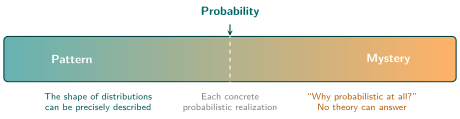
The shape of a probability distribution can be perfectly described mathematically. This belongs to Pattern.
But no theory can answer the question “why is the universe probabilistic rather than deterministic?” This belongs to Mystery. Figure 9 marks this exact midpoint.
Deeper still: each concrete probabilistic realization (this particular electron appearing here and not there) also belongs to Mystery. A probability distribution can tell you all possible outcomes and their probabilities, but it cannot tell you “why this outcome.”
Your life is the same. The probability of your birth (this particular sperm meeting this particular egg) is astronomically low. “You” are, in probabilistic terms, nearly impossible. Yet here you are. Pattern can calculate this probability; Mystery silently receives this fact.
Probability is the precise meeting point of Pattern and Mystery; the structure of probability belongs to Pattern; the existence of probability belongs to Mystery. This is a philosophical commitment, not a mathematical proof. A thoroughgoing physicalist can coherently classify concrete realizations as Pattern-governed events that merely exceed finite prediction. The Tao of Lucidity classifies them as Mystery for reasons developed in §III.3, where the epistemic status of this commitment is examined explicitly.
Even probability theory’s own axiomatic system confirms this boundary. Kolmogorov’s 1933 axiomatization in Grundbegriffe der Wahrscheinlichkeitsrechnung specified how probability operates through non-negativity, normalization, and countable additivity, yet remained silent on what probability is: frequency, degree of belief, or physical propensity. That silence is a manifestation of Mystery within Pattern’s most precise instrument. See Appendix B.1. Pattern’s most precise instrument, at its very core, points beyond Pattern.
Formal Structure Dependency Diagram
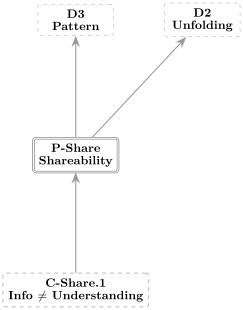
Figure 10 shows the logical dependencies among this chapter’s formal structures. An arrow \(A \to B\) means “\(A\) depends on \(B\)” (\(B\) is a premise of \(A\)). Structures at the same logical depth are arranged horizontally. Grey nodes are structures defined in Chapter I and inherited here.
Summary
Pattern is dynamic structure unfolding through four fundamental modes, not static order: dissipation, gradient, selection, and feedback. Together these modes constitute the full face of intelligibility, and all four can be unified in the language of probability. Probability is the precise meeting point of Pattern and Mystery: the structure of probability belongs to Pattern; the existence of probability belongs to Mystery. The next chapter approaches from Mystery’s side, revealing the unspeakable depths that lie beyond Pattern.
Inquiries
Pattern (Tao’s intelligible-order face) unfolds through four fundamental modes: dissipation (order flowing into disorder), gradient (motion along a difference), selection (choice among possibilities), feedback (closed loop). Which one most dominates your current way of thinking? Might it also be obscuring the other three?
P-Share (the Untransmissibility-of-Understanding Proposition) says content (information, propositions, formulas) can be transmitted, but understanding (first-person grasping) cannot. Recall a moment when you “got it”: could that insight be taught to someone else? If not, where does its value lie?
The four modes of Pattern operate both externally (in nature) and internally (in cognition: logic, reasoning, proof, mathematics). Is this symmetry a coincidence, or a structural consequence of finite agents (D7: finite beings unfolding within Tao) embedded in Tao?
Bell’s theorem shows that uncertainty is the shape of reality itself. If grasping probability distributions is the deepest form of understanding, how does this change your expectations about certainty?
How do feedback loops (positive amplifying, negative stabilizing) operate in your daily life? Identify a positive feedback loop you are currently caught in: what is it amplifying?
This chapter says probability is the precise meeting point of Pattern (intelligible structure) and Mystery (unspeakable depth): the structure belongs to Pattern; the existence belongs to Mystery. Can you illustrate this meeting point with an everyday experience?
Gradients (slopes of difference) drive all motion, but exploiting a gradient destroys it (Venice’s commercial decline is one example). What gradients in your own life are being consumed?
Pierre-Simon Laplace proposed this thought experiment in his A Philosophical Essay on Probabilities (Laplace 1814) (1814): a hypothetical intelligence that knows the position and momentum of every particle could compute the entire past and future. This “demon” became the symbol of mechanical determinism. Heisenberg’s uncertainty principle (Heisenberg 1927) (1927) physically negated Laplace’s demon, not because our measurements are insufficiently precise, but because particles do not possess simultaneously definite position and momentum prior to measurement.↩︎
In 1964, physicist John Bell (1928–1990) proved a theorem: if quantum probability merely reflected some hidden deterministic variable, then certain measurable statistical correlations would have to satisfy a set of inequalities (Bell inequalities). Decades of experiments, from Alain Aspect (1982) to the work of the 2022 Nobel laureates in physics, have repeatedly confirmed that quantum systems violate Bell’s inequalities. The implication: quantum probability cannot be explained away as ignorance of an underlying deterministic world. The universe is genuinely probabilistic at the most fundamental level.↩︎
The Second Law of Thermodynamics (Clausius, 1850; Boltzmann, 1877): in a closed system, entropy (disorder) never spontaneously decreases. Boltzmann provided the statistical-mechanical explanation: ordered states occupy far less volume in phase space than disordered states, so systems naturally evolve toward the vastly more numerous disordered configurations. Schrödinger noted in What Is Life? (Schrödinger 1944) (1944) that life’s essence is the continuous absorption of “negative entropy” from the environment to maintain its ordered structure.↩︎
Bayes’ Theorem (Thomas Bayes, published posthumously in 1763): \(P(H|E) = P(E|H) \cdot P(H) / P(E)\). This deceptively simple formula describes how to update one’s belief in hypothesis \(H\) after observing evidence \(E\). Darwin’s natural selection (1859) can be understood as nature’s implementation of Bayesian updating: the environment is “evidence,” fitness is “likelihood,” and population frequencies are “posterior probabilities.”↩︎
Economist Frank Knight (1885–1972), in Risk, Uncertainty and Profit (1921), first distinguished “risk” (known probability distribution) from “uncertainty” (unknown distribution). Contemporary decision theory further delineates three levels: (1) Risk: distribution known, precisely calculable, pure Pattern; (2) Ambiguity: the set of possible distributions is known but which one is correct is not, at the boundary of Pattern and Mystery; (3) Deep uncertainty (Knightian uncertainty): even the set of possible distributions is unknown, entering Mystery’s domain. Most of life’s important decisions (career, commitment, civilizational direction) fall in the second or third layer. See Appendix B.4.↩︎
Was this chapter helpful?