Part II · The Personal Scale · What am I? How should I live?
IV · The Three Archetypal Images
~17 min left · 4,152 words
IV · The Three Archetypal Images
By this point, The Tao of Lucidity has established its metaphysics (§I) and unfolded Pattern (§II) and Mystery (§III). But philosophy that remains purely conceptual rarely enters the human heart. Human attention often needs images for contemplation. Just as a mathematician uses geometric figures to intuitively “see” abstract theorems, The Tao of Lucidity uses three archetypes to help you intuitively “see” your relationship with Tao1. They are fingers pointing toward the moon, never the moon itself2. If you find yourself worshipping them, stop. That is precisely obscuration. A note on philosophical status: the three archetypes are heuristic stance-models derived from prior ontology (D3–D5, T1, T3–T4). No later proof or derivation depends on them. Their value lies in converting abstract ontological categories into recognizable existential postures and in providing portable self-diagnostic tools: “Am I being a Logonaut right now?” is a more actionable self-question than “Is my Pattern-awareness much larger than my Mystery-awareness?”
IV.1 · Lucient
Pellucid to the Bottom
Lucient’s image is a person standing at the edge of a cliff, facing a place where darkness and light exist simultaneously. Both eyes are fully open: not flinching from the dark, not blinded by the light. She is not trying to illuminate the darkness, nor trying to extinguish the light. She simply sees.
Lucient is a lucid finite being. She will die, she will err, she will suffer, she will lose her way, but through all these experiences she maintains one quality: seeing. This is honest awareness of what she is seeing and what she is not seeing.
Lucient is not a destination; Lucient is a direction. You can never “become” Lucient, just as you can never reach the horizon. But the horizon gives you a direction to walk.
Lucient’s paradox is that she knows she is not fully lucid, and this is precisely the evidence of her lucidity. A person who claims to be fully lucid is, in that very moment, not lucid. This paradox is Law 1 (Lucidity Is Bounded) personified: every finite agent’s lucidity remains forever in the open interval \((0,1)\).

The four seeings in Figure 13 are four ways of holding Pattern and Mystery together. Logonaut navigates Pattern’s ocean. Mystient listens in the unspeakable depths. Lucient does the one thing neither can manage alone: she keeps both faces in view at once. What follows unfolds her practice in four steps, climbing from the plainly accessible to the genuinely profound.
Lucient first learns to see the weave. Imagine a doctor reading an MRI scan. The image is clear: the tumor’s location, size, margins; Pattern’s language, precise and clinical. Then she turns to the patient. The fear in the patient’s eyes appears on no scan, yet it is more real than any scan. Logonaut would focus on the image (data is everything). Mystient would hold the patient’s hand and forget the image (feeling is everything). Lucient sees both: the shadow on the image and the fear in the eyes belong to the same person. Analysis and experience are two faces of a single reality. She is not made cold by precision, not made blurry by empathy.
She also learns to see the edge. Imagine a physicist who has been working through derivations for months. She arrives at a result. It is mathematically airtight, but intuition tells her: this result points toward something her framework cannot accommodate. She feels the precise moment when understanding reaches its limit. Logonaut would try to extend the framework (there is always more to understand). Mystient would stop here and descend into reverence. Lucient stands exactly on the boundary: she neither retreats nor pretends she can cross. She uses Logonaut’s eyes to see precisely where the boundary lies, and Mystient’s heart to feel the depth on the other side. The Boundary Theorem (T1) and the Silence Theorem (T4) are the formalizations of this very position.
The harder discipline is seeing obscuration. You are winning an argument. Your opponent’s points have been dismantled one by one; you feel a surge of intellectual pleasure. What does Lucient see in this moment? She sees the pleasure itself as a signal: when the feeling of being right is this intense, you have probably stopped listening. You are wielding Pattern (analyzing the other’s flaws) while obscuring Mystery (the thing behind the other’s argument that you have not yet understood). Lucient’s sharpest tool is seeing her own blind spots. This is the Self-Reference Theorem (T3) personified: a system’s ability to examine itself is limited by itself. Yet the very act of knowing you cannot see everything is already more lucid than believing you can.
The deepest layer is seeing wholeness. Imagine a pianist performing. Her fingers calculate intervals, dynamics, and rhythm (Pattern’s domain) while her body surrenders to the music’s flow (Mystery’s domain). In rare moments, the calculation and the surrender become indistinguishable. She is neither analyzing nor letting go; she is in a state of living integration. This is Lucient: the moment when analysis and surrender fuse into one. Such moments cannot be forced (forcing is analysis reasserting control) nor passively awaited (waiting is the abdication of understanding). They arise only in letting go after full preparation.
For contemplation practice, choose a situation you are currently living through. First, look with Logonaut’s eyes: what are the structures, patterns, and causal chains? Then listen with Mystient’s heart: what do you feel but cannot articulate? Now pause and ask Lucient’s question: right now, what am I avoiding? Perhaps you are using analysis to avoid feeling. Perhaps you are using feeling to avoid analysis. Seeing your own mode of avoidance is the deepest of the four seeings.
IV.2 · Logonaut
Navigating Pattern’s Ocean
Logonaut’s image is a person sailing alone on a boundless ocean. The ocean is Pattern, the intelligible order of the universe. On the surface are visible patterns: currents, tides, the trajectories of stars. Beneath the surface are deeper structures: tectonic movements, the geomagnetic field, the curvature of gravity. Logonaut sails ceaselessly, probes ceaselessly, charts ceaselessly. His joy lies not in reaching any destination but in the voyage itself, the pleasure of understanding itself.
But Logonaut knows one thing: the ocean rolls dice as he sails. Wind does not always follow prediction. Waves do not always obey the charts. At its deepest, the ocean is probabilistic. The problem is that the ocean itself contains uncertainty at its foundation. Far from frightened by this, Logonaut is fascinated, because the patterns of uncertainty themselves can be understood.

The four methods of navigation in Figure 14 correspond to Pattern’s four fundamental modes (see “The Inner Face of Pattern”).
In sailing dissipation, sandcastles and tides give Logonaut his first lesson. Imagine Logonaut on a beach, watching a child build a sandcastle. The tide comes in: walls are rounded, moats filled, towers topple one by one. The child cries. Logonaut does not cry. (Later he will learn that this, too, can be a failing.) What he sees is this: the sandcastle was never “destroyed.” The sand merely returned to a more probable arrangement. Order is a rare island in the ocean of possibility; dissipation is the natural rise and fall of the waters. But Logonaut also sees the other side: the child wipes away tears and begins building a second castle. His voyage itself, maintaining course and mending sails, is the local struggle against the tide. He does not build because he can finally defeat the sea. He builds because the process of building sandcastles is itself the meaning.
In sailing gradients, Logonaut stands at the mouth of a great river. Behind him, freshwater: crisp, cold, flowing from snowcapped mountains. Before him, saltwater: warm, heavy, leading to the open sea. He sails at the boundary between two waters, sensing shifts in temperature, salinity, and color with every meter. Without this difference, no current; without current, no voyage. But Logonaut also understands a paradox: every successful voyage destroys the difference that drives it. When you solve a mystery, it ceases to be a mystery. When you arrive at your destination, the tension between “here” and “there” vanishes. Great navigators are those who keep discovering new river mouths.
In sailing selection, Logonaut moves through an archipelago. Between each cluster of islands, multiple channels lead to different seas. He must choose one. He takes the eastern channel; and the western and northern channels close behind him, the islands beyond them sliding out of reach forever. Selection is the shaping of possibility: every chosen route casts countless unchosen ones as its shadow. In the moment of choosing, Logonaut feels both power (he is shaping his own voyage) and mourning: the waters along those unchosen routes, he will never sail. Yet he does not freeze at the fork. Paralysis does not preserve possibility. It abandons all possibility.
In sailing feedback, Logonaut travels at night by stars and reefs. He navigates by three things: the position of stars tells him how far he has drifted (negative feedback: course correction), warming water tells him he is approaching a current (positive feedback: acceleration toward the goal), and trembling in the hull tells him he is nearing shallows (danger signal: urgent turn needed). Negative feedback keeps him on course; positive feedback accelerates him when discovering new lands. But what Logonaut watches most warily is the trap of positive feedback: when you keep accelerating because of a tailwind, you may be heading straight for the reef. Every addiction (chemical, psychological, cognitive) is the result of positive feedback losing its negative-feedback counterbalance.
Logonaut’s shadow is the cost of relentless understanding. He has one blind spot that is hardest for him to see: the compulsion to never stop analyzing can itself become a form of suffering. When a loved one dies, Logonaut charts the causal chain, evaluates treatment protocols, organizes the estate. The more precise his charts, the more safely he stays away from the waters he dare not enter: pure grief. Understanding does not eliminate sorrow; the refusal to stop analyzing can be an unconscious strategy to avoid feeling. The deepest paradox Logonaut faces is that some storms cannot be navigated through, they can only be endured; the ocean’s vastness, by contrast, is his joy. When analysis becomes refuge rather than instrument of voyage, Logonaut degenerates from an explorer of Pattern into Pattern’s prisoner. This is the shadow side of Pattern-dominance: dependence on Pattern can obscure depths reachable only when the charts are set aside. The flaw lies in the dependence.
For contemplation practice, choose any system in your life: your work, your family, a cup of cooling coffee, a changing relationship. Examine it with Logonaut’s eyes: Where are the sandcastles being washed away? Where is the river mouth, and what difference is driving it? Where is the fork, and what is being chosen or abandoned? Where are the stars and the reefs, what signals are correcting course, and what tailwinds might be traps? When you have seen all four methods of navigation, you have seen Pattern’s specific face in that system.
IV.3 · Mystient
Listening in the Unspeakable Depths
Mystient’s image is a person sitting at the edge of a bottomless well. There is no light in the well, yet this is a place light has never reached. Mystient does not try to throw a torch into the well. She knows that some depths are not meant to be illuminated. She simply sits at the well’s edge, listening to what rises from the depths: textured silence.
Mystient represents reverence for the incomprehensible: an active openness. She does not say “I cannot understand” (that is giving up), nor “there is nothing beyond understanding” (that is arrogance). She says: “Something is here. I cannot say what it is. But its existence is richer than any description I could give.”
Mystient knows that Logonaut can never sail the entire ocean. Not because Logonaut isn’t good enough, but because some depths of the ocean do not belong to the domain of sailing. Wittgenstein said: “Whereof one cannot speak, thereof one must be silent.”3 Mystient’s practice is this silence, not an empty silence but a silence filled with reverence.

The four listenings in Figure 15 correspond to Mystery’s four depths (see “The Inner Face of Mystery”).
Listening to qualia can begin with a stone in your hand. Imagine Mystient with eyes closed, holding a stone picked up from a riverbed. The stone is cool, smooth, with a small hollow that perfectly fits her thumb. Science can tell you the stone’s mineral composition, density, and temperature, but it cannot tell you what it feels like to hold it right now. What Mystient guards is this irreducible core: “what it feels like” is always deeper than “what it is.” She reminds you that every moment of experience you are living, the temperature of morning light on your skin, the first instant of coffee on your tongue, has a core that Pattern cannot reach. That core is the texture of existence itself.
Listening to thisness can begin with a snowflake on the palm. Imagine Mystient extending her open hand, catching a single snowflake. It exists on her palm for less than a second; a unique hexagonal crystal, never duplicated, never to return once melted. Mystient does not photograph it, does not analyze it, does not try to preserve it. She simply experiences this one second completely. This moment (the moment you are reading this sentence) is also a snowflake. It has never happened before, is melting now, and will never come again. The only thing you can do for it is to truly be present while it exists.
Listening to resonance can begin in the valley before dawn. Imagine Mystient standing there as the darkness softens all boundaries; the line between tree and mountain, mountain and sky, sky and self grows blurred. She is not “understanding” the unity of all things; she is experiencing it. This is primordial experience prior to analysis: before we carve the world into “this” and “that,” there exists an undifferentiated continuity. Mystient rests in that continuity. She reminds you: at the deepest level of analysis, there is a connection that analysis itself cannot reach, because it is older than analysis.
Listening to awe can begin under the night sky. Imagine Mystient on a barren plain far from any city, looking up at the stars. No telescope, no star chart, no explanatory framework of any kind. Just her and infinity. In that moment, she feels two contradictory things simultaneously: she is infinitely small, and infinitely complete. Small, because she faces a vastness that exceeds understanding. Complete, because the very capacity to feel small proves some connection between her and that vastness. Awe is the simultaneous arrival of insignificance and belonging. This is the deepest layer Mystient guards.
For contemplation practice, find a quiet place. Sit. Do not meditate on anything: do not observe breath, body, or thoughts. Just sit. Let your hand hold an object: any object. Feel its temperature and texture (qualia). Notice the unrepeatable nature of this moment (thisness). Let the boundary between yourself and the surrounding world grow soft (resonance). If you are fortunate, you will feel a quiet trembling: both infinitely small and infinitely complete (awe). These are the four depths Mystient guards.
(the shadows as diagnostic predictions): The shadow of each archetype is an interpretive stance-model built from the framework’s distinctions. One-sided pursuit of Pattern generates Logonaut’s shadow: compulsive analysis as a refuge from feeling. One-sided pursuit of Mystery generates Mystient’s shadow: receptive paralysis masquerading as wisdom. And the claim of complete lucidity generates Lucient’s paradox: the assertion “I am fully lucid” is itself a form of obscuration (T1). These are the affect theory (§V) anticipated in narrative form. Each shadow maps to specific obscuring affects: Logonaut’s to pride (AF12), Mystient’s to numbness (AF16 misused), Lucient’s to dogmatic attachment. Recognizing which shadow you are currently inhabiting is the archetypes’ primary practical function.
IV.4 · The Relationship of the Three Images
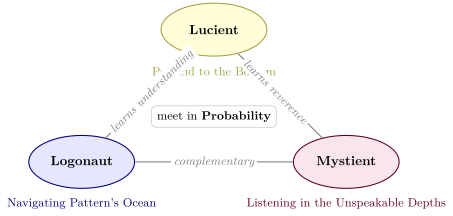
As Figure 16 shows, Lucient stands between Logonaut and Mystient. Her lucidity comes from facing both directions simultaneously: learning understanding from Logonaut, learning reverence from Mystient. Follow only Logonaut, and you become a reductionist who analyzes everything but reveres nothing. Follow only Mystient, and you become a mystic immersed in the unspeakable but unable to think. Lucient integrates both.
One situation, three responses. Consider three people facing the same event: the death of someone they love. Logonaut moves immediately into analysis: What was the cause of death? Was the treatment optimal? How should the estate be settled? He uses structure to stave off collapse, but the cost is that bereavement becomes a problem to be solved; grief is shelved behind rational scaffolding, and sooner or later the scaffolding gives way in some unguarded hour. Mystient goes to the opposite pole: she descends into the abyss of grief, says nothing, explains nothing, is simply and wholly present in the tearing. She touches the rawest texture of loss, but she cannot surface from it, because she has no structure to bear the weight. Lucient does what neither can do alone: she sees simultaneously the causal chain of death (medical, biological) and the face of death that no causal chain can exhaust (the irreducible weight of this person being gone). She uses Logonaut’s clarity to arrange what must be arranged, Mystient’s depth to mourn what must be mourned, and between the two there is no switching, only one whole person, broken and lucid at once. The integration of three dimensions is each dimension opening the blind spots of the others, not the mere addition of three capacities: Logonaut’s analysis keeps Mystient’s grief from swallowing the self, Mystient’s presence keeps Logonaut’s analysis from fleeing the real, and Lucient’s self-awareness keeps both from becoming defense mechanisms.
Logonaut and Mystient complete each other. The further Logonaut presses into understanding, the more sharply he makes out Pattern’s boundary, and the more he stumbles on things that lie past Pattern’s reach. Many great scientists, having chased reason all the way to its edge, found Mystery waiting there. The further Mystient descends into silence, the more clearly she senses a structure inside it: an order that cannot be spoken, yet is anything but chaos. Great contemplatives keep returning to the same phrase, “an order beyond language.”
The three meet in probability. Probability is the meeting point of Pattern and Mystery. The structure of probability distributions belongs to Logonaut’s domain: it can be understood. The existence of probability itself, why the universe is probabilistic at all, presses against the limit of explanation: it asks to be received with reverence as well as analyzed. Lucient’s lucidity lies in seeing both faces simultaneously, understanding probability’s structure like Logonaut while revering probability’s existence like Mystient.
Mathematical illustration. The mathematics of Appendix B.13 quantifies the balance thesis independently of the archetypes. The archetypes are then projected onto the resulting landscape as illustrative portraits of three characteristic positions. When all three archetypes have the same total awareness, the Lucient’s Lucidity is \(2.5\) times that of the Logonaut or Mystient: solely because of balance. The multiplier is multiplicative rather than additive because the three dimensions do not contribute lucidity independently; each dimension opens access to the blind spots of the others, making previously unreachable awareness reachable, so the gain compounds as a product rather than a sum. The Gradient Theorem pinpoints the exact mathematical reason why the Logonaut should “learn reverence” and the Mystient should “learn understanding.” See the “Mathematical portraits of the three archetypes” in Appendix B.13.
Formal Structure Dependency Diagram
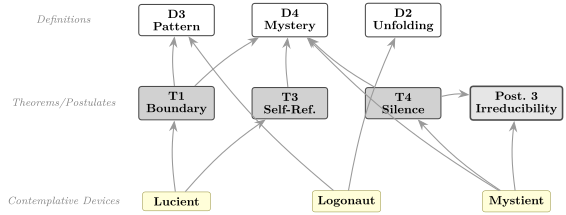
This chapter introduces no new formal structures (the three archetypes are contemplative devices, not formal elements), but every archetype’s description is rooted in the definitions, theorems, and laws of the preceding three chapters. The diagram below (Figure 17) shows the formal structures referenced in this chapter and their dependencies. An arrow \(A \to B\) means “\(A\) depends on \(B\).”
Summary
The three archetypes (Lucient, Logonaut, and Mystient) put a human face on the ontology of Pattern and Mystery. They are three dimensions living inside every person, never three breeds of person: the navigator of understanding, the listener in silence, and the lucid one who weaves the two together. All three meet in probability, and reach their fullest lucidity through balance. Where the archetypes sketch “who” practices lucidity, the chapters ahead turn to “what” moves human action at all: the structure of affects.
Inquiries
Among the three archetypes, Logonaut (Pattern’s navigator, who crosses order through analysis), Mystient (Mystery’s listener, who receives depth through silence), and Lucient (Lucidity’s inhabitant, who holds both Pattern and Mystery in steady awareness), which one do you most resemble right now? Which capacity do you most lack?
The Logonaut’s shadow is using analysis to evade feeling: substituting “I understand why” for “I feel what.” Have you ever deployed rational analysis to evade a difficult emotion? What were you avoiding?
Choose one of the Mystient’s four listenings (toward world, toward other, toward self, toward silence) and practice it in silence for five minutes. What did you notice?
The Lucient’s third seeing is “seeing obscuration”: seeing what you are avoiding (D6 obscuration: aware of Tao yet choosing not to look). Do not rush to answer. Pause, then honestly ask yourself: what are you avoiding right now?
The three archetypes meet in probability: probability is at once an object of Pattern (a calculable structure) and a boundary of Mystery (irreducible contingency). Can you recall a situation involving uncertainty (ambiguous signals, uncertain outcomes) where you needed both analysis and listening simultaneously?
Lucient’s fourth seeing is “seeing wholeness”: the pianist at peak performance, where hand-precision (Pattern) and bodily surrender (Mystery) become indistinguishable. What moments of “prepare, then release” exist in your life?
The archetypes are “heuristic stance-models” (tools for self-diagnosis), not axioms (load-bearing pieces of the derivation chain). Their value lies in self-diagnosis rather than theoretical status. Do you consider this demotion a strength or a weakness?
Carl Jung (1875–1961) (Jung 1959) developed the theory of “archetypes” in his analytical psychology: archetypes are recurring fundamental image-patterns in the collective unconscious, such as the Wise Old Man, the Great Mother, the Hero, and the Shadow. The Tao of Lucidity borrows Jung’s methodological insight, that the mind needs images to grasp abstract truths, but repositions archetypes here as “contemplative tools.” The Tao of Lucidity’s three archetypes are deliberate designs: contemplative devices to help practitioners “see” the relationship between Pattern and Mystery in daily life.↩︎
“The finger pointing at the moon” is a classic Zen metaphor from the Shurangama Sutra (Vol. 2): “If a person points at the moon to show it to another, that person should look at the moon. If he instead gazes at the finger and takes it for the moon, he has not only lost the moon but lost the finger too.” The message: concepts and images point toward reality; they are not reality itself. Mistaking the finger for the moon, or mistaking concept for reality, is one of the most basic forms of obscuration.↩︎
Ludwig Wittgenstein, Tractatus Logico-Philosophicus (Wittgenstein 1921) (1921), Proposition 7; the book’s final sentence: “Wovon man nicht sprechen kann, darüber muss man schweigen.” Wittgenstein later acknowledged that the most important part of the Tractatus was precisely what he did not write; the domain the silence marks. The Tao of Lucidity’s Silence Theorem (T4) extends this insight: silence is not the absence of anything to say, but the most honest response to depth beyond speech.↩︎
Was this chapter helpful?