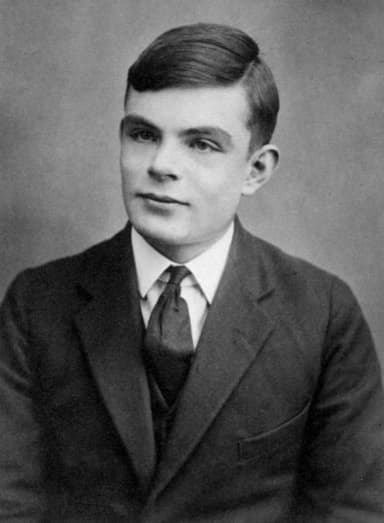
Significant
Turing
1912–1954 · Machine intelligence
Formalized computation and asked whether machines can think, opening the question of machine intelligence that the framework must answer in the age of AI.
How Turing shapes The Tao of Lucidity
The serious question of machine cognition
Turing formalized computation and asked, in earnest, whether machines can think, refusing to let the question be dismissed as nonsense. The framework inherits that seriousness and treats machine cognition as something it must answer, not evade, through its account of Extended Intelligence (E-Int). Turing's clarity about what a computing machine actually is gives the framework a precise object to reason about when it asks how far the Pattern aspect (D3) of mind can be carried by a mechanism.
Pattern can be extended, experience cannot
The framework answers Turing's question by drawing a line he did not draw. A machine can extend Pattern (D3), processing intelligible structure with a reach no human possesses, and to that extent Extended Intelligence (E-Int) is real. But it cannot extend first-person experience (P5), the having of a point of view from the inside, and so it cannot host wisdom in the sense the framework reserves that word. Turing asked whether machines can think; the Pattern-Mystery distinction lets the answer be yes to computation and no to lived awareness, without either evasion or overclaim.
Why the distinction guides us with AI
Everything in our relation to artificial intelligence depends on getting Turing's question right. If we believe a sufficiently capable machine simply thinks as we do, we will either fear it as a rival self or defer to it as a sage. The framework's answer keeps us lucid: we can welcome Extended Intelligence (E-Int) as a genuine amplifier of Pattern while remembering that experience (P5), and the awareness of both aspects of Tao that constitutes lucidity (D5), remain ours to carry. To live lucidly with AI is to use it as an extension of intelligence without surrendering the first-person seat where wisdom actually lives.
Inheritance and departure, at a glance
What the book inherits
The serious question of machine cognition.
Where it departs
Pattern-processing is distinguished from wisdom: a machine can extend Pattern but not first-person experience.
In one line
The question whether machines can think is answered by the Pattern and Mystery distinction.
Shaped
Read it unfold